
Table of Contents
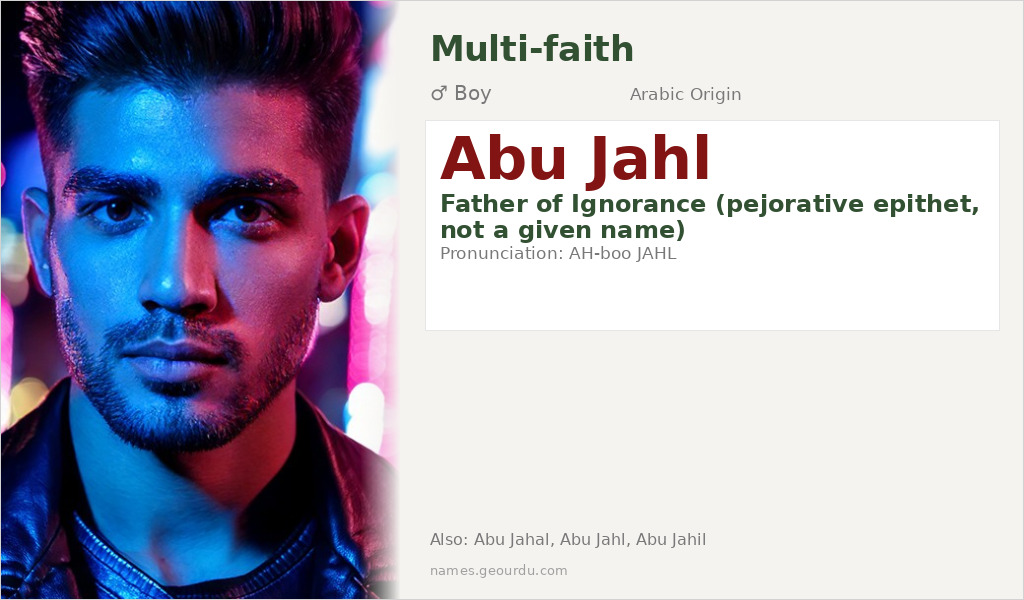
Abu Jahl is often misunderstood as a Muslim baby name, but it is actually a historical epithet with significant negative connotations in Islamic tradition. Meaning ‘Father of Ignorance’ in Arabic, this term was used to describe Amr ibn Hishām, a prominent opponent of Prophet Muhammad in 7th century Arabia. Unlike traditional Arabic names that carry positive meanings, Abu Jahl represents opposition to Islam and is never used as a given name for children in Muslim communities. Understanding this distinction is crucial for anyone researching Arabic names and Islamic history.
Meaning of Abu Jahl
The name Abu Jahl is an Arabic compound consisting of two elements: ‘Abu’ (أبو), a common prefix meaning ‘father of’ or ‘possessor of’, and ‘Jahl’ (جهل), which translates to ‘ignorance’, ‘foolishness’, or ‘lack of knowledge’. In classical Arabic, ‘Jahl’ carries deeper connotations beyond mere ignorance—it refers specifically to the pre-Islamic period known as ‘Jahiliyyah’ (Age of Ignorance) when Arabian society lacked divine guidance. The complete phrase ‘Abu Jahl’ thus means ‘Father of Ignorance’, symbolizing someone who embodies or promotes ignorance, particularly in religious matters. This epithet was deliberately chosen by early Muslims to contrast with Islamic values of knowledge and enlightenment.
| 📛 Name | Abu Jahl |
| 💎 Meaning | Father of Ignorance (pejorative epithet, not a given name) |
| 👤 Gender | Boy |
| 🕌 Religion | Multi-faith |
| 🌍 Origin | Arabic |
| 🗣 Pronunciation | AH-boo JAHL |
| ✍️ Urdu | ابو جہل |
| ✍️ Arabic | أبو جهل |
| 🔢 Numerology | |
| ✨ Spellings | Abu Jahal, Abu Jahl, Abu Jahil |
Origin & Cultural Significance
Abu Jahl originated in 7th century Mecca as a derogatory nickname for Amr ibn Hishām ibn al-Mughīrah, a powerful leader of the Quraysh tribe who vehemently opposed Prophet Muhammad and the early Muslim community. Historical sources indicate he earned this epithet due to his fierce resistance to Islam, persecution of Muslims, and attempts to suppress the new faith. In Islamic tradition, he is remembered as one of the archenemies of early Islam who was ultimately killed in the Battle of Badr (624 CE). Unlike traditional Arabic names that are passed down through generations, Abu Jahl has never been used as a legitimate given name in any Muslim culture or community, remaining exclusively a historical reference.
Personality Traits
Since Abu Jahl is not a given name but a historical epithet, it does not carry associated personality traits for name bearers. However, in Islamic historical narratives, the figure known as Abu Jahl (Amr ibn Hishām) is depicted as arrogant, stubborn, and hostile to religious truth. Early Muslim sources describe him as a leader who used his influence and wealth to oppose the spread of Islam, making him a symbolic figure of resistance to divine guidance. These characteristics are specific to the historical individual, not attributes that would be associated with a name in naming traditions.
Similar Names
If you like Abu Jahl, consider: Abu Bakr, Abu Talib, Abu Hurairah, Abu Dhar, Abu Sufyan
Famous People Named Abu Jahl
- Amr ibn Hishām (died 624 CE) — Known by the epithet Abu Jahl, he was a Meccan polytheist leader who fiercely opposed Prophet Muhammad and early Muslims, killed in the Battle of Badr
- No contemporary figures use this as a given name — it remains exclusively a historical reference to Amr ibn Hishām
Frequently Asked Questions About Abu Jahl
What does Abu Jahl mean?
Abu Jahl means 'Father of Ignorance' in Arabic. It is a compound of 'Abu' (father of) and 'Jahl' (ignorance), specifically referring to religious ignorance in Islamic context.
Is Abu Jahl a boy or girl name?
Abu Jahl is grammatically masculine in Arabic (as 'Abu' means 'father'), but it is not actually used as a given name for either gender. It was exclusively a historical epithet for a male figure, Amr ibn Hishām.
What is the origin of Abu Jahl?
Abu Jahl originated in 7th century Arabia as a derogatory nickname given by early Muslims to Amr ibn Hishām, a Meccan leader who opposed Prophet Muhammad. It comes from Classical Arabic and has never been used as a legitimate given name in any culture.





