
Table of Contents
Achilles is one of the most legendary names from ancient Greek mythology, immortalized as the greatest warrior of the Trojan War in Homer’s epic poem, the Iliad. This powerful name carries deep historical and literary significance, representing both heroic strength and tragic vulnerability. While primarily associated with Greek culture, Achilles has been adopted across various cultures as a symbol of martial prowess and classical heritage. The name’s enduring appeal lies in its connection to one of Western literature’s most compelling characters.
Meaning of Achilles
The name Achilles originates from Ancient Greek ‘Ἀχιλλεύς’ (Achilleus), with its most widely accepted meaning being ‘pain’, ‘grief’, or ‘distress’, derived from the Greek word ‘ἄχος’ (akhos). This etymology is particularly fitting given the tragic narrative of the mythological Achilles, whose story involves profound suffering despite his heroic status. Some scholars suggest alternative origins, including possible connections to the river name Achelous or pre-Greek linguistic roots, but the ‘pain’ interpretation remains dominant in classical scholarship. The name’s meaning reflects the complex nature of the hero—invincible in battle yet vulnerable in his heel and destined for an early death. This duality between strength and suffering has made Achilles a psychologically rich character study for millennia.
| 📛 Name | Achilles |
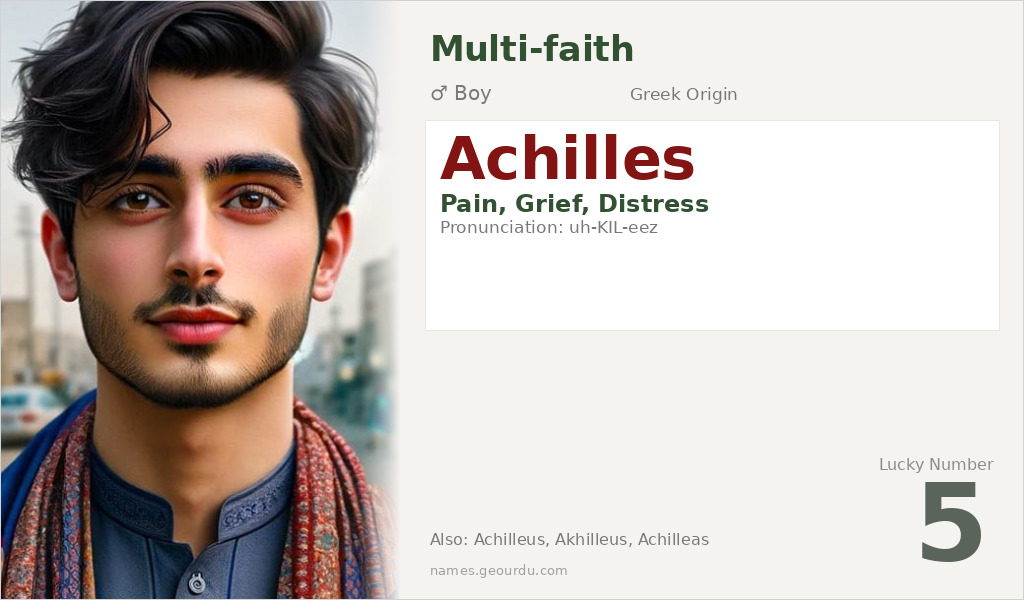
| 💎 Meaning | Pain, Grief, Distress |
| 👤 Gender | Boy |
| 🕌 Religion | Multi-faith |
| 🌍 Origin | Greek |
| 🗣 Pronunciation | uh-KIL-eez |
| ✍️ Urdu | اکیلس |
| ✍️ Arabic | أخيل |
| 🔢 Numerology | 5 |
| ✨ Spellings | Achilleus, Akhilleus, Achilleas, Akhilles |
Origin & Cultural Significance
Achilles has its roots firmly in ancient Greek mythology and literature, first appearing in Homer’s 8th-century BCE epic poem, the Iliad. The character of Achilles represents the archetypal Greek hero—possessing near-divine abilities but subject to human emotions and fate. While the name originated in Greek culture, it spread through Roman adoption (as Achilles) and later entered various European naming traditions through classical education and literary influence. The name gained particular prominence during the Renaissance when classical Greek texts were rediscovered and celebrated. Today, Achilles is used internationally, though it remains most strongly associated with Greek heritage and classical studies rather than any specific religious tradition.
Personality Traits
Those named Achilles often carry associations with the mythological hero’s defining traits: exceptional ability, competitive drive, and intense passion. The name suggests someone with natural leadership qualities and physical or mental prowess, though it also implies potential vulnerability or sensitivity. Like the Greek warrior who balanced martial excellence with deep emotional connections (particularly to Patroclus), individuals with this name may exhibit both strength and compassion. The name’s meaning of ‘pain’ adds psychological depth, suggesting someone who understands struggle and transforms adversity into achievement.
Similar Names
If you like Achilles, consider: Hector, Odysseus, Perseus, Theseus, Aeneas
Famous People Named Achilles
- Achilles (Greek Mythology) — Legendary hero of the Trojan War, central figure in Homer's Iliad
- Achilleus (Saint) — Early Christian martyr and saint from the 3rd century AD
Frequently Asked Questions About Achilles
What does Achilles mean?
Achilles means 'pain', 'grief', or 'distress' in Greek, derived from the Ancient Greek word 'ἄχος' (akhos). This meaning reflects the tragic aspects of the mythological hero's story.
Is Achilles a boy or girl name?
Achilles is exclusively a masculine name, originating as the name of the male Greek hero in Homer's Iliad. There are no traditional feminine forms, though some similar-sounding names exist across cultures.
What is the origin of Achilles?
Achilles originates from Ancient Greek mythology and literature, specifically from Homer's 8th-century BCE epic poem the Iliad. The name is fundamentally Greek with no verified connections to Hindu, Islamic, or other religious traditions despite some modern adaptations.





