Table of Contents
Ada is a beautifully versatile name with rich cultural roots spanning continents and languages. From Arabic ornamentation to Turkish islands and Germanic nobility, this name carries diverse meanings that have made it popular across different cultures. Whether you encounter Ada as a mathematician, a biblical figure, or a modern child, this name represents creativity, intelligence, and elegance.
Meaning of Ada
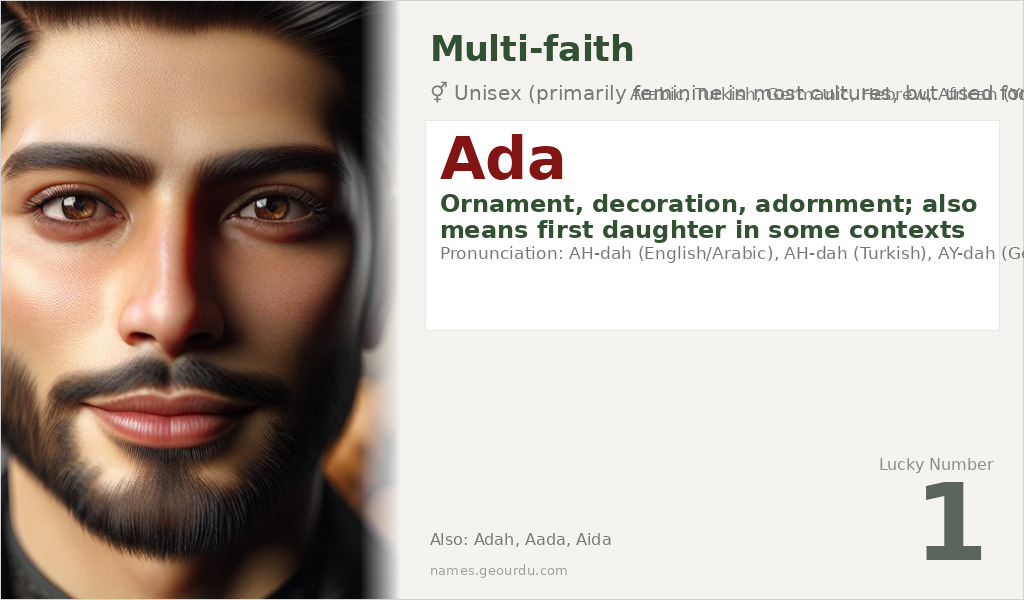
The name Ada has several well-documented meanings across different linguistic traditions. In Arabic, Ada (عدى) derives from the root ع-د-ي and means ‘ornament,’ ‘decoration,’ or ‘adornment,’ reflecting beauty and embellishment. In Turkish, Ada means ‘island,’ evoking imagery of natural beauty and separation. In Germanic languages, particularly Old German, Ada is a short form of names like Adelaide and means ‘noble’ or ‘nobility.’ In Hebrew, Ada (עָדָה) appears in the Bible as the wife of Lamech and means ‘ornament’ or ‘adornment.’ Additionally, in Yoruba and some other African languages, Ada signifies ‘first daughter’ or ‘royal daughter,’ indicating special family status.
| 📛 Name | Ada |
| 💎 Meaning | Ornament, decoration, adornment; also means first daughter in some contexts |
| 👤 Gender | Unisex (primarily feminine in most cultures, but used for boys in some Muslim contexts) |
| 🕌 Religion | Multi-faith |
| 🌍 Origin | Arabic, Turkish, Germanic, Hebrew, African (Yoruba) |
| 🗣 Pronunciation | AH-dah (English/Arabic), AH-dah (Turkish), AY-dah (Germanic) |
| ✍️ Urdu | عدی |
| ✍️ Arabic | عدى |
| 🔢 Numerology | 1 |
| ✨ Spellings | Adah, Aada, Aida, Adda |
Origin & Cultural Significance
Ada’s origins are truly multicultural, with documented usage in Arabic-speaking regions, Turkey, Germanic Europe, Israel, and West Africa. The Arabic version has been used for centuries in Muslim communities, though it’s not exclusively Islamic. The Turkish usage dates back to Ottoman times, while the Germanic form gained popularity in medieval Europe. The Hebrew biblical reference gives it ancient Semitic roots, and the Yoruba usage reflects its importance in African naming traditions. This cross-cultural adoption makes Ada a truly international name that transcends single religious or ethnic boundaries.
Personality Traits
Individuals named Ada often exhibit traits of creativity, intelligence, and independence. They tend to be natural problem-solvers with strong analytical skills, as exemplified by historical figures like Ada Lovelace. Their artistic sensibilities and attention to detail make them excel in both scientific and creative fields, while their inherent nobility (reflected in the Germanic meaning) often gives them natural leadership qualities.
Similar Names
If you like Ada, consider: Adara, Adina, Adela, Adelaide, Ayla
Famous People Named Ada
- Ada Lovelace — English mathematician and writer, considered the first computer programmer
- Ada Yonath — Israeli crystallographer and Nobel Prize winner in Chemistry
Frequently Asked Questions About Ada
What does Ada mean?
Ada has multiple meanings depending on language: 'ornament' in Arabic, 'island' in Turkish, 'noble' in Germanic, and 'first daughter' in Yoruba.
Is Ada a boy or girl name?
Ada is primarily feminine in most cultures worldwide, though it can be used for boys in some Muslim communities. It's generally considered unisex with strong feminine associations.
What is the origin of Ada?
Ada has multiple origins including Arabic (عدى), Turkish, Germanic (Old German), Hebrew (עָדָה), and African languages like Yoruba, making it a truly multicultural name.