
Table of Contents
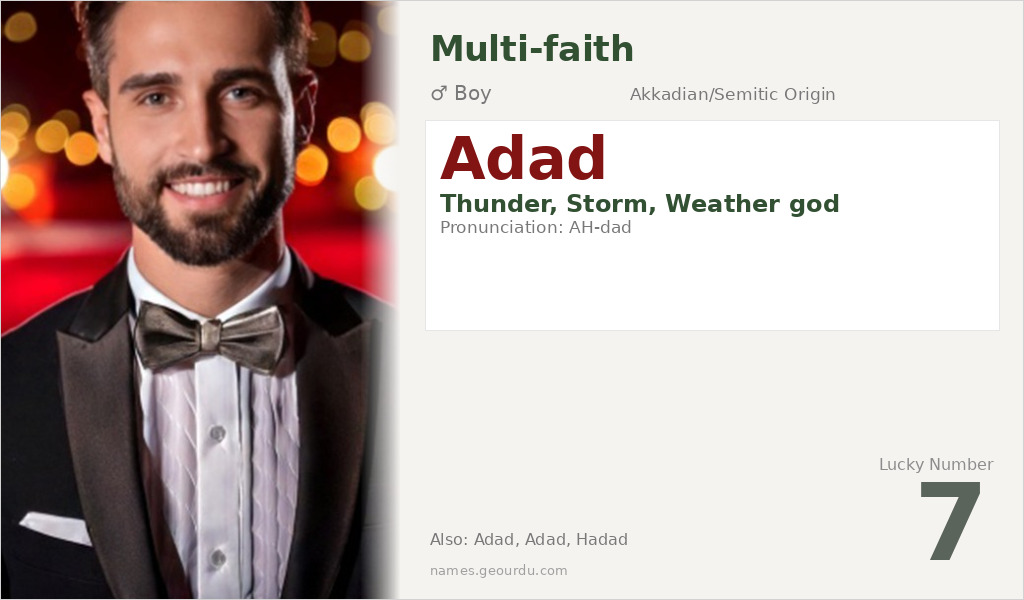
Adad is a name that echoes through ancient history, carrying the power of thunderstorms and divine authority. This ancient Semitic name belonged to one of the most important deities in Mesopotamian mythology—the god of storms, rain, and fertility. While occasionally used in modern times, Adad remains primarily a historical and mythological name with deep roots in Bronze Age civilizations. Discover the fascinating story behind this name that once commanded reverence across the ancient Near East.
Meaning of Adad
Adad derives from the Akkadian language, where it specifically refers to the storm god worshipped throughout ancient Mesopotamia. The name is linguistically connected to other Semitic storm deities: Hadad in Aramaic and Hebrew, and Addu in Ugaritic. In cuneiform texts, the name was written with the signs 𒀭𒅎 (dIM), representing the god of weather phenomena. As a theophoric name (containing a god’s name), Adad was often incorporated into royal names of Assyrian and Babylonian rulers, signifying divine protection and power. The core meaning relates directly to atmospheric phenomena—thunder, lightning, rain, and storms—which were both feared and revered in ancient agricultural societies.
| 📛 Name | Adad |
| 💎 Meaning | Thunder, Storm, Weather god |
| 👤 Gender | Boy |
| 🕌 Religion | Multi-faith |
| 🌍 Origin | Akkadian/Semitic |
| 🗣 Pronunciation | AH-dad |
| ✍️ Urdu | ادد |
| ✍️ Arabic | أدد |
| 🔢 Numerology | 7 |
| ✨ Spellings | Adad, Adad, Hadad, Addu |
Origin & Cultural Significance
Adad originates from ancient Mesopotamian civilization, specifically from Akkadian-speaking cultures of the Bronze Age (circa 2500–500 BCE). The worship of Adad spread across the Fertile Crescent, from Assyria and Babylonia to Syria and Anatolia, where he was syncretized with local storm gods like Teshub among the Hurrians and Hittites. While the name has ancient Semitic roots rather than Arabic origins, it has occasionally been adopted in Muslim communities, particularly in regions with historical connections to Mesopotamian civilization. The name’s usage today is rare but maintains cultural significance for those interested in ancient Near Eastern history and mythology.
Personality Traits
Those named Adad often carry an air of authority and intensity, reflecting the powerful storm deity from whom the name originates. They may exhibit natural leadership qualities, a commanding presence, and the ability to make significant impacts in their environments. Like the weather patterns their namesake controlled, individuals with this name might display both nurturing qualities (like life-giving rain) and formidable power (like destructive storms), making them complex and compelling personalities.
Similar Names
If you like Adad, consider: Hadad, Baal, Marduk, Enlil, Teshub
Famous People Named Adad
- Adad-nirari I — Assyrian king (1307–1275 BCE) who expanded the Middle Assyrian Empire
- Adad-shuma-usur — Kassite king of Babylon (1216–1187 BCE) during the Bronze Age
Frequently Asked Questions About Adad
What does Adad mean?
Adad means 'thunder' or 'storm god' in ancient Akkadian, referring specifically to the Mesopotamian deity of weather, rain, and fertility.
Is Adad a boy or girl name?
Adad is exclusively a masculine name, as it was the name of a male deity in ancient Mesopotamian religion and has been used historically for male rulers and figures.
What is the origin of Adad?
Adad originates from ancient Akkadian/Semitic languages of Mesopotamia, where it was the name of the storm god worshipped throughout the Bronze Age Near East.





