
Table of Contents
Adam is one of the most ancient and widely recognized names in human history, deeply rooted in religious and cultural traditions across the globe. From the Biblical and Quranic narratives to modern usage, this name carries profound significance as the designation for the first human. Its timeless appeal spans continents and faiths, making it a classic choice for parents seeking a name with historical weight and universal recognition. In this guide, we explore the rich etymology, cultural contexts, and contemporary relevance of the name Adam.
Meaning of Adam
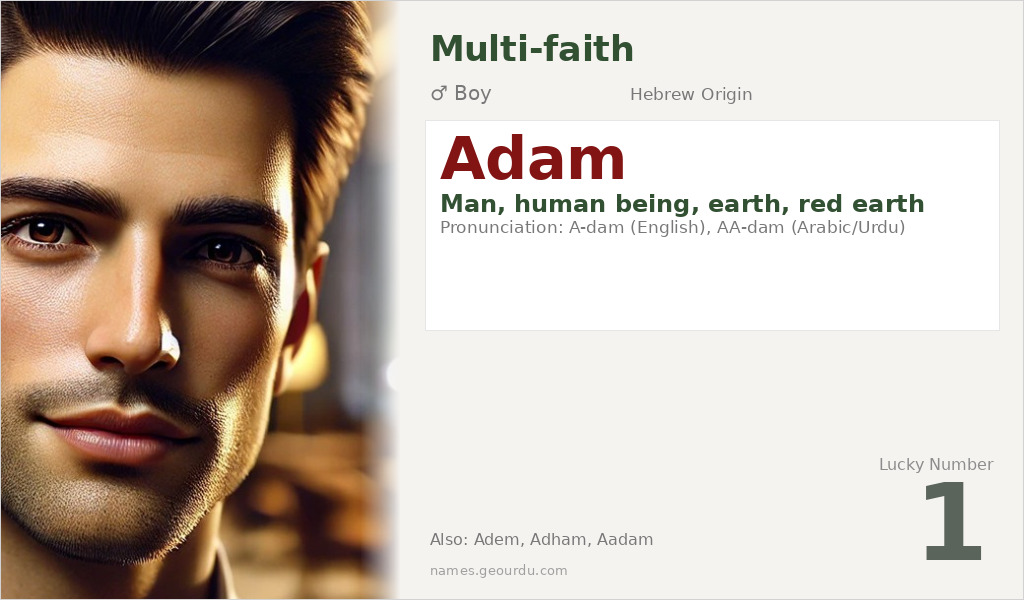
The name Adam derives from the Hebrew word ‘adam’ (אָדָם), which translates directly to ‘man’ or ‘human being.’ This is linked to the Hebrew root ‘adamah’ (אֲדָמָה), meaning ‘earth’ or ‘ground,’ often interpreted as ‘red earth’ due to the reddish clay of the region. In linguistic terms, the name emphasizes humanity’s connection to the earth, reflecting the creation story where Adam was formed from dust or clay. Across Semitic languages, including Arabic where it is ‘Ādam’ (آدم), the meaning remains consistent, underscoring its role in Abrahamic theology as the progenitor of mankind.
| 📛 Name | Adam |
| 💎 Meaning | Man, human being, earth, red earth |
| 👤 Gender | Boy |
| 🕌 Religion | Multi-faith |
| 🌍 Origin | Hebrew |
| 🗣 Pronunciation | A-dam (English), AA-dam (Arabic/Urdu) |
| ✍️ Urdu | آدم |
| ✍️ Arabic | آدم |
| 🔢 Numerology | 1 |
| ✨ Spellings | Adem, Adham, Aadam, Adám |
Origin & Cultural Significance
Adam originates from Hebrew, with its earliest recorded usage in the Torah (Old Testament) as the name of the first human created by God. It was adopted into Aramaic, Arabic, and later into various languages through religious texts like the Bible and Quran. In Islamic tradition, Adam (آدم) is revered as the first prophet and father of humanity, mentioned in the Quran multiple times. The name spread globally via Christianity, Islam, and Judaism, becoming common in European languages during the Middle Ages and maintaining popularity in diverse cultures from the Middle East to the West.
Personality Traits
People named Adam are often perceived as foundational and resilient, mirroring the name’s earthy origins. They may display natural leadership, a practical mindset, and a strong sense of responsibility, traits associated with being a ‘first’ or pioneer. Their connection to tradition and history can make them thoughtful and grounded individuals, valued for their stability and integrity in personal and professional spheres.
Similar Names
If you like Adam, consider: Adnan, Ayman, Ibrahim, Idris, Noah
Famous People Named Adam
- Adam (Biblical/Quranic figure) — First human and prophet in Abrahamic traditions
- Adam Smith — Scottish economist and philosopher, author of 'The Wealth of Nations'
Frequently Asked Questions About Adam
What does Adam mean?
Adam means 'man,' 'human being,' or 'earth' (specifically red earth) from the Hebrew language, with the same meaning in Arabic and other Semitic languages.
Is Adam a boy or girl name?
Adam is traditionally a boy's name, used for males in all cultural and religious contexts where it appears, from Abrahamic traditions to modern secular usage.
What is the origin of Adam?
Adam originates from Hebrew, with roots in the word 'adamah' meaning 'earth.' It is central to Jewish, Christian, and Islamic traditions as the name of the first human.





