
Table of Contents
Adib is a distinguished Arabic name that has resonated across centuries and cultures. Meaning ‘scholar’ or ‘cultured person,’ this name carries with it the weight of intellectual tradition and refined character. From the Middle East to South Asia and beyond, Adib represents the ideal of educated, well-mannered individuals who contribute to their communities through knowledge and wisdom. Whether you’re considering this name for your child or researching its historical significance, understanding Adib’s rich linguistic heritage reveals why it remains a timeless choice.
Meaning of Adib
The name Adib originates from the Arabic root ‘adab’ (أدب), which encompasses a rich constellation of meanings including culture, literature, etiquette, and refined manners. In classical Arabic tradition, ‘adab’ represented the complete education of a civilized person — encompassing both intellectual knowledge and proper social conduct. As a personal name, Adib specifically means ‘one who possesses adab’ — a cultured, educated individual with refined manners and literary sensibilities. This name has been particularly favored among scholars, writers, and intellectuals throughout Islamic history, reflecting the high value placed on learning and cultural refinement in Arab and Muslim societies. The feminine form of the name is ‘Adiba,’ though Adib itself is exclusively masculine.
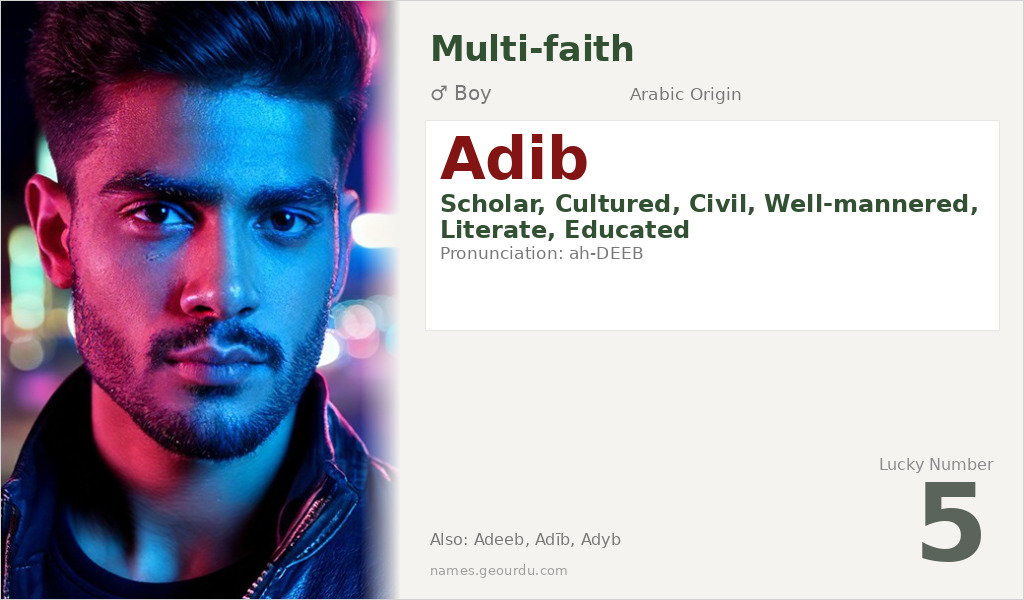
| 📛 Name | Adib |
| 💎 Meaning | Scholar, Cultured, Civil, Well-mannered, Literate, Educated |
| 👤 Gender | Boy |
| 🕌 Religion | Multi-faith |
| 🌍 Origin | Arabic |
| 🗣 Pronunciation | ah-DEEB |
| ✍️ Urdu | ادیب |
| ✍️ Arabic | أديب |
| 🔢 Numerology | 5 |
| ✨ Spellings | Adeeb, Adīb, Adyb, Adib |
Origin & Cultural Significance
Adib has its origins in classical Arabic language and culture, dating back to pre-Islamic and early Islamic periods when the concept of ‘adab’ was developing as a comprehensive educational ideal. The name gained prominence during the Islamic Golden Age when scholarship and literary culture flourished across the Muslim world from Spain to Central Asia. While most commonly associated with Arabic-speaking Muslim communities, Adib has also been used by Arabic-speaking Christians and has spread to non-Arab Muslim cultures including Persian, Turkish, Urdu, and Malay-speaking regions through cultural exchange. In modern times, the name remains popular across the Middle East, North Africa, and South Asia, maintaining its association with education and cultural refinement.
Personality Traits
Those named Adib are often associated with intellectual curiosity, cultural sophistication, and diplomatic social skills. They tend to be natural learners who value education and knowledge acquisition throughout their lives. With their refined manners and appreciation for literature and arts, Adibs often excel in academic, literary, or cultural fields where their intellectual gifts can shine. Their name suggests someone who bridges traditional wisdom with modern understanding, making them effective communicators and respected members of their communities.
Similar Names
If you like Adib, consider: Adnan, Adil, Arif, Alim, Hakim, Kamil, Rashid, Salim, Talib, Waris
Famous People Named Adib
- Adib al-Shishakli — Syrian military officer and President of Syria (1949-1954)
- Adib Jatene — Brazilian physician and former Minister of Health
- Adib al-Mulk — Persian statesman and Prime Minister of Iran in the 19th century
Frequently Asked Questions About Adib
What does Adib mean?
Adib means 'scholar,' 'cultured person,' 'well-mannered,' or 'educated' in Arabic. It comes from the root word 'adab' which encompasses culture, literature, and proper etiquette.
Is Adib a boy or girl name?
Adib is exclusively a masculine name in Arabic. The feminine equivalent is 'Adiba,' though Adib itself is never used for girls in Arabic naming tradition.
What is the origin of Adib?
Adib originates from classical Arabic language and culture. It derives from the Arabic root 'adab' and has been used for centuries across Arab and Islamic societies, with spread to Persian, Turkish, Urdu, and other cultures through cultural exchange.





