
Table of Contents
Adveka is a profound Sanskrit name with deep philosophical roots in Hindu spirituality. Meaning ‘Non-dual’ or ‘Without duality,’ this name carries centuries of spiritual wisdom about the nature of reality and consciousness. While uncommon in modern usage, Adveka represents important concepts from Vedanta philosophy about transcending opposites and perceiving ultimate unity. This guide explores the authentic meaning, origin, and cultural significance of this spiritually rich name.
Meaning of Adveka
Adveka derives from classical Sanskrit, combining the negative prefix ‘a-‘ (अ) meaning ‘not’ or ‘without’ with ‘dveka’ (द्वेक) meaning ‘duality’ or ‘two-ness.’ The term appears in philosophical contexts discussing ‘advaita’ (non-duality), a central concept in Hindu philosophy particularly associated with the teachings of Adi Shankara. Unlike the common misinterpretation as ‘Unique,’ Adveka specifically refers to the state beyond dualistic perception—where subject and object, self and other, are experienced as one. This linguistic construction follows standard Sanskrit negation patterns seen in terms like ‘advaita’ (non-dual) and ‘ananta’ (endless). The name embodies the philosophical pursuit of perceiving ultimate reality beyond apparent divisions.
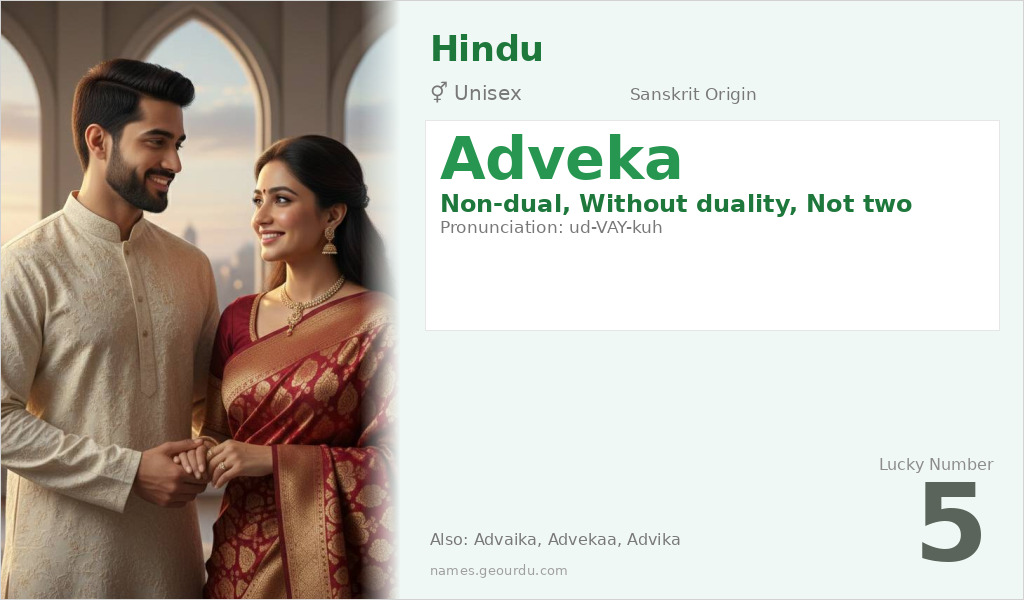
| 📛 Name | Adveka |
| 💎 Meaning | Non-dual, Without duality, Not two |
| 👤 Gender | Unisex |
| 🕌 Religion | Hindu |
| 🌍 Origin | Sanskrit |
| 🗣 Pronunciation | ud-VAY-kuh |
| ✍️ Urdu | ادویکا |
| ✍️ Arabic | أدفيكا |
| 🔢 Numerology | 5 |
| ✨ Spellings | Advaika, Advekaa, Advika |
Origin & Cultural Significance
Adveka originates from classical Sanskrit, the ancient liturgical language of Hinduism, Buddhism, and Jainism. Its philosophical usage dates back to early Vedantic texts that explore the nature of reality and consciousness. While not a common personal name historically, it appears in philosophical discussions about non-duality (advaita) in Hindu spiritual traditions. The name reflects India’s rich tradition of philosophical inquiry and spiritual exploration, particularly within schools of thought that emphasize transcending dualistic perception. In contemporary usage, it remains rare but carries significant spiritual weight for those familiar with Sanskrit philosophical terminology.
Personality Traits
Those named Adveka often exhibit traits aligned with their name’s philosophical meaning. They tend to be contemplative individuals who seek harmony and unity in their relationships and worldview. With a natural inclination toward resolving conflicts and seeing connections where others see divisions, they often approach life with a holistic perspective. Their spiritual or philosophical orientation may lead them to value inner peace and understanding over material concerns.
Similar Names
If you like Adveka, consider: Advaita, Advika, Aditi, Aditya, Adhira
Famous People Named Adveka
- No widely known contemporary figures with this name found in records
- Historical references appear in Sanskrit philosophical texts discussing non-duality concepts
Frequently Asked Questions About Adveka
What does Adveka mean?
Adveka means 'Non-dual' or 'Without duality' in Sanskrit, referring to the philosophical concept of transcending opposites and perceiving ultimate unity.
Is Adveka a boy or girl name?
Adveka is historically unisex in Sanskrit philosophical contexts, though in modern usage it may be given to children of any gender who appreciate its spiritual significance.
What is the origin of Adveka?
Adveka originates from classical Sanskrit, the ancient language of Hindu philosophical texts, specifically from terms discussing non-duality (advaita) in Vedanta philosophy.