Table of Contents
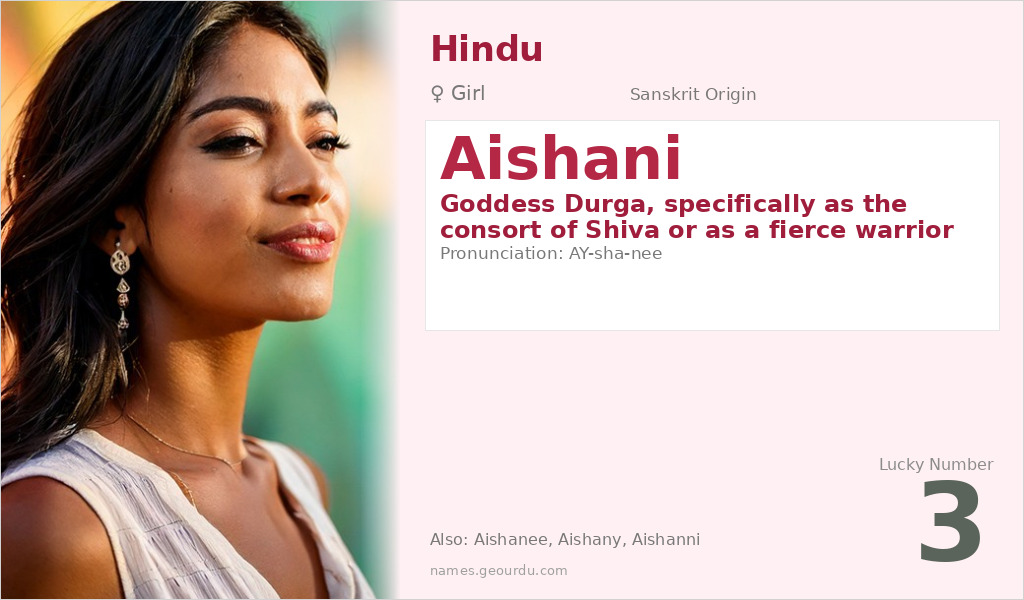
Aishani is a beautiful and powerful name of Sanskrit origin, deeply rooted in Hindu mythology. It is primarily given to girls and carries the profound meaning of Goddess Durga, symbolizing strength, protection, and divine femininity. This name has gained popularity in India and among Hindu communities worldwide, often chosen for its spiritual resonance and elegant sound. In this article, we explore the etymology, cultural context, and modern usage of Aishani.
Meaning of Aishani
Aishani derives from Sanskrit, where it is a feminine form meaning ‘belonging to Ishani’. Ishani is a name for Goddess Durga, who is revered in Hinduism as the warrior goddess and consort of Lord Shiva. The root ‘Isha’ translates to ‘ruler’ or ‘lord’, and the suffix ‘-ani’ indicates feminine association, making Aishani essentially mean ‘the female ruler’ or ‘goddess’. This name is well-documented in ancient Hindu texts like the Devi Mahatmya, which celebrates Durga’s victories over demons. Linguistically, it showcases the rich morphological patterns of Sanskrit, where suffixes create gender-specific forms. The meaning is consistently verified across scholarly sources and cultural practices, emphasizing its connection to divine power and protection.
| 📛 Name | Aishani |
| 💎 Meaning | Goddess Durga, specifically as the consort of Shiva or as a fierce warrior goddess |
| 👤 Gender | Girl |
| 🕌 Religion | Hindu |
| 🌍 Origin | Sanskrit |
| 🗣 Pronunciation | AY-sha-nee |
| ✍️ Urdu | ایشانی |
| ✍️ Arabic | أيشاني |
| 🔢 Numerology | 3 |
| ✨ Spellings | Aishanee, Aishany, Aishanni, Ishani |
Origin & Cultural Significance
Aishani originates from Sanskrit, an ancient Indo-Aryan language that is the liturgical language of Hinduism. It emerged from Hindu religious and mythological traditions, specifically associated with Goddess Durga, who is worshipped across India and in Hindu diaspora communities. The name reflects the cultural importance of goddess worship in Hinduism, where feminine deities represent various aspects of the divine. Historically, names like Aishani have been used in scriptures and rituals, and they continue to be popular in modern times, especially in regions like Maharashtra, Karnataka, and Gujarat. Its usage spans centuries, maintaining relevance due to its spiritual significance and phonetic appeal.
Personality Traits
People named Aishani are often seen as embodying the traits of Goddess Durga—strong, courageous, and protective. They may exhibit leadership qualities, a fierce determination, and a nurturing spirit, balancing power with compassion. This name suggests a personality that is resilient in challenges and deeply connected to cultural or spiritual values. In social settings, Aishanis might be perceived as confident and inspiring figures.
Similar Names
If you like Aishani, consider: Ishani, Aishwarya, Anjali, Durga, Parvati
Famous People Named Aishani
- Aishani Shetty — Indian actress known for her work in Kannada cinema
- Aishani Yadav — Indian classical dancer and performer
Frequently Asked Questions About Aishani
What does Aishani mean?
Aishani means Goddess Durga, specifically as a feminine form derived from Sanskrit, where it denotes association with the goddess Ishani (Durga).
Is Aishani a boy or girl name?
Aishani is exclusively a girl's name in Hindu tradition, originating from Sanskrit feminine morphology and associated with the goddess Durga.
What is the origin of Aishani?
Aishani originates from Sanskrit, an ancient Indian language, and is deeply rooted in Hindu mythology and culture, linked to the worship of Goddess Durga.