
Table of Contents
Ajat is a profoundly spiritual name with roots in ancient Sanskrit philosophy. Unlike common personal names, Ajat carries weighty metaphysical significance, describing that which is eternal and without beginning. This rare name offers parents seeking a name with deep philosophical resonance a unique option steeped in Hindu spiritual tradition. While uncommon as a given name, its meaning connects directly to core concepts in Indian spirituality.
Meaning of Ajat
Ajat originates from Sanskrit, where ‘a-‘ is a negative prefix meaning ‘without’ or ‘not,’ and ‘jat’ comes from the root verb ‘jan’ (जन्) meaning ‘to be born,’ ‘to originate,’ or ‘to produce.’ Thus, Ajat literally translates to ‘unborn,’ ‘birthless,’ or ‘without origin.’ In Hindu philosophical context, this term is particularly significant as it describes the nature of the divine – specifically attributes of deities like Shiva and Vishnu who are considered eternal, uncreated, and beyond the cycle of birth and death. The concept appears in foundational texts including the Upanishads, where it denotes the absolute reality (Brahman) that exists without beginning. As a personal name, it’s quite rare and would be chosen for its profound spiritual connotations rather than common usage.
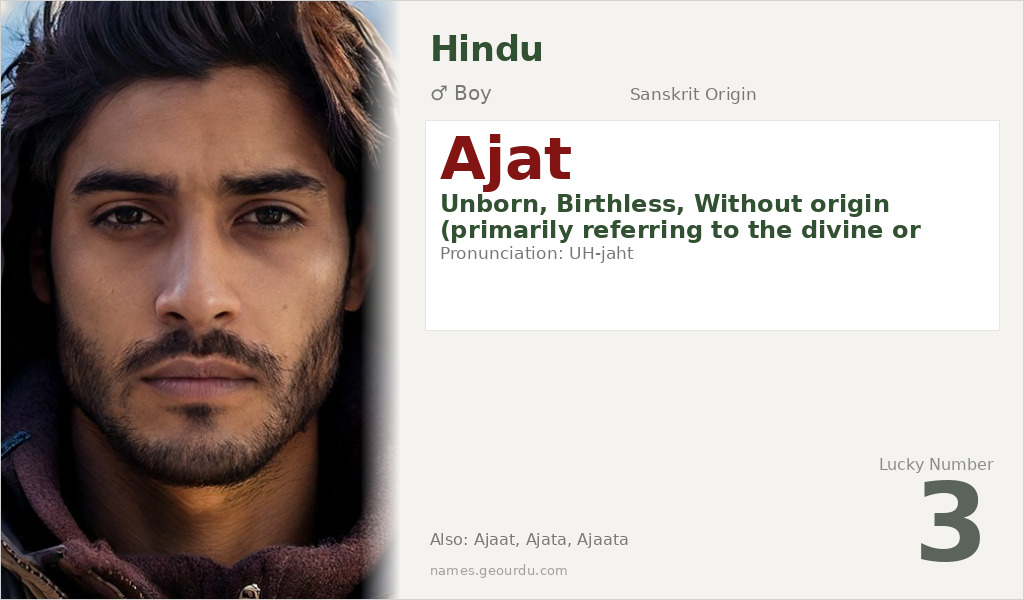
| 📛 Name | Ajat |
| 💎 Meaning | Unborn, Birthless, Without origin (primarily referring to the divine or eternal) |
| 👤 Gender | Boy |
| 🕌 Religion | Hindu |
| 🌍 Origin | Sanskrit |
| 🗣 Pronunciation | UH-jaht |
| ✍️ Urdu | اجت |
| ✍️ Arabic | أجات |
| 🔢 Numerology | 3 |
| ✨ Spellings | Ajaat, Ajata, Ajaata |
Origin & Cultural Significance
Ajat emerges from ancient Sanskrit, the classical language of India and Hinduism. Its usage is primarily philosophical and theological rather than as a common personal name. In Hindu scriptures, ‘Ajat’ appears as an epithet for divine beings, most notably in references to Lord Shiva as ‘Ajateshwar’ (the unborn lord) and in Vaishnavism for Vishnu’s eternal nature. The concept reflects the Advaita Vedanta philosophy of the eternal, unchanging reality. While the name has Sanskrit origins, it doesn’t appear to have significant usage in other Indian languages or regional dialects as a given name. Its rarity makes it a distinctive choice within Hindu naming traditions, typically selected by parents deeply engaged with spiritual or philosophical aspects of Hinduism.
Personality Traits
Given its meaning of ‘unborn’ or ‘eternal,’ individuals named Ajat might be perceived as having a calm, centered personality with philosophical depth. The name suggests someone who values spiritual truths over material concerns, potentially exhibiting wisdom and introspection. In cultural context, such a name might inspire the bearer to seek understanding beyond superficial appearances and develop a thoughtful, contemplative approach to life. While personality traits associated with names are culturally constructed, the profound meaning of Ajat naturally lends itself to associations with spiritual maturity and eternal perspective.
Similar Names
If you like Ajat, consider: Ajay, Ajit, Ajan, Aja, Ajanta, Anadi, Ananta, Avyaya, Akshara
Famous People Named Ajat
- No notable contemporary figures found with this name due to its rarity as a personal name
- In Hindu mythology, the term 'Ajat' is used as an epithet for Lord Shiva and Vishnu in scriptures
Frequently Asked Questions About Ajat
What does Ajat mean?
Ajat means 'unborn,' 'birthless,' or 'without origin' in Sanskrit. It's a philosophical term describing eternal, divine qualities, particularly associated with Hindu deities like Shiva and Vishnu.
Is Ajat a boy or girl name?
Ajat is exclusively a boy's name in Hindu naming tradition. The name carries masculine grammatical gender in Sanskrit and is used for male children when chosen as a personal name.
What is the origin of Ajat?
Ajat originates from Sanskrit, the ancient classical language of India. It's primarily a philosophical and theological term from Hindu scriptures that has occasionally been adopted as a rare personal name.





