
Table of Contents
Ajathashatru is a profound and ancient name with deep roots in Indian culture and Sanskrit literature. Meaning ‘one without enemies’, this name carries a legacy of peace and respect, often associated with historical figures and spiritual ideals. In Hindu traditions, it is considered auspicious, linked to specific lucky elements that enhance its significance. Explore the rich etymology, cultural context, and modern relevance of this timeless name.
Meaning of Ajathashatru
Ajathashatru is a Sanskrit compound name, meticulously formed from two elements: ‘Ajāta’ and ‘Śatru’. ‘Ajāta’ (अजात) derives from the root ‘jan’ (to be born), with the prefix ‘a-‘ indicating negation, thus meaning ‘unborn’ or ‘without’. ‘Śatru’ (शत्रु) means ‘enemy’ or ‘opponent’. Combined, the name translates to ‘one who has no enemies’ or ‘without opponents’. This meaning is well-documented in classical Sanskrit texts like the Mahabharata and Buddhist scriptures, where it symbolizes a person free from hostility, often a ruler or sage. The name reflects ideals of non-violence and universal goodwill, resonating with Hindu, Buddhist, and Jain philosophies. Its linguistic structure showcases the precision of Sanskrit in conveying complex concepts through compounding.
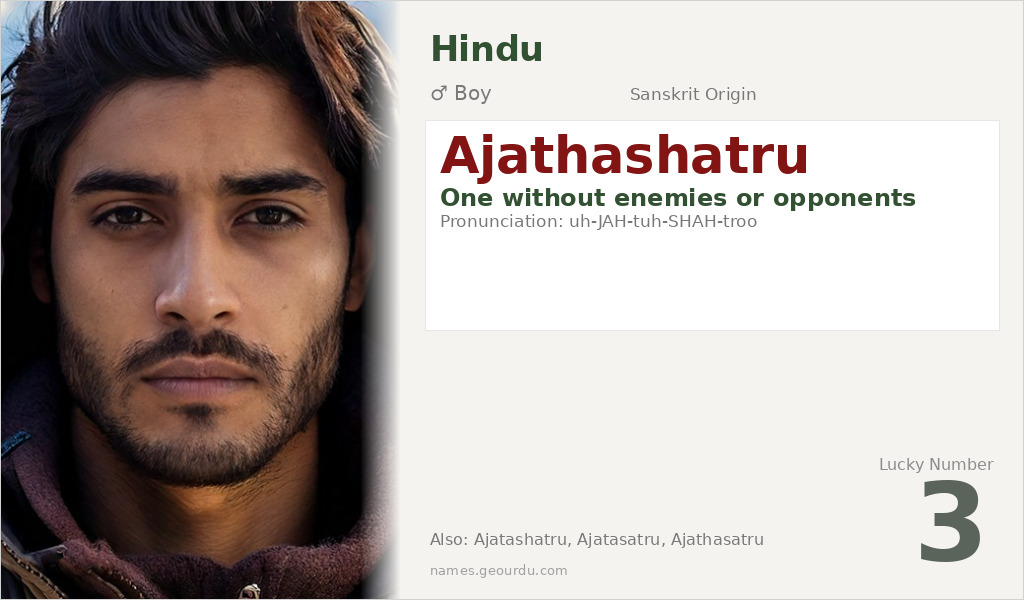
| 📛 Name | Ajathashatru |
| 💎 Meaning | One without enemies or opponents |
| 👤 Gender | Boy |
| 🕌 Religion | Hindu |
| 🌍 Origin | Sanskrit |
| 🗣 Pronunciation | uh-JAH-tuh-SHAH-troo |
| ✍️ Urdu | اجاتشترو |
| ✍️ Arabic | أجاتاشاتر |
| 🔢 Numerology | 3 |
| ✨ Spellings | Ajatashatru, Ajatasatru, Ajathasatru |
Origin & Cultural Significance
Originating from Sanskrit, an ancient Indo-Aryan language of India, Ajathashatru has historical and cultural significance in South Asia. It is prominently associated with Ajatashatru, a king of Magadha (modern-day Bihar) around the 5th century BCE, mentioned in Buddhist texts like the Digha Nikaya and Jain chronicles. This historical figure adds a layer of regal and spiritual weight to the name. In Hindu naming traditions, it is used primarily for boys, emphasizing virtues of peace and leadership. The name’s usage spans Hindu, Buddhist, and Jain communities, reflecting its multi-faith appeal in Indian culture. Over centuries, it has maintained its classical form with minor spelling variations, preserving its etymological integrity.
Personality Traits
Those named Ajathashatru are often seen as calm, wise, and adept at navigating social dynamics without creating adversaries. They may exhibit traits of diplomacy, empathy, and a strong sense of justice, aligning with the name’s meaning of being enemy-less. In personal and professional settings, they tend to foster cooperation and avoid unnecessary conflicts, making them natural peacemakers. This personality profile is inspired by the name’s historical and linguistic connotations, suggesting a life guided by harmony and respect.
Similar Names
If you like Ajathashatru, consider: Ajay, Abhaya, Nirbhaya, Shantanu, Ashoka
Famous People Named Ajathashatru
- Ajatashatru — Ancient Indian king of Magadha (c. 492–460 BCE), son of King Bimbisara, featured in Buddhist and Jain texts
- Ajatashatru — A character in the Hindu epic Mahabharata, though less prominent than the historical king
Frequently Asked Questions About Ajathashatru
What does Ajathashatru mean?
Ajathashatru means 'one without enemies or opponents' in Sanskrit, derived from 'Ajāta' (without) and 'Śatru' (enemy).
Is Ajathashatru a boy or girl name?
Ajathashatru is traditionally a boy name in Hindu and Indian cultures, though its usage is almost exclusively masculine due to historical and linguistic context.
What is the origin of Ajathashatru?
Ajathashatru originates from Sanskrit, an ancient Indian language, with historical ties to King Ajatashatru of Magadha and appearances in Buddhist and Jain texts.





