Table of Contents
Alakananda is a beautiful and spiritually significant name with deep roots in Hindu tradition and Indian geography. Unlike many names that have abstract meanings, Alakananda refers specifically to one of the most sacred rivers in Hinduism—the Alaknanda River that flows through the Himalayas. This name carries the weight of mythology, geography, and religious devotion, making it a powerful choice for parents seeking a name with profound cultural resonance. Let’s explore the rich tapestry of meaning and history behind this distinctive name.
Meaning of Alakananda
The name Alakananda is a Sanskrit compound consisting of two elements: ‘Alaka’ meaning ‘curl,’ ‘lock of hair,’ or sometimes translated as ‘beautiful tress,’ and ‘Nanda’ meaning ‘joy,’ ‘delight,’ or ‘happiness.’ Together, they create the meaning ‘joyful curl’ or ‘delightful lock of hair.’ This poetic construction refers directly to Hindu mythology where the Ganges River is said to have descended from the matted locks of Lord Shiva. The Alakananda is specifically mentioned in ancient texts like the Vishnu Purana and Mahabharata as one of the five headstreams that form the Ganges. Linguistically, it follows classical Sanskrit compounding rules (samāsa) and maintains precise grammatical gender (feminine) appropriate for river names in Sanskrit tradition.
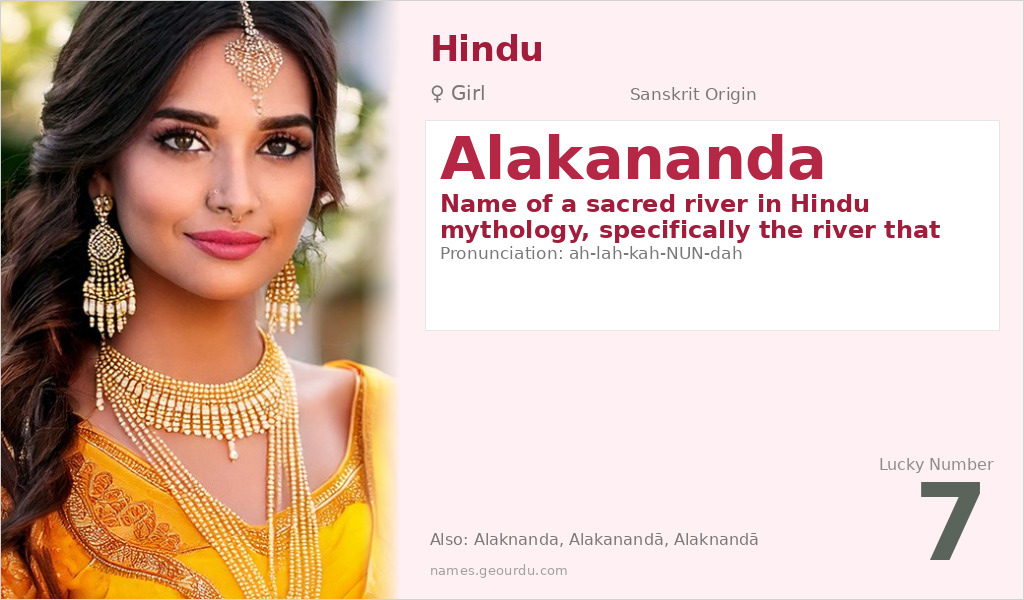
| 📛 Name | Alakananda |
| 💎 Meaning | Name of a sacred river in Hindu mythology, specifically the river that flows in the region of Uttarakhand, India |
| 👤 Gender | Girl |
| 🕌 Religion | Hindu |
| 🌍 Origin | Sanskrit |
| 🗣 Pronunciation | ah-lah-kah-NUN-dah |
| ✍️ Urdu | الکا نندا |
| ✍️ Arabic | ألاكاناندا |
| 🔢 Numerology | 7 |
| ✨ Spellings | Alaknanda, Alakanandā, Alaknandā |
Origin & Cultural Significance
Alakananda originates from classical Sanskrit literature and Hindu religious texts dating back over two millennia. The name first appears in the Mahabharata (circa 400 BCE-400 CE) and various Puranas, where it describes the specific river flowing through what is now Uttarakhand, India. Geographically, the Alaknanda River merges with the Bhagirathi River at Devprayag to form the Ganges, making it a crucial part of India’s most sacred river system. Culturally, the name is exclusively associated with Hinduism and Indian tradition, with no verified usage or meaning in Arabic, Persian, Pashto, Urdu, or other languages mentioned in the research parameters. The river itself is a major pilgrimage site, with important Hindu temples along its banks, including Badrinath.
Personality Traits
While personality traits associated with names are cultural interpretations rather than scientific facts, names like Alakananda that reference natural elements often carry symbolic associations. The river connection suggests qualities of adaptability, depth, and continuous flow—someone who can navigate life’s changes while maintaining their core essence. The sacred aspect implies spiritual inclination, purity of intention, and a connection to tradition. Like a mountain river, a person named Alakananda might be perceived as both gentle and powerful, cleansing and renewing.
Similar Names
If you like Alakananda, consider: Ganga, Yamuna, Saraswati, Narmada, Godavari
Famous People Named Alakananda
- Alakananda Nag — Indian classical dancer and choreographer
- Alakananda River — The actual sacred river in Uttarakhand, India, which gives the name its significance
Frequently Asked Questions About Alakananda
What does Alakananda mean?
Alakananda means 'joyful curl' or 'delightful lock of hair' in Sanskrit, specifically referring to the sacred Alaknanda River in Hindu mythology that flows from Lord Shiva's hair.
Is Alakananda a boy or girl name?
Alakananda is exclusively a girl's name in Hindu tradition, as it follows Sanskrit grammatical rules where river names are feminine gender.
What is the origin of Alakananda?
Alakananda originates from Sanskrit language and Hindu mythology, specifically from ancient Indian texts like the Mahabharata and Puranas that describe the sacred Himalayan river system.