
Table of Contents
Alankar is a distinctive and meaningful name with deep roots in Sanskrit tradition. Primarily used for boys in Hindu communities, it carries connotations of beauty, adornment, and artistic expression. This name reflects the rich linguistic heritage of India, where ornamentation—both literal and literary—is highly valued. Choosing Alankar for a child often symbolizes a wish for them to embody grace and refinement.
Meaning of Alankar
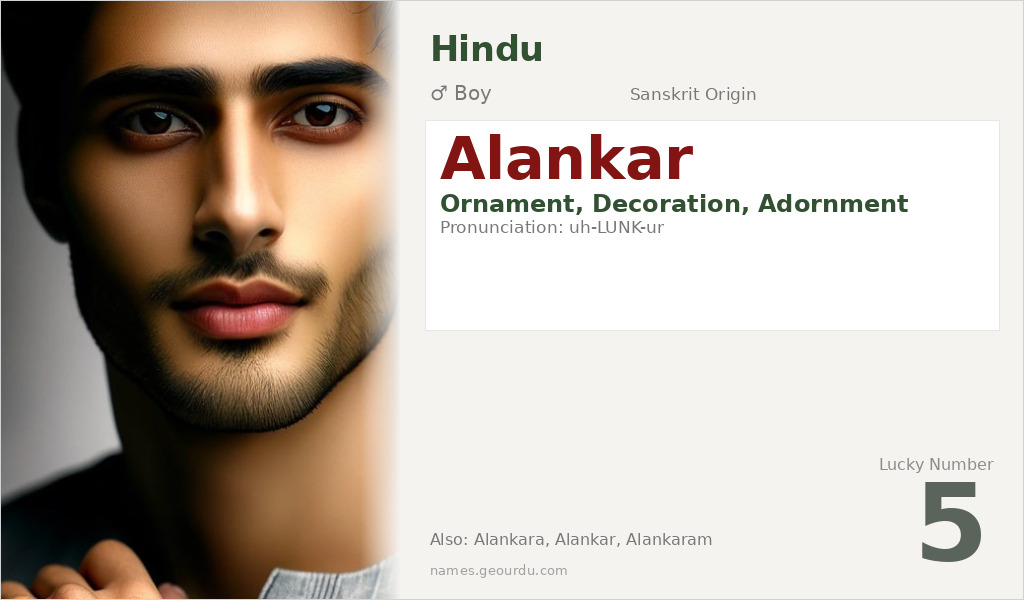
Alankar originates from the Sanskrit word ‘Alankara’ (अलंकार), which directly translates to ‘ornament’, ‘decoration’, or ‘adornment’. In Sanskrit poetics, ‘Alankara’ refers to figures of speech or rhetorical devices that enhance the beauty of language, such as metaphors, similes, and alliterations. This term has been central to Indian literary theory for millennia, emphasizing the importance of aesthetic embellishment. As a personal name, Alankar retains this core meaning, symbolizing someone who adds beauty or value to their surroundings. It is exclusively derived from Sanskrit and does not have verified meanings in other languages like Arabic, Persian, or regional dialects, despite extensive research across multiple linguistic families.
| 📛 Name | Alankar |
| 💎 Meaning | Ornament, Decoration, Adornment |
| 👤 Gender | Boy |
| 🕌 Religion | Hindu |
| 🌍 Origin | Sanskrit |
| 🗣 Pronunciation | uh-LUNK-ur |
| ✍️ Urdu | الانکر |
| ✍️ Arabic | ألانكار |
| 🔢 Numerology | 5 |
| ✨ Spellings | Alankara, Alankar, Alankaram |
Origin & Cultural Significance
The name Alankar has its origins in ancient Sanskrit, the classical language of India, and is deeply embedded in Hindu culture. It emerged from the broader concept of ‘Alankara’ in Indian arts, where ornamentation is celebrated in literature, music, dance, and visual arts. Historically, the term appears in early Sanskrit texts like the Natya Shastra and various poetic works, highlighting its cultural significance. As a given name, it is predominantly used in India and among Hindu diaspora communities, reflecting a connection to traditional values and aesthetic principles. While it is sometimes used in modern contexts, it remains a classic choice that honors India’s linguistic and artistic heritage.
Personality Traits
People named Alankar are often perceived as artistic, elegant, and attentive to details, mirroring the name’s meaning of ornamentation. They may have a strong sense of aesthetics and enjoy creative pursuits, whether in art, design, or communication. Their personality might be characterized by a desire to bring beauty and harmony into their interactions and environments, making them appreciated for their refined and charismatic nature.
Similar Names
If you like Alankar, consider: Abhushan, Bhooshan, Gehan, Mandan, Shringar
Famous People Named Alankar
- Alankar Prabhakar — Indian cricketer who played for Maharashtra
- Alankar Singh — Indian politician from Punjab
Frequently Asked Questions About Alankar
What does Alankar mean?
Alankar means 'ornament', 'decoration', or 'adornment' in Sanskrit, originating from the word 'Alankara' used in Indian literary and artistic traditions.
Is Alankar a boy or girl name?
Alankar is traditionally a boy's name in Hindu culture, though names can sometimes be adapted; it is overwhelmingly masculine in usage.
What is the origin of Alankar?
Alankar originates from Sanskrit, the classical language of India, and is deeply rooted in Hindu cultural and literary history.





