
Table of Contents
Ali is a timeless and powerful name with deep roots in Arabic language and Islamic history. Meaning ‘High,’ ‘Exalted,’ or ‘Noble,’ it carries connotations of honor and leadership. Used across continents and faiths, Ali remains one of the most popular and culturally significant names globally. This guide explores its etymology, historical figures, and modern usage.
Meaning of Ali
The name Ali originates from the Arabic triliteral root ع-ل-ي (ʕ-l-y), which conveys the concept of height, elevation, and supremacy. As an adjective, ‘Aliyy’ (عَلِيّ) means ‘high’ or ‘exalted,’ and Ali is its comparative/superlative form, often interpreted as ‘the highest’ or ‘most noble.’ In Islamic theology, Al-Ali (The Most High) is one of the divine attributes of Allah. Linguistically, the name has been adopted into numerous languages including Persian, Urdu, Turkish, Kurdish, Pashto, Bengali, Sindhi, and Swahili without semantic change, maintaining its core meaning of nobility and elevation. It is also used as a component in compound names like Ali Akbar (Ali the Greatest) or Ali Reza.
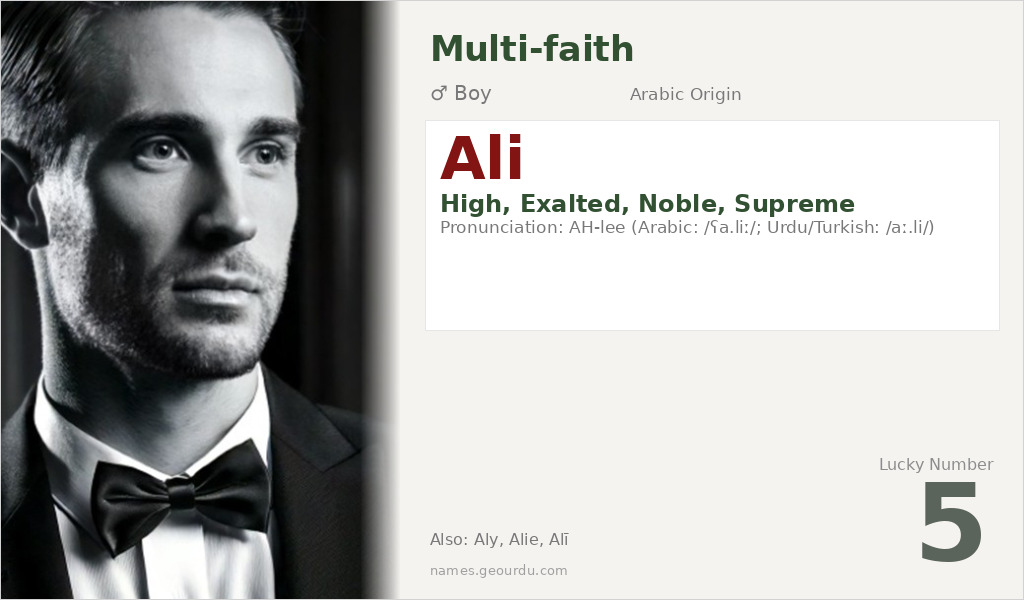
| 📛 Name | Ali |
| 💎 Meaning | High, Exalted, Noble, Supreme |
| 👤 Gender | Boy |
| 🕌 Religion | Multi-faith |
| 🌍 Origin | Arabic |
| 🗣 Pronunciation | AH-lee (Arabic: /ʕa.liː/; Urdu/Turkish: /aː.li/) |
| ✍️ Urdu | علی |
| ✍️ Arabic | عَلِيّ |
| 🔢 Numerology | 5 |
| ✨ Spellings | Aly, Alie, Alī, Aali, Alee |
Origin & Cultural Significance
Ali emerged as a significant personal name in pre-Islamic Arabia but gained profound historical and religious importance through Ali ibn Abi Talib (c. 600–661 CE), the cousin and son-in-law of Prophet Muhammad. His leadership and martyrdom made Ali a central figure in Islam, especially revered in Shia tradition as the first Imam. The name spread across the Muslim world through conquests, trade, and cultural exchange, becoming common in regions from the Middle East to South Asia, Africa, and the Balkans. Notably, Ali is also used by Arabic-speaking Christians and others, reflecting its cross-cultural appeal beyond religious boundaries.
Personality Traits
Those named Ali are often associated with traits of dignity, resilience, and moral integrity. Inspired by historical figures like Ali ibn Abi Talib, they may be seen as just, courageous, and intellectually sharp. In many cultures, the name evokes a sense of legacy and responsibility, encouraging bearers to uphold high ethical standards and community leadership.
Similar Names
If you like Ali, consider: Alim, Alaa, Amin, Amir, Karim
Famous People Named Ali
- Ali ibn Abi Talib — cousin and son-in-law of Prophet Muhammad, fourth Caliph in Sunni Islam, first Imam in Shia Islam
- Muhammad Ali — American professional boxer and activist, born Cassius Clay, who changed his name after converting to Islam
Frequently Asked Questions About Ali
What does Ali mean?
Ali means 'High,' 'Exalted,' 'Noble,' or 'Supreme.' It comes from the Arabic root ع-ل-ي (ʕ-l-y), meaning 'to be high or elevated.'
Is Ali a boy or girl name?
Ali is primarily a masculine name across Arabic, Persian, Turkish, Urdu, and other cultures. In some regions, it can be unisex or feminine (e.g., Aliye in Turkish), but the overwhelming global usage is for boys.
What is the origin of Ali?
Ali originates from Arabic language and culture. It predates Islam but gained prominence through Ali ibn Abi Talib in the 7th century and has since spread to many languages and regions worldwide.





