
Table of Contents
Alison is a timeless feminine name with roots stretching back to medieval Europe. Originally a diminutive of Alice, it has evolved into a beloved standalone name across English-speaking countries and beyond. With its meaning of ‘noble’ or ‘of noble kind,’ Alison carries an air of dignity and grace that has maintained its appeal for centuries. This name’s journey from Norman France to global popularity tells a fascinating story of linguistic evolution.
Meaning of Alison
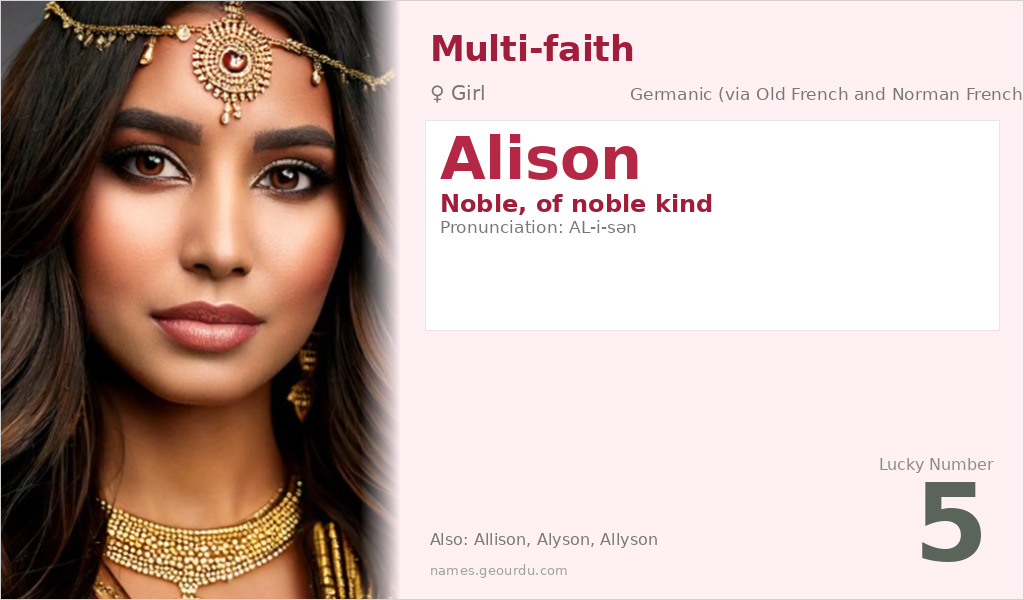
The name Alison derives from the Germanic name Adalheidis, which combines two elements: ‘adal’ meaning ‘noble’ and ‘heid’ meaning ‘kind, sort, or type.’ Through linguistic evolution, Adalheidis became Adelais in Old French, then Alis as a shortened form, and finally Alison as a diminutive. The ‘-son’ suffix in Alison is actually a diminutive ending in medieval French, not related to the English ‘son’ meaning male child. This etymological path demonstrates how names transform across languages and cultures while retaining their core meaning. The ‘noble’ connotation has remained consistent throughout its history, giving the name its enduring dignified quality.
| 📛 Name | Alison |
| 💎 Meaning | Noble, of noble kind |
| 👤 Gender | Girl |
| 🕌 Religion | Multi-faith |
| 🌍 Origin | Germanic (via Old French and Norman French) |
| 🗣 Pronunciation | AL-i-sən |
| ✍️ Urdu | ایلسن |
| ✍️ Arabic | أليسون |
| 🔢 Numerology | 5 |
| ✨ Spellings | Allison, Alyson, Allyson, Alisoun |
Origin & Cultural Significance
Alison entered the English language through the Norman Conquest of 1066, when French names became fashionable among the English aristocracy. It appears in medieval English literature, most notably in Chaucer’s ‘The Miller’s Tale’ where Alisoun is a character. The name experienced a revival in the 20th century, particularly in the mid-1900s, becoming one of the most popular girls’ names in English-speaking countries. While its origins are European, Alison has been adopted globally and appears in various cultures without specific religious associations. Its popularity reflects broader naming trends that favor classic names with clear, positive meanings and historical depth.
Personality Traits
Those named Alison often embody the noble qualities suggested by their name’s meaning. They tend to approach life with dignity, integrity, and a natural grace that others admire. The name’s historical connection to medieval nobility might influence perceptions, with Alisons often seen as having leadership potential and refined tastes. Their adaptable nature, reflected in the name’s journey through languages, suggests flexibility and openness to new experiences.
Similar Names
If you like Alison, consider: Alice, Alicia, Alisa, Alix, Adelaide
Famous People Named Alison
- Alison Brie — American actress known for 'Community' and 'GLOW'
- Alison Krauss — American bluegrass-country singer and musician
- Alison Moyet — English singer known for her work with Yazoo
- Alison Steadman — English actress known for 'Gavin & Stacey'
- Alison Weir — British historian and author
Frequently Asked Questions About Alison
What does Alison mean?
Alison means 'noble' or 'of noble kind.' It derives from the Germanic name Adalheidis, composed of 'adal' (noble) and 'heid' (kind, type), which evolved through Old French before becoming Alison in English.
Is Alison a boy or girl name?
Alison is primarily a feminine name. While historically it appeared occasionally for males in medieval records, in modern usage it is overwhelmingly given to girls across English-speaking countries and internationally.
What is the origin of Alison?
Alison has Germanic origins via Old French. It began as Adalheidis in Germanic languages, became Adelais then Alis in Old French, and developed as the diminutive Alison in medieval England after the Norman Conquest.





