Table of Contents
AmatuzZaahir is a beautiful and meaningful Arabic name for girls that carries deep spiritual significance in Islamic tradition. As a compound name combining ‘Amatu’ (servant) with one of Allah’s 99 names, it represents devotion to divine attributes. This name reflects the rich theological heritage of Muslim naming conventions, where children are named as servants of God’s qualities. Understanding its components reveals layers of meaning about faith and identity.
Meaning of AmatuzZaahir
AmatuzZaahir derives from classical Arabic and consists of two distinct elements that together create a profound spiritual meaning. The first part, ‘Amatu’ (أَمَةُ), specifically means ‘female servant of’ or ‘handmaiden of’, establishing a relationship of servitude and devotion. The second part, ‘Az-Zaahir’ (الظَّاهِرُ), is one of the 99 names of Allah in Islamic theology, meaning ‘The Manifest’, ‘The Apparent’, ‘The Outward’, or ‘The Evident’. This divine name refers to God’s presence that is visible and apparent in creation, as opposed to His hidden aspects. Thus, the complete name translates to ‘Servant of the Manifest’, indicating the bearer’s relationship to this particular attribute of God. This naming pattern follows established Arabic conventions where ‘Abdul’ (for males) or ‘Amatu’ (for females) is combined with one of God’s names or attributes.
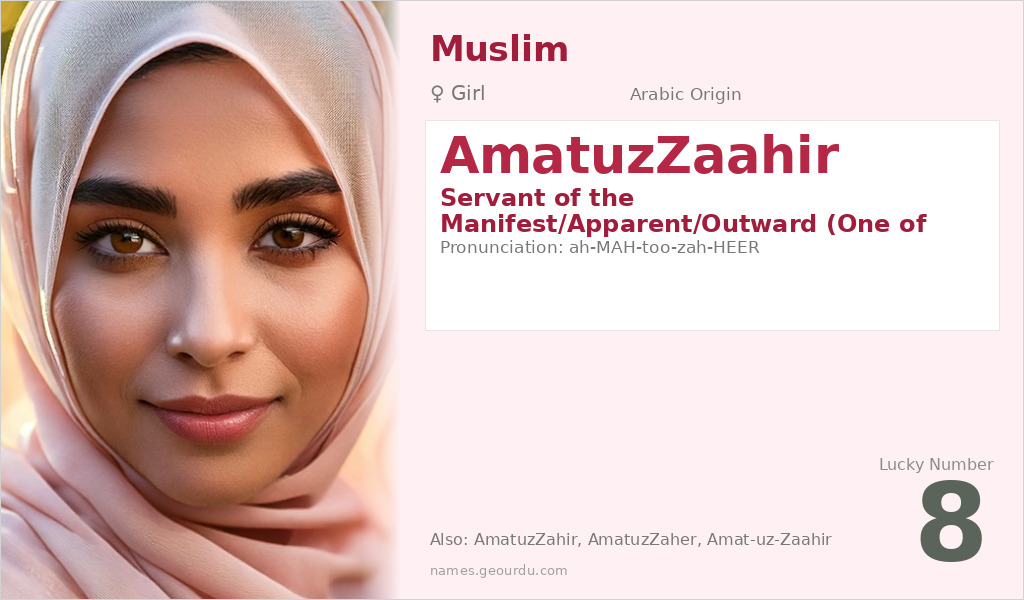
| 📛 Name | AmatuzZaahir |
| 💎 Meaning | Servant of the Manifest/Apparent/Outward (One of God's attributes) |
| 👤 Gender | Girl |
| 🕌 Religion | Muslim |
| 🌍 Origin | Arabic |
| 🗣 Pronunciation | ah-MAH-too-zah-HEER |
| ✍️ Urdu | امۃ الظاہر |
| ✍️ Arabic | أَمَةُ الظَّاهِر |
| 🔢 Numerology | 8 |
| ✨ Spellings | AmatuzZahir, AmatuzZaher, Amat-uz-Zaahir, Amat uz Zaahir |
Origin & Cultural Significance
AmatuzZaahir originates from Arabic linguistic and Islamic religious traditions, specifically from the Quranic and theological concept of Allah’s 99 names (Asma ul-Husna). The name Az-Zaahir appears in Islamic scriptures and theological works as one of God’s attributes, emphasizing His manifest nature in the universe. This naming convention became particularly popular in Muslim communities across the Middle East, South Asia, and beyond as parents sought names that expressed devotion while carrying beautiful meanings. While the name follows classical Arabic structure, its usage spans various Muslim cultures including Arab, Persian, Urdu-speaking, and other communities where Arabic-derived names are valued. The name represents the Islamic tradition of naming children as servants of divine attributes, a practice that dates back to early Islamic history and continues today.
Personality Traits
Those named AmatuzZaahir often embody qualities associated with both parts of their name. The ‘servant’ component suggests humility, devotion, and service-oriented values, while connection to ‘The Manifest’ implies perceptiveness, clarity, and an ability to recognize divine signs in the visible world. Such individuals may be particularly attuned to spiritual realities manifest in physical creation, balancing practical awareness with deep faith. Their personality often reflects the theological concept they’re named after—finding the divine in what is apparent and evident in daily life.
Similar Names
If you like AmatuzZaahir, consider: Amatullah, Amatul Jameel, Amatul Qadeer, Amatul Hakeem, Amatul Baseer
Famous People Named AmatuzZaahir
- No widely known public figures with this exact name found in records, though it appears in Muslim communities globally
Frequently Asked Questions About AmatuzZaahir
What does AmatuzZaahir mean?
AmatuzZaahir means 'Servant of the Manifest' or 'Handmaiden of the Apparent' in Arabic. It combines 'Amatu' (female servant) with 'Az-Zaahir' (one of Allah's 99 names meaning The Manifest/Apparent).
Is AmatuzZaahir a boy or girl name?
AmatuzZaahir is exclusively a girl's name. The 'Amatu' prefix specifically denotes a female servant, as opposed to 'Abdul' which is used for male names in the same naming pattern.
What is the origin of AmatuzZaahir?
AmatuzZaahir originates from Arabic language and Islamic religious tradition. It follows the pattern of combining 'Amatu' (servant) with one of the 99 names of Allah (Asma ul-Husna), specifically Az-Zaahir (The Manifest).