
Table of Contents
Amin is a classic Arabic name with deep religious and cultural significance across the Middle East, North Africa, and Muslim communities worldwide. Meaning ‘trustworthy’ or ‘faithful’, this name carries centuries of historical weight, from pre-Islamic Arabia to modern times. Its association with honesty and reliability makes it a timeless choice for parents seeking a name with strong moral foundations. Whether in Arabic-speaking Christian families or Muslim households, Amin represents a universal value cherished across faith traditions.
Meaning of Amin
The name Amin originates from the Arabic root ‘amn’ (أمن), which encompasses concepts of security, safety, peace, and trust. As an active participle, Amin literally translates to ‘one who is trustworthy’ or ‘faithful custodian’. This etymology is deeply embedded in Semitic languages, with cognates in Hebrew (Amon/אמון) and Aramaic sharing similar meanings of faithfulness and reliability. In Islamic context, the name gained particular prominence as an epithet of Prophet Muhammad, who was known as ‘Al-Amin’ (The Trustworthy) even before his prophethood due to his impeccable character. The Quran reinforces this meaning when prophets repeatedly declare themselves as ‘amin’ messengers sent by God.
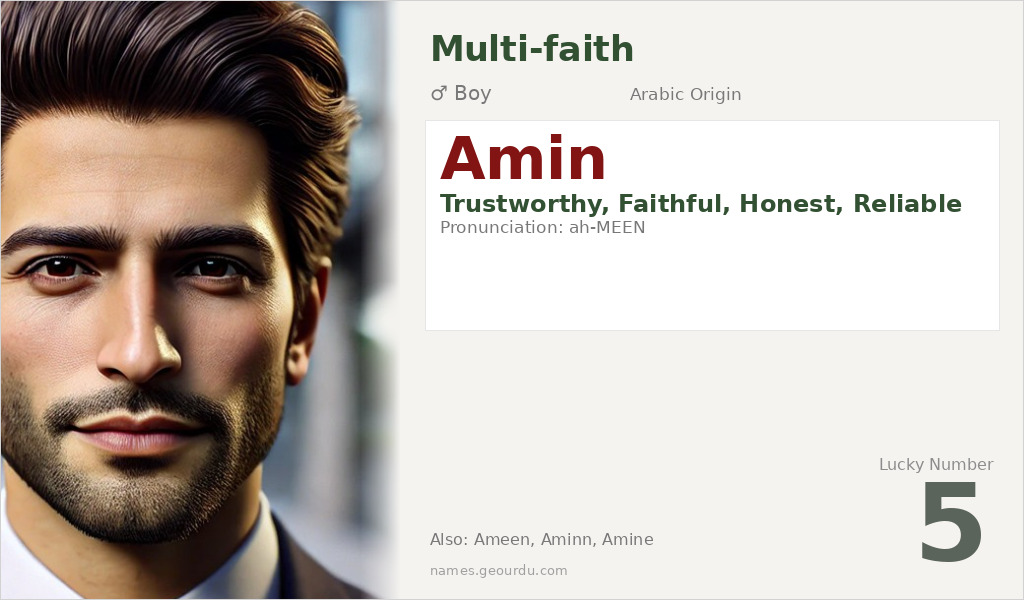
| 📛 Name | Amin |
| 💎 Meaning | Trustworthy, Faithful, Honest, Reliable |
| 👤 Gender | Boy |
| 🕌 Religion | Multi-faith |
| 🌍 Origin | Arabic |
| 🗣 Pronunciation | ah-MEEN |
| ✍️ Urdu | امین |
| ✍️ Arabic | أمين |
| 🔢 Numerology | 5 |
| ✨ Spellings | Ameen, Aminn, Amine, Amein |
Origin & Cultural Significance
Amin has its origins in pre-Islamic Arabia, where it was used to describe individuals of exceptional honesty and reliability in tribal societies. With the advent of Islam, the name gained religious significance through its association with Prophet Muhammad and its appearance in the Quran. While predominantly used in Muslim communities globally, the name also appears among Arabic-speaking Christians and Jews, particularly in Levantine regions. Beyond the Arab world, Amin spread through Persian, Turkish, Urdu, and various African languages (especially Swahili and Hausa) via Islamic influence. In South Asia, it became common among Muslim populations while maintaining its original Arabic meaning and pronunciation.
Personality Traits
Those named Amin often embody the qualities their name represents: trustworthiness, integrity, and dependability. They tend to be calm, thoughtful individuals who approach life with sincerity and purpose. Their natural inclination toward honesty makes them valued friends and colleagues, while their principled nature can manifest as strong moral convictions. While generally peaceful, Amins can be fiercely protective of those they care about and the values they hold dear.
Similar Names
If you like Amin, consider: Aman, Aminullah, Aminah, Emin, Amani, Amir, Aminul
Famous People Named Amin
- Muhammad Amin al-Husseini — Palestinian Arab nationalist and Muslim leader in the British Mandate of Palestine
- Amin Maalouf — Lebanese-born French author and member of the Académie française
Frequently Asked Questions About Amin
What does Amin mean?
Amin means 'trustworthy, faithful, honest, reliable' in Arabic, derived from the root 'amn' meaning security and trust.
Is Amin a boy or girl name?
Amin is primarily a masculine name in Arabic and Islamic cultures, though the feminine form 'Aminah' is common. In some African contexts, it can be unisex.
What is the origin of Amin?
Amin originates from Classical Arabic and has been used since pre-Islamic times. It spread through Islamic expansion to Persian, Turkish, Urdu, Swahili, and other languages influenced by Arabic culture and religion.





