
Table of Contents
Aminuddin is a distinguished Arabic name with deep Islamic roots that has been cherished for centuries across Muslim communities worldwide. Meaning ‘trustworthy of the faith’, this name carries significant religious and moral weight, reflecting virtues highly valued in Islamic tradition. From South Asia to the Middle East, Aminuddin has been borne by scholars, leaders, and individuals respected for their integrity and devotion. This comprehensive guide explores the rich etymology, cultural significance, and contemporary usage of this meaningful name.
Meaning of Aminuddin
Aminuddin is a compound Arabic name with clear etymological roots. The first component, ‘Amin’ (أمين), derives from the Arabic root أ-م-ن (a-m-n) meaning security, trust, and safety, giving it the meaning of ‘trustworthy, faithful, or reliable’. The second component, ‘al-Din’ (الدين), comes from the Arabic root د-ي-ن (d-y-n) meaning debt, judgment, or religion, specifically referring to the Islamic faith in this context. When combined, Aminuddin literally translates to ‘trustworthy of the faith’ or ‘faithful to the religion’. This theophoric naming pattern is common in Islamic cultures, where names incorporating ‘al-Din’ emphasize religious devotion and identity. The name has been documented in Islamic historical records since at least the medieval period.
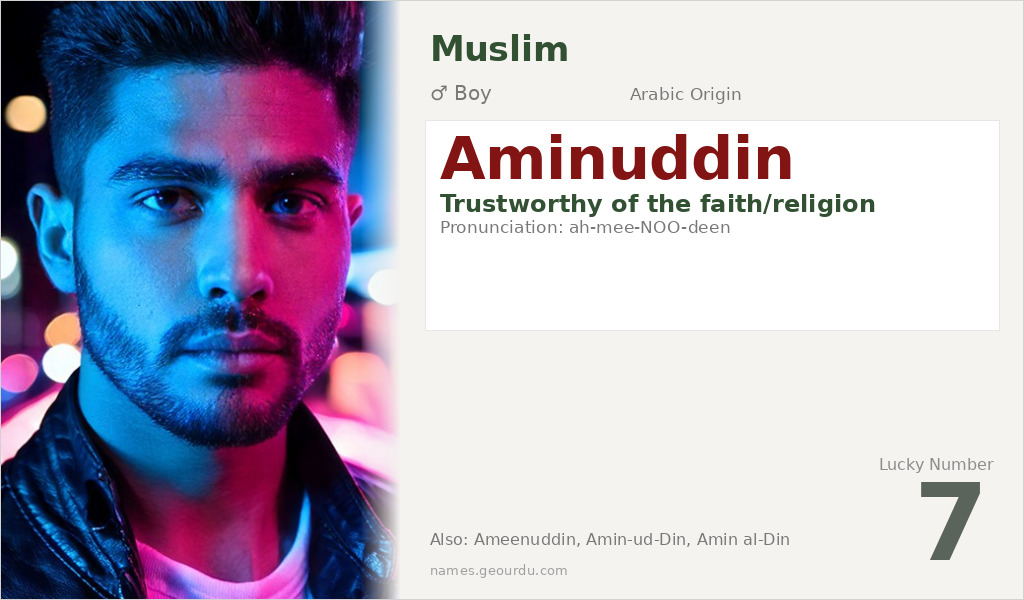
| 📛 Name | Aminuddin |
| 💎 Meaning | Trustworthy of the faith/religion |
| 👤 Gender | Boy |
| 🕌 Religion | Muslim |
| 🌍 Origin | Arabic |
| 🗣 Pronunciation | ah-mee-NOO-deen |
| ✍️ Urdu | امین الدین |
| ✍️ Arabic | أمين الدين |
| 🔢 Numerology | 7 |
| ✨ Spellings | Ameenuddin, Amin-ud-Din, Amin al-Din, Ameen-ud-Din |
Origin & Cultural Significance
Aminuddin originated in the Arabic-speaking world during the early Islamic period as part of a tradition of creating compound names that express religious devotion. The name spread throughout the Islamic world via trade routes, scholarly networks, and cultural exchange, becoming particularly popular in South Asia (Pakistan, India, Bangladesh) and Southeast Asia (Malaysia, Indonesia). In these regions, the name was often adopted by Muslim families seeking to emphasize both moral character (amin) and religious commitment (din). Historical records show numerous Islamic scholars, Sufi saints, and community leaders bearing this name across centuries, contributing to its enduring popularity. The name remains in use today, though its frequency varies by region and community.
Personality Traits
Those named Aminuddin are often associated with qualities of reliability, integrity, and spiritual depth. The name’s meaning suggests someone who is trustworthy in matters of faith and principle, potentially influencing how bearers perceive themselves and are perceived by others. In many cultures, names are believed to shape character, and Aminuddin carries expectations of honesty, devotion, and moral steadfastness. While individual personalities vary, the name’s etymology points toward foundational values that many families hope to instill in their children.
Similar Names
If you like Aminuddin, consider: Abdul, Nuruddin, Shamsuddin, Fakhruddin, Sirajuddin
Famous People Named Aminuddin
- Aminuddin Khan — 19th century Indian Islamic scholar and poet from Bhopal
- Aminuddin Ahmad — Malaysian politician and former Deputy Minister of Education
Frequently Asked Questions About Aminuddin
What does Aminuddin mean?
Aminuddin means 'trustworthy of the faith' or 'faithful to the religion' in Arabic. It is a compound name combining 'Amin' (trustworthy) and 'al-Din' (the faith/religion).
Is Aminuddin a boy or girl name?
Aminuddin is exclusively a boy's name in all cultures where it is used. There is no feminine equivalent in common usage, though similar feminine names might incorporate 'Amina' (the feminine form of Amin) with other elements.
What is the origin of Aminuddin?
Aminuddin originates from Arabic and has been used in Islamic cultures since the medieval period. It spread throughout the Muslim world and is particularly common in South Asia and Southeast Asia among Muslim communities.





