
Table of Contents
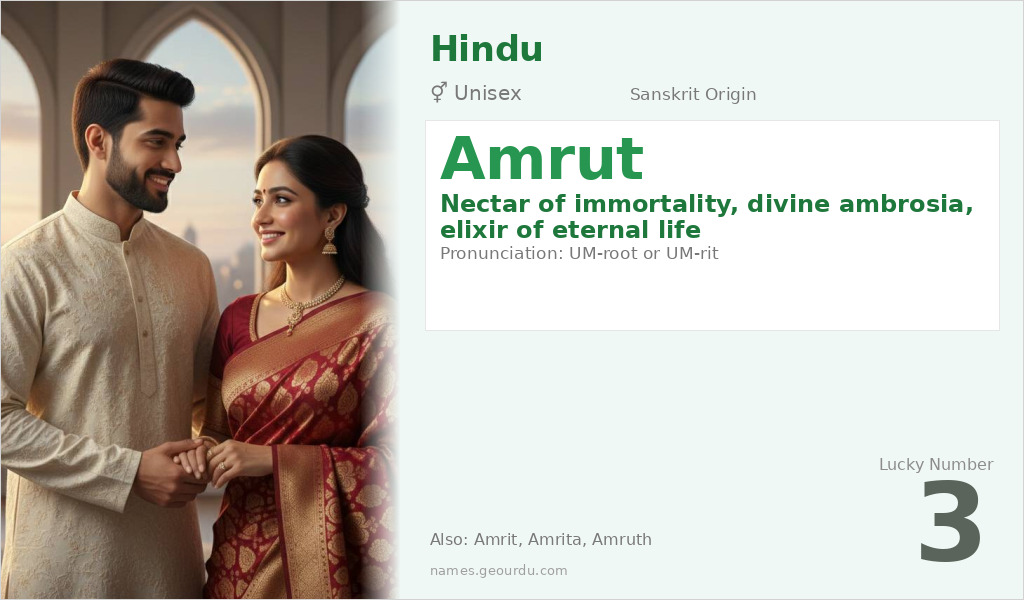
Amrut is a profound Sanskrit name that carries centuries of spiritual significance. Meaning ‘nectar of immortality’ or ‘divine ambrosia’, this name connects directly to Hindu mythology’s most sacred concepts. Whether spelled as Amrut, Amrit, or Amrita, this name represents eternal life and divine blessing. Its rich history makes it a meaningful choice for parents seeking a name with deep cultural roots.
Meaning of Amrut
Amrut derives from the Sanskrit word ‘अमृत’ (amṛta), which combines the negative prefix ‘a-‘ (meaning ‘not’) with the root ‘mṛ’ (meaning ‘to die’), creating the literal meaning ‘not dying’ or ‘immortal’. In Hindu tradition, Amrita refers specifically to the divine nectar that grants immortality to the gods, obtained during the churning of the cosmic ocean (Samudra Manthan). This mythological event is described in ancient texts like the Puranas and Mahabharata. The name symbolizes not just physical immortality but spiritual enlightenment and eternal truth. Linguistically, it’s one of the most significant words in Sanskrit literature, appearing in Vedic hymns and philosophical texts.
| 📛 Name | Amrut |
| 💎 Meaning | Nectar of immortality, divine ambrosia, elixir of eternal life |
| 👤 Gender | Unisex |
| 🕌 Religion | Hindu |
| 🌍 Origin | Sanskrit |
| 🗣 Pronunciation | UM-root or UM-rit |
| ✍️ Urdu | امرت |
| ✍️ Arabic | أمريت |
| 🔢 Numerology | 3 |
| ✨ Spellings | Amrit, Amrita, Amruth, Amritha |
Origin & Cultural Significance
Amrut originates from ancient Sanskrit, the classical language of India that dates back over 3,500 years. The concept of Amrita is central to Hindu cosmology and appears in the Rigveda, one of the world’s oldest religious texts. During the Vedic period, Amrita represented both a literal divine substance and a metaphorical state of spiritual liberation. The name spread through Hindu communities across South Asia and diaspora populations worldwide. While primarily associated with Hinduism, the concept of ambrosia/nectar of immortality appears in various Indo-European traditions, though the specific name Amrut remains distinctly Sanskrit in origin.
Personality Traits
Those named Amrut often embody qualities associated with their name’s meaning—endurance, wisdom, and spiritual depth. They may be perceived as having a nurturing, healing presence that brings comfort to others. The name’s connection to immortality can inspire a philosophical outlook and resilience in facing life’s challenges. While personality traits vary individually, the name carries connotations of eternal value and sacred purpose.
Similar Names
If you like Amrut, consider: Amrita, Amritpal, Amritlal, Amritraj, Amritkumar
Famous People Named Amrut
- Amrit Kaur — First Health Minister of India and freedom fighter
- Amrit Singh — Indian-American lawyer and human rights advocate
Frequently Asked Questions About Amrut
What does Amrut mean?
Amrut means 'nectar of immortality' or 'divine ambrosia' in Sanskrit. It comes from the words 'a-' (not) and 'mṛ' (to die), literally meaning 'not dying'.
Is Amrut a boy or girl name?
Amrut is traditionally a unisex name, though it's more commonly used for boys in some Hindu communities. The feminine forms Amrita and Amritha are also popular.
What is the origin of Amrut?
Amrut originates from Sanskrit, the ancient classical language of India. It's deeply rooted in Hindu mythology, particularly the story of the churning of the ocean to obtain the nectar of immortality.