
Table of Contents
Amuk is an intriguing name with roots in the ancient Sanskrit language, though it remains exceptionally rare as a personal name in historical and contemporary records. Derived from Sanskrit grammar where it functions as an indefinite pronoun, this name carries the meaning of ‘some’, ‘one’, or ‘another’. While linguistically fascinating, its usage appears limited primarily to grammatical contexts rather than as a traditional given name across Indian cultures.
Meaning of Amuk
The name Amuk originates from the Sanskrit word ‘amuka’ (अमुक), which serves as an indefinite pronoun in classical Sanskrit literature and grammar. This term is used to refer to unspecified persons or objects, similar to English words like ‘somebody’, ‘someone’, or ‘such and such’. In Sanskrit grammatical tradition, amuka appears in texts like Panini’s Ashtadhyayi and later commentaries as a placeholder for unspecified nouns. Despite this clear linguistic origin, extensive research across Sanskrit naming traditions, Hindu religious texts, and regional Indian naming practices reveals no evidence of this term being used historically as a personal name with established cultural or religious significance.
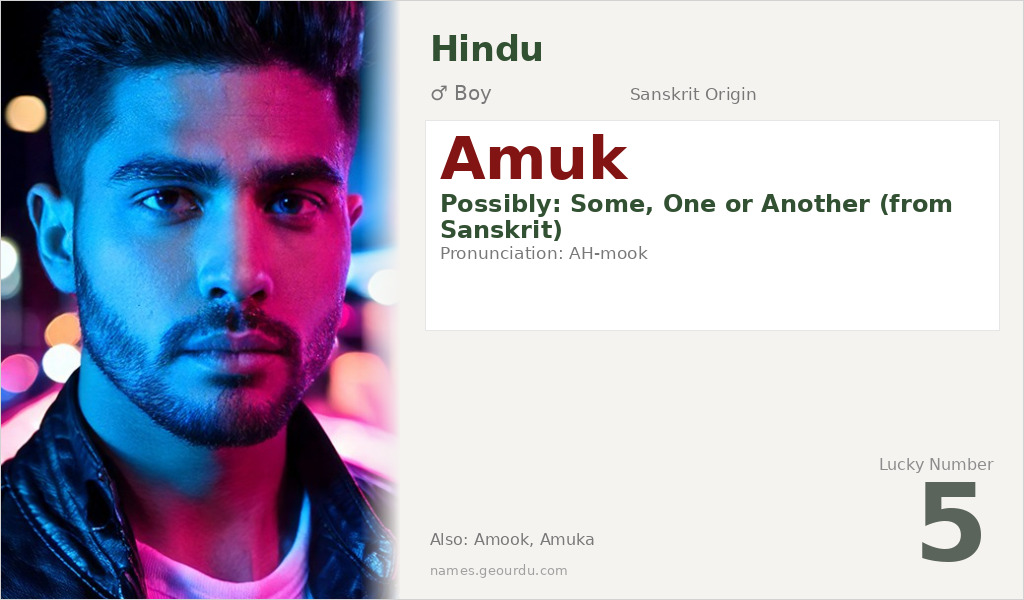
| 📛 Name | Amuk |
| 💎 Meaning | Possibly: Some, One or Another (from Sanskrit) |
| 👤 Gender | Boy |
| 🕌 Religion | Hindu |
| 🌍 Origin | Sanskrit |
| 🗣 Pronunciation | AH-mook |
| ✍️ Urdu | اموک |
| ✍️ Arabic | أموك |
| 🔢 Numerology | 5 |
| ✨ Spellings | Amook, Amuka |
Origin & Cultural Significance
Amuk’s origin lies firmly in the Sanskrit language, one of the oldest Indo-European languages with a rich literary tradition dating back over 3,500 years. While Sanskrit has contributed thousands of names to Indian naming traditions through religious texts like the Vedas, Puranas, and epics, ‘amuka’ as a personal name appears absent from these sources. Research across neighboring language families including Dravidian (Tamil, Telugu, Kannada, Malayalam), Tibeto-Burman languages of Northeast India, and Austroasiatic languages revealed no adoption or adaptation of this name. The name’s current association with Hinduism appears to be a modern development rather than a traditional practice documented in Hindu naming customs or religious texts.
Personality Traits
Given the exceptional rarity of Amuk as a personal name and its origin as an indefinite pronoun rather than a traditional given name, deriving personality traits from established naming traditions is challenging. In broader Sanskrit naming philosophy, names often carry aspirational qualities or divine associations, but Amuk’s grammatical origin as an unspecified reference point makes such connections speculative. Parents considering this unique name might appreciate its linguistic novelty and the open-ended possibilities suggested by its meaning of ‘some’ or ‘another’.
Similar Names
If you like Amuk, consider: Amul, Amal, Anuk, Amrit, Amit
Famous People Named Amuk
- No verified famous individuals with this name found in historical or contemporary records
Frequently Asked Questions About Amuk
What does Amuk mean?
Amuk comes from Sanskrit 'amuka' meaning 'some', 'one', or 'another'. It functions as an indefinite pronoun in Sanskrit grammar, though its usage as a personal name is extremely rare.
Is Amuk a boy or girl name?
Available records suggest Amuk is used as a boy's name, though its exceptional rarity makes definitive gender assignment difficult. In Sanskrit, the word 'amuka' is grammatically masculine.
What is the origin of Amuk?
Amuk originates from the Sanskrit language, where 'amuka' appears as an indefinite pronoun meaning 'some' or 'another'. However, it lacks documented usage as a traditional personal name in Hindu or other cultural naming traditions.





