
Table of Contents
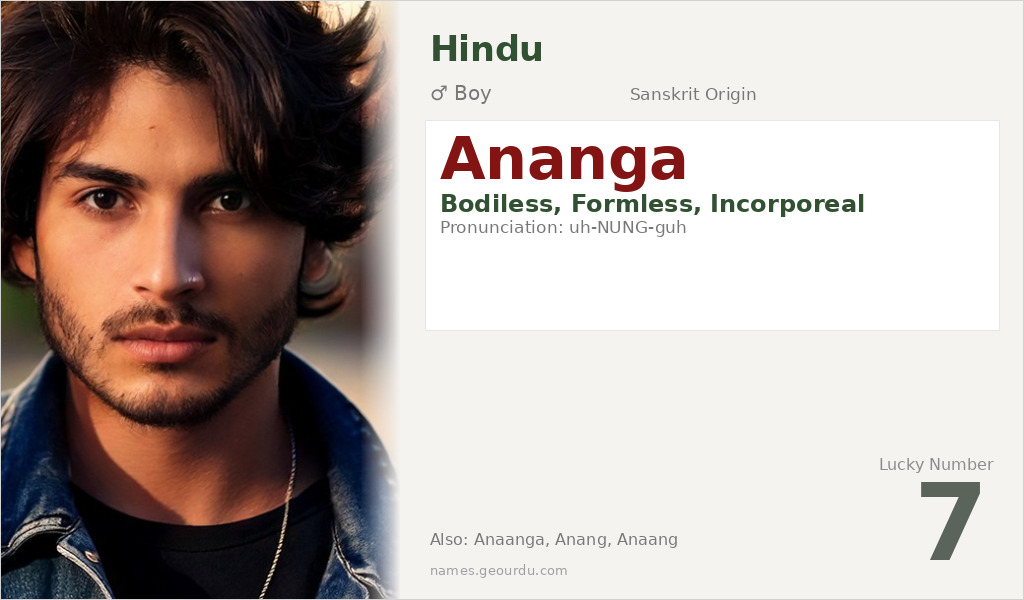
Ananga is a beautiful Sanskrit name with deep mythological roots in Hindu tradition. Meaning ‘bodiless’ or ‘formless’, it carries the poetic imagery of love’s invisible nature. As an epithet of Kamadeva, the god of love, this name connects its bearer to ancient stories of divine romance and desire. Discover the rich linguistic and cultural heritage behind this distinctive name.
Meaning of Ananga
Ananga derives from the Sanskrit words ‘an’ (without) and ‘anga’ (body), literally translating to ‘bodiless’ or ‘formless’. This name is most famously associated with Kamadeva, the Hindu deity of love, who earned this epithet after being reduced to ashes by Shiva’s third eye, becoming invisible yet still potent in his influence. In classical Sanskrit literature, the term appears in texts like the Mahabharata and various Puranas, where it poetically describes love’s intangible, pervasive nature. The name embodies the concept that true love transcends physical form, operating on a spiritual and emotional plane. This etymological construction follows common Sanskrit patterns where the prefix ‘an-‘ negates the root word, creating a term rich in philosophical meaning.
| 📛 Name | Ananga |
| 💎 Meaning | Bodiless, Formless, Incorporeal |
| 👤 Gender | Boy |
| 🕌 Religion | Hindu |
| 🌍 Origin | Sanskrit |
| 🗣 Pronunciation | uh-NUNG-guh |
| ✍️ Urdu | اننگ |
| ✍️ Arabic | أنانغا |
| 🔢 Numerology | 7 |
| ✨ Spellings | Anaanga, Anang, Anaang |
Origin & Cultural Significance
Ananga originates from classical Sanskrit, the ancient liturgical language of Hinduism, Buddhism, and Jainism. Its usage dates back to early Hindu scriptures and epic poetry, where it appears as both a descriptive term and a proper name. Culturally, the name is deeply embedded in Hindu mythology, specifically in stories about Kamadeva, whose formless state after being burned by Shiva symbolizes love’s enduring power beyond physical destruction. While primarily used in Hindu communities, the name’s Sanskrit roots give it pan-Indian recognition across various linguistic regions. The name maintains its traditional association with divine love mythology rather than developing extensive astrological correspondences like some other Sanskrit names.
Personality Traits
Those named Ananga are often associated with qualities of subtlety, creativity, and emotional intelligence. The name’s meaning suggests someone who influences situations indirectly rather than through overt force. They may possess artistic sensibilities and a natural understanding of relationships, reflecting the name’s connection to the deity of love. Their approach to challenges tends to be nuanced and perceptive, with an ability to navigate complex emotional landscapes.
Similar Names
If you like Ananga, consider: Kamadeva, Madan, Manmatha, Pradyumna, Kandarpa
Famous People Named Ananga
- Ananga Ranga — Author of the classical Sanskrit text on love and marriage
- Ananga Mohan — Indian classical musician and composer
Frequently Asked Questions About Ananga
What does Ananga mean?
Ananga means 'Bodiless' or 'Formless' in Sanskrit. It is an epithet of Kamadeva, the Hindu god of love, referring to his invisible nature after being burned by Shiva.
Is Ananga a boy or girl name?
Ananga is traditionally a boy name in Hindu culture, as it refers to the male deity Kamadeva. There are no recorded feminine usages in classical sources.
What is the origin of Ananga?
Ananga originates from Sanskrit, the ancient Indian language. It appears in Hindu scriptures and mythology, specifically associated with stories of Kamadeva, the god of love.





