
Table of Contents
Anant is a profound and timeless name that carries the weight of eternity within its syllables. Rooted in ancient Sanskrit, it evokes images of the infinite cosmos and spiritual boundlessness. This name is not just a label but a philosophical concept, often chosen by parents seeking a name with deep metaphysical resonance. In Hindu culture, Anant connects the bearer to divine attributes and cosmic symbolism.
Meaning of Anant
The name Anant originates from the Sanskrit word ‘ananta,’ which directly translates to ‘without end’ or ‘infinite.’ It is composed of two parts: the prefix ‘an-‘ meaning ‘not’ or ‘without,’ and ‘anta’ meaning ‘end’ or ‘limit.’ This etymology places it firmly in the Indo-Aryan language family, with cognates in other Indian languages like Hindi and Bengali. In Hindu scriptures, Anant is used to describe the eternal serpent Shesha, who supports the universe, and as an epithet for deities like Vishnu, emphasizing their timeless nature. The name conveys concepts of perpetuity, boundlessness, and the unending cycle of existence, making it rich in spiritual and philosophical undertones.
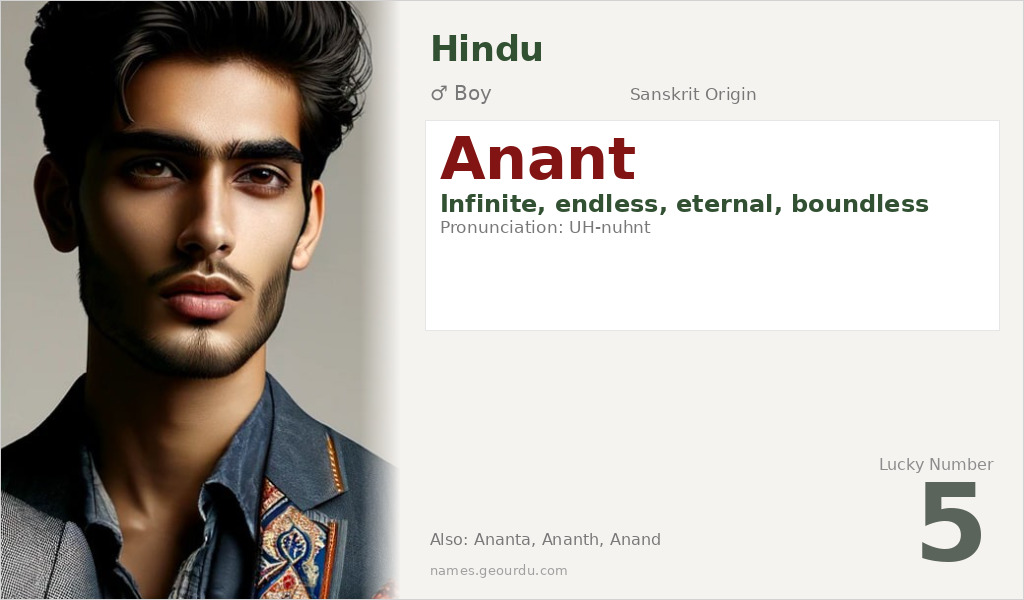
| 📛 Name | Anant |
| 💎 Meaning | Infinite, endless, eternal, boundless |
| 👤 Gender | Boy |
| 🕌 Religion | Hindu |
| 🌍 Origin | Sanskrit |
| 🗣 Pronunciation | UH-nuhnt |
| ✍️ Urdu | اننت |
| ✍️ Arabic | أنانت |
| 🔢 Numerology | 5 |
| ✨ Spellings | Ananta, Ananth, Anand, Ananta |
Origin & Cultural Significance
Anant has its origins in ancient India, deeply embedded in Hindu religious and cultural traditions. It first appears in Vedic and Puranic texts, where it is associated with cosmological elements like Ananta Shesha, the multi-headed serpent upon which Lord Vishnu rests. The name is predominantly used in Hindu communities across India, Nepal, and the diaspora, reflecting its Sanskrit heritage. Over centuries, it has maintained its spiritual significance, often chosen for boys to invoke qualities of eternity and divine protection. While primarily a Hindu name, its philosophical meaning has also influenced its occasional use in other Indian religious contexts, though it remains most common within Hinduism.
Personality Traits
Those named Anant are often perceived as having a broad, expansive outlook on life, mirroring the name’s meaning of infinity. They may exhibit traits such as creativity, adaptability, and a deep-seated curiosity about the universe. Their personality tends to be philosophical and visionary, with a natural inclination toward exploring endless possibilities and seeking spiritual or intellectual growth. This name inspires a sense of boundlessness, encouraging the bearer to think beyond conventional limits.
Similar Names
If you like Anant, consider: Aadi, Advait, Akshay, Amrit, Nitya
Famous People Named Anant
- Anant Ambani — Indian businessman and son of Mukesh Ambani
- Anant Nag — Indian actor in Kannada and Hindi cinema
Frequently Asked Questions About Anant
What does Anant mean?
Anant means 'infinite,' 'endless,' or 'eternal.' It is derived from the Sanskrit word 'ananta,' which literally translates to 'without end.'
Is Anant a boy or girl name?
Anant is traditionally a boy's name in Hindu culture, though its unisex potential exists in modern contexts due to its meaning, but it is overwhelmingly used for males.
What is the origin of Anant?
Anant originates from Sanskrit, an ancient Indo-Aryan language of India, and is deeply rooted in Hindu religious texts and traditions.





