Table of Contents
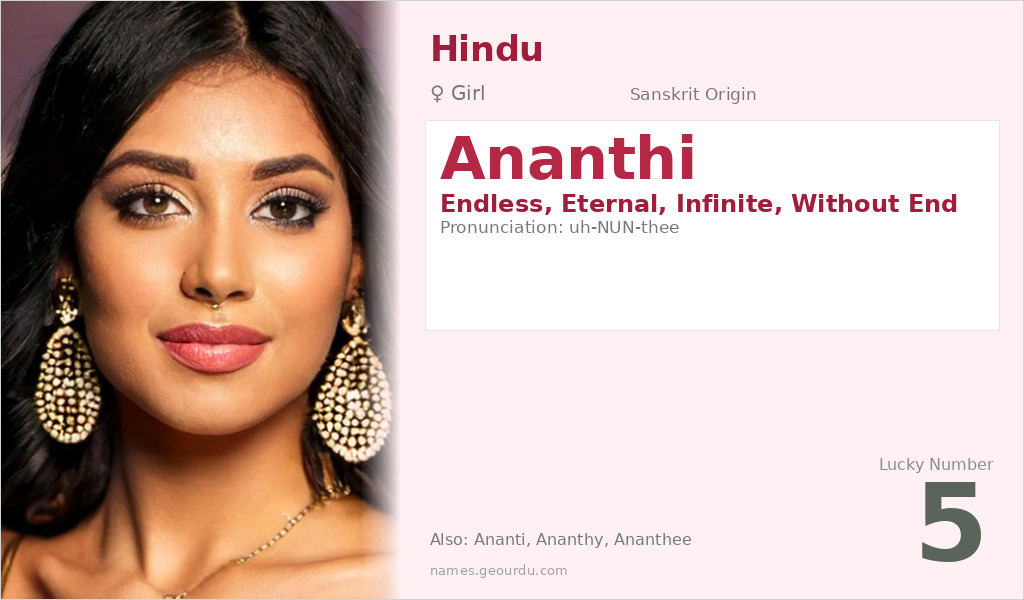
Ananthi is a beautiful and meaningful name of Sanskrit origin, predominantly used for girls in Hindu communities, especially in South India. Derived from the word ‘Ananta’, it carries the profound significance of ‘endless’ or ‘eternal’, reflecting timeless values and spiritual depth. This name connects to rich cultural traditions and mythological references, making it a popular choice for parents seeking a name with deep roots and positive connotations. Explore the etymology, usage, and personality traits associated with Ananthi in this comprehensive guide.
Meaning of Ananthi
Ananthi originates from the Sanskrit term ‘Ananta’, which is composed of the elements ‘an-‘ (meaning ‘not’ or ‘without’) and ‘anta’ (meaning ‘end’), resulting in the literal translation ‘without end’. This name signifies concepts of infinity, eternity, and boundlessness, often associated with divine attributes in Hindu philosophy. In linguistic context, it is the feminine form of Ananta, adapted into Dravidian languages like Tamil and Telugu, where it retains its original meaning. The name is deeply rooted in Hindu mythology, as Ananta is another name for Shesha, the cosmic serpent who supports the universe, symbolizing endless time and stability. This etymological background highlights the name’s spiritual and philosophical dimensions, making it a meaningful choice beyond mere aesthetics.
| 📛 Name | Ananthi |
| 💎 Meaning | Endless, Eternal, Infinite, Without End |
| 👤 Gender | Girl |
| 🕌 Religion | Hindu |
| 🌍 Origin | Sanskrit |
| 🗣 Pronunciation | uh-NUN-thee |
| ✍️ Urdu | اننتھی |
| ✍️ Arabic | أنانثي |
| 🔢 Numerology | 5 |
| ✨ Spellings | Ananti, Ananthy, Ananthee |
Origin & Cultural Significance
Ananthi has its origins in Sanskrit, an ancient Indo-Aryan language that is the liturgical language of Hinduism. It is widely used in South Indian states such as Tamil Nadu, Kerala, Karnataka, and Andhra Pradesh, where Sanskrit-derived names are common in Hindu naming traditions. Culturally, the name is often chosen for girls to invoke qualities of permanence, divinity, and auspiciousness, reflecting Hindu beliefs in eternal truths and cosmic order. Historically, names like Ananthi have been passed down through generations, maintaining their relevance in modern times while preserving classical linguistic heritage. The name’s usage extends beyond India to Hindu diaspora communities worldwide, where it continues to symbolize cultural identity and spiritual values.
Personality Traits
People named Ananthi are often described as imaginative and dynamic, with a natural inclination toward exploration and innovation. They may exhibit a philosophical mindset, pondering life’s infinite aspects, while also being sociable and adaptable in various situations. Their energetic and curious nature drives them to seek new experiences, making them well-suited for creative or adventurous pursuits that align with their name’s meaning of endless possibilities.
Similar Names
If you like Ananthi, consider: Ananta, Ananya, Anandi, Ananth, Anantika
Famous People Named Ananthi
- Ananthi — Indian actress known for Tamil television serials
- Ananthi — Tamil playback singer who has worked in South Indian cinema
Frequently Asked Questions About Ananthi
What does Ananthi mean?
Ananthi means 'Endless', 'Eternal', or 'Infinite', derived from the Sanskrit word 'Ananta', which combines 'an-' (without) and 'anta' (end).
Is Ananthi a boy or girl name?
Ananthi is primarily a girl's name, especially in Hindu communities in South India, where it is the feminine form of the Sanskrit name Ananta.
What is the origin of Ananthi?
Ananthi originates from Sanskrit, an ancient Indian language, and is commonly used in Hindu naming traditions, particularly in South Indian cultures like Tamil, Telugu, and Malayalam.