
Table of Contents
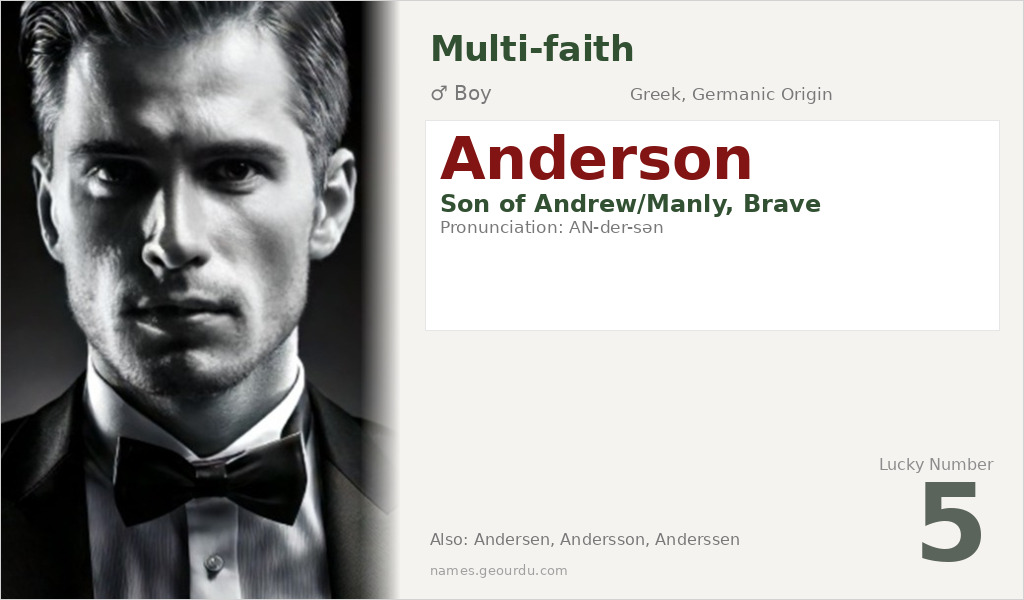
Anderson is a strong, classic name with deep historical roots, originally a surname that has become a popular given name worldwide. Derived from the Greek name Andrew, it carries connotations of bravery and masculinity. This name transcends religious boundaries, appearing in diverse cultures from Europe to the Americas. Its patronymic origin gives it a familial and enduring quality.
Meaning of Anderson
Anderson is a patronymic name meaning ‘son of Andrew.’ The name Andrew originates from the Greek Andreas, which stems from ‘aner’ (ἀνήρ), meaning ‘man’ or ‘manly.’ This Greek root implies qualities like bravery, strength, and warrior spirit. The ‘-son’ suffix is of Old English and Old Norse origin, commonly used in surnames to indicate lineage. Thus, Anderson literally translates to ‘son of the manly one,’ with ‘brave’ being a derived interpretation. The name’s meaning is well-documented in etymological sources, reflecting its linguistic journey from Greek to Germanic languages.
| 📛 Name | Anderson |
| 💎 Meaning | Son of Andrew/Manly, Brave |
| 👤 Gender | Boy |
| 🕌 Religion | Multi-faith |
| 🌍 Origin | Greek, Germanic |
| 🗣 Pronunciation | AN-der-sən |
| ✍️ Urdu | اینڈرسن |
| ✍️ Arabic | أندرسون |
| 🔢 Numerology | 5 |
| ✨ Spellings | Andersen, Andersson, Anderssen |
Origin & Cultural Significance
Anderson has its origins in Scotland and England as a surname, derived from the given name Andrew. It spread through Scandinavian influences (e.g., Andersen in Denmark/Norway) and later became a first name in English-speaking countries during the 19th century. The name is not tied to any specific religion; it is used by Christians, Muslims, Hindus, and others globally, often as a surname-turned-given-name. Its popularity increased in the United States and Latin America, where it is common in Brazil and other regions. Historically, it reflects the practice of using patronymics to denote family lineage.
Personality Traits
People named Anderson are often perceived as dynamic and courageous, reflecting the name’s etymological link to bravery. They may exhibit leadership qualities and a pioneering spirit, with an ability to adapt to changing circumstances. Their energetic nature often makes them sociable and open to new adventures, valuing independence and intellectual curiosity.
Similar Names
If you like Anderson, consider: Andrew, Anders, Alexander, Harrison, Jackson
Famous People Named Anderson
- Anderson Cooper — American journalist and TV host
- Anderson Silva — Brazilian mixed martial artist and former UFC champion
Frequently Asked Questions About Anderson
What does Anderson mean?
Anderson means 'son of Andrew,' with Andrew deriving from the Greek word for 'manly' or 'brave.' It is a patronymic name of Greek and Germanic origin.
Is Anderson a boy or girl name?
Anderson is traditionally a boy's name, originating as a masculine patronymic surname. It is rarely used for girls, though unisex usage is minimal.
What is the origin of Anderson?
Anderson originates from Scotland and England as a surname, with roots in Greek (via Andrew) and Germanic languages (via the '-son' suffix). It is now used globally as a given name.





