
Table of Contents
Anish is a classic and meaningful name with deep roots in Sanskrit and Hindu culture. Often chosen for boys, it carries connotations of supremacy and leadership, making it a popular choice among parents seeking a name with spiritual significance. This name has transcended its origins to gain international recognition through notable figures in arts and sports. In this guide, we explore the etymology, cultural context, and modern usage of the name Anish.
Meaning of Anish
The name Anish originates from the Sanskrit word ‘अनीश’ (anīśa), which is composed of two elements: ‘अ-‘ (a-), a negative prefix meaning ‘without’ or ‘not’, and ‘ईश’ (īśa), meaning ‘lord’, ‘master’, or ‘ruler’. Thus, the literal translation is ‘without a lord’ or ‘supreme’, indicating someone who has no superior. In Hindu mythology and scriptures, this term is used as an epithet for major deities like Vishnu, Shiva, and Krishna, highlighting their ultimate authority and divinity. The name has been used in Indian languages for centuries, maintaining its core meaning of excellence and preeminence. Linguistically, it is a straightforward compound that reflects the philosophical depth of Sanskrit naming traditions.
| 📛 Name | Anish |
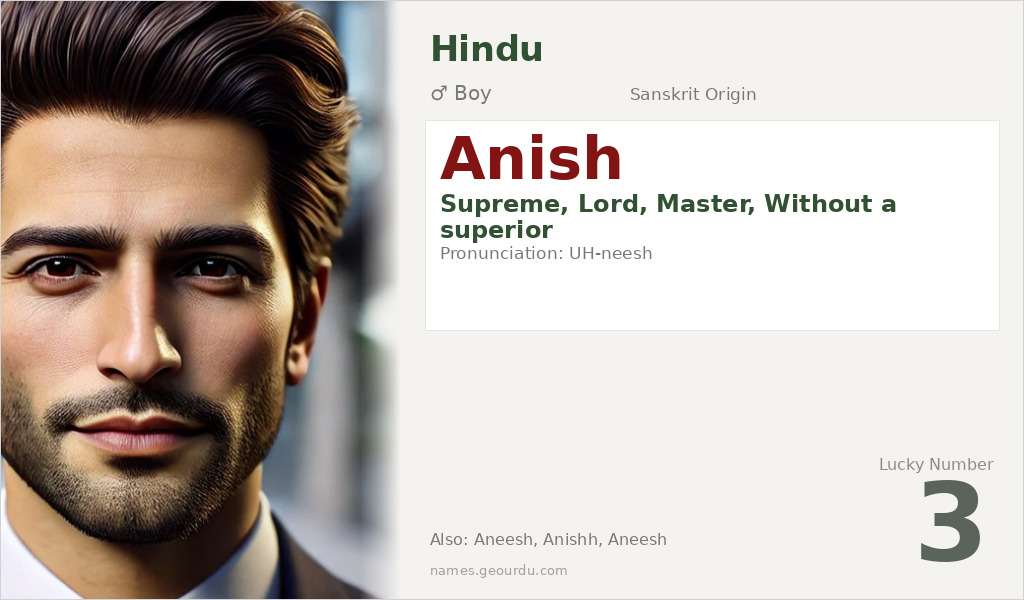
| 💎 Meaning | Supreme, Lord, Master, Without a superior |
| 👤 Gender | Boy |
| 🕌 Religion | Hindu |
| 🌍 Origin | Sanskrit |
| 🗣 Pronunciation | UH-neesh |
| ✍️ Urdu | انیش |
| ✍️ Arabic | أنيش |
| 🔢 Numerology | 3 |
| ✨ Spellings | Aneesh, Anishh, Aneesh, Anīś |
Origin & Cultural Significance
Anish has its origins in ancient Sanskrit, the classical language of India, and is deeply embedded in Hindu culture and religion. It is primarily used in India and among Hindu communities worldwide, including in countries like Nepal, Bangladesh, and the diaspora. The name’s association with deities underscores its spiritual significance, often chosen to invoke qualities of leadership and reverence. Over time, it has spread beyond religious contexts, appearing in modern settings through global figures like artist Anish Kapoor, showcasing its adaptability. Its usage remains most common in South Asia, but it has gained recognition internationally due to migration and cultural exchange.
Personality Traits
People named Anish are often seen as confident and assertive, with a natural inclination toward leadership roles. They tend to be intelligent and analytical, approaching challenges with thoughtfulness and determination. Their independent streak is balanced by a sense of responsibility, making them reliable and ambitious individuals in both personal and professional spheres.
Similar Names
If you like Anish, consider: Aarav, Arjun, Ishaan, Vishnu, Dev, Aryan, Rohan, Krishna, Shiva, Aditya
Famous People Named Anish
- Anish Kapoor — British-Indian sculptor known for public artworks like 'Cloud Gate' in Chicago
- Anish Giri — Dutch chess grandmaster of Nepalese descent
Frequently Asked Questions About Anish
What does Anish mean?
Anish means 'supreme', 'lord', or 'without a superior' in Sanskrit, derived from the words 'a-' (without) and 'īśa' (lord).
Is Anish a boy or girl name?
Anish is traditionally a boy's name in Hindu and Indian cultures, though it is rarely used for girls.
What is the origin of Anish?
Anish originates from Sanskrit, an ancient Indian language, and is deeply rooted in Hindu tradition and mythology.





