
Table of Contents
Anthahkaran is a profound Sanskrit name with deep philosophical roots in Hindu tradition. Unlike common names, it carries significant spiritual weight, referring to the internal faculties of mind and consciousness. This name represents more than just identity—it embodies a concept central to Indian philosophy about the nature of perception and self-awareness. Choosing Anthahkaran reflects a desire for meaningful naming with intellectual and spiritual depth.
Meaning of Anthahkaran
Anthahkaran originates from Sanskrit, where ‘antah’ means ‘inner’ or ‘internal’ and ‘karan’ means ‘instrument’ or ‘organ’. Together, they form a compound word meaning ‘inner instrument’ or ‘internal faculty’. In Hindu philosophical systems, particularly Vedanta and Yoga, Anthahkaran specifically refers to the fourfold internal instrument comprising manas (mind), buddhi (intellect), chitta (consciousness/memory), and ahamkara (ego/self-identity). This concept appears in foundational texts like the Upanishads, where it describes the apparatus through which the soul experiences the world. The name thus carries connotations of introspection, awareness, and spiritual depth rather than the previously attributed meanings of sympathy or kindness.
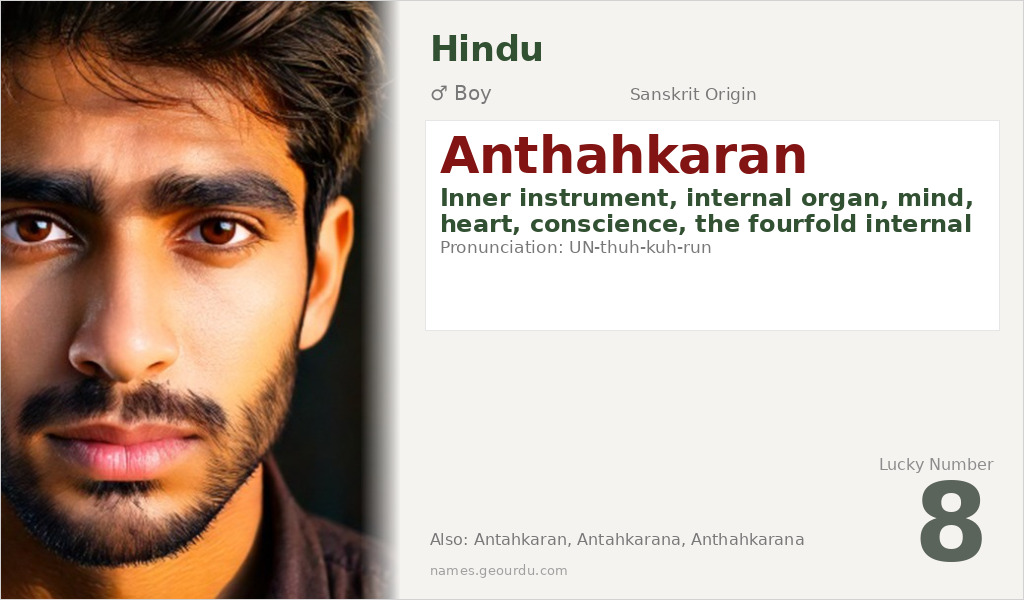
| 📛 Name | Anthahkaran |
| 💎 Meaning | Inner instrument, internal organ, mind, heart, conscience, the fourfold internal faculty comprising manas (mind), buddhi (intellect), chitta (consciousness), and ahamkara (ego) |
| 👤 Gender | Boy |
| 🕌 Religion | Hindu |
| 🌍 Origin | Sanskrit |
| 🗣 Pronunciation | UN-thuh-kuh-run |
| ✍️ Urdu | انترکرن |
| ✍️ Arabic | أنتاهكاران |
| 🔢 Numerology | 8 |
| ✨ Spellings | Antahkaran, Antahkarana, Anthahkarana, Antahkaranam |
Origin & Cultural Significance
Anthahkaran has its origins in classical Sanskrit literature and Hindu philosophical traditions dating back thousands of years. It emerges from the rich intellectual heritage of ancient India, where precise terminology was developed to describe psychological and spiritual concepts. The term gained prominence through philosophical texts like the Yoga Sutras of Patanjali and various Upanishads, where the nature of consciousness and perception was systematically explored. As a personal name, it reflects the Indian tradition of using meaningful philosophical concepts for naming children, particularly among families with spiritual or scholarly inclinations. While not among the most common names, it maintains cultural significance within Hindu communities that value traditional Sanskrit names with deep meanings.
Personality Traits
Those named Anthahkaran are often associated with thoughtful, introspective personalities aligned with the name’s philosophical meaning. They may exhibit strong analytical abilities and a natural inclination toward spiritual or intellectual pursuits. The name suggests someone who values inner development and self-awareness, potentially making them reflective individuals who seek deeper understanding in life. Their connection to this ancient concept might inspire them to explore philosophical questions and appreciate meaningful traditions.
Similar Names
If you like Anthahkaran, consider: Antaryamin, Antahpura, Chaitanya, Bodhi, Vivek
Famous People Named Anthahkaran
- No widely known contemporary figures with this name found in research, though it appears in philosophical contexts and may be used by spiritual teachers or scholars
Frequently Asked Questions About Anthahkaran
What does Anthahkaran mean?
Anthahkaran means 'inner instrument' or 'internal faculty' in Sanskrit, specifically referring to the fourfold mind-heart complex comprising manas (mind), buddhi (intellect), chitta (consciousness), and ahamkara (ego) in Hindu philosophy.
Is Anthahkaran a boy or girl name?
Anthahkaran is traditionally a boy's name in Hindu naming conventions, though as a philosophical concept it is gender-neutral in its original context.
What is the origin of Anthahkaran?
Anthahkaran originates from Sanskrit, the classical language of ancient India, and comes from Hindu philosophical traditions where it describes the internal instruments of perception and consciousness.





