
Table of Contents
Arshavant is a distinctive and rare name that carries an air of majesty and authority. Often chosen for boys, it sparks curiosity with its unique sound and potential roots in ancient languages. While not widely documented, it evokes imagery of thrones and divine power, making it a compelling choice for parents seeking a name with depth. This article delves into the possible origins, meanings, and cultural nuances of Arshavant.
Meaning of Arshavant
The meaning of Arshavant is not firmly established in linguistic sources, but analysis suggests it may derive from Persian or regional languages. The prefix ‘Arsh’ comes from Arabic and Persian, meaning ‘throne,’ often associated with celestial or divine authority in Islamic and Persian traditions. The suffix ‘-avant’ could relate to Persian or Sanskrit elements indicating possession, such as ‘-vant’ in Sanskrit meaning ‘having’ or ‘full of.’ Thus, Arshavant might loosely translate to ‘throne-like’ or ‘majestic,’ though this interpretation lacks verification in authoritative dictionaries. It is possible the name is a modern compound or regional variant without historical usage.
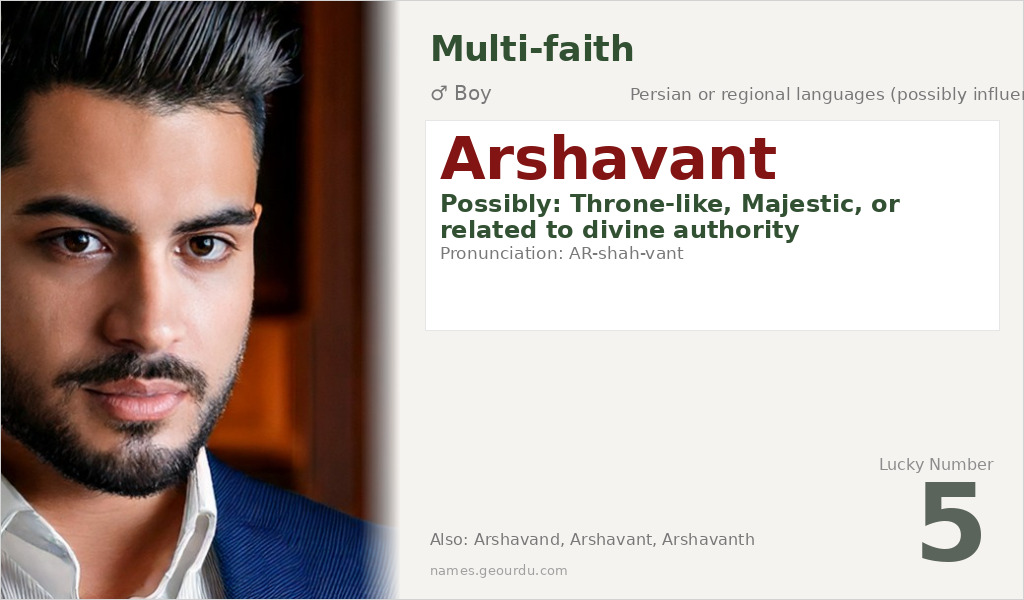
| 📛 Name | Arshavant |
| 💎 Meaning | Possibly: Throne-like, Majestic, or related to divine authority |
| 👤 Gender | Boy |
| 🕌 Religion | Multi-faith |
| 🌍 Origin | Persian or regional languages (possibly influenced by Arabic/Sanskrit) |
| 🗣 Pronunciation | AR-shah-vant |
| ✍️ Urdu | ارشونت |
| ✍️ Arabic | أرشافانت |
| 🔢 Numerology | 5 |
| ✨ Spellings | Arshavand, Arshavant, Arshavanth |
Origin & Cultural Significance
Arshavant likely originates from Persian or regional languages influenced by Arabic and Sanskrit. In Persian culture, names incorporating ‘Arsh’ reflect themes of sovereignty and spirituality, such as in the name Arshad (meaning ‘most righteous’). The name may also appear in regional dialects or tribal languages, though no specific community claims it as traditional. Its multi-faith potential stems from the cross-cultural use of ‘throne’ imagery in Islamic, Persian, and even Hindu contexts (e.g., Sanskrit ‘simhasana’ for throne). However, it is not tied exclusively to any one religion, allowing for broad cultural adoption.
Personality Traits
Those named Arshavant are often seen as natural leaders with a commanding presence. They tend to be innovative and resourceful, embracing change with confidence. While they may project strength, they also value introspection and personal growth, balancing authority with empathy.
Similar Names
If you like Arshavant, consider: Arshad, Arsham, Arshan, Arshia, Arsh
Famous People Named Arshavant
- No widely known public figures with this name found in records
Frequently Asked Questions About Arshavant
What does Arshavant mean?
The meaning is unverified, but it may derive from Persian 'Arsh' (throne) and a suffix like '-avant,' possibly meaning 'throne-like' or 'majestic.'
Is Arshavant a boy or girl name?
Arshavant is primarily used as a boy's name, based on cultural naming patterns in regions where it appears.
What is the origin of Arshavant?
The origin is likely Persian or regional languages, with influences from Arabic and Sanskrit, though it is not well-documented in historical sources.





