Table of Contents
Arsia is a name rich with regal symbolism and spiritual depth, originating from the Arabic word for ‘Throne.’ While traditionally feminine in its linguistic roots, this name has crossed gender boundaries in various Muslim cultures, carrying connotations of authority, elevation, and divine connection. Its usage spans centuries and regions, from the Middle East to South Asia, where it continues to be chosen for its powerful meaning and elegant sound.
Meaning of Arsia
The name Arsia derives directly from the Arabic noun ‘Arsh’ (عرش), meaning throne, seat of power, or elevated platform. In Islamic theology, ‘Arsh’ holds profound significance as it refers to the Throne of God, mentioned in multiple Quranic verses (such as 2:255, 7:54, 20:5) as the ultimate symbol of divine sovereignty and majesty. The feminine suffix ‘-ia’ transforms the word into a personal name, literally meaning ‘belonging to the throne’ or ‘throne-like.’ This etymology connects Arsia to concepts of authority, protection, and spiritual elevation across Semitic language traditions, with cognates found in Hebrew (Aron for Ark) and Aramaic.
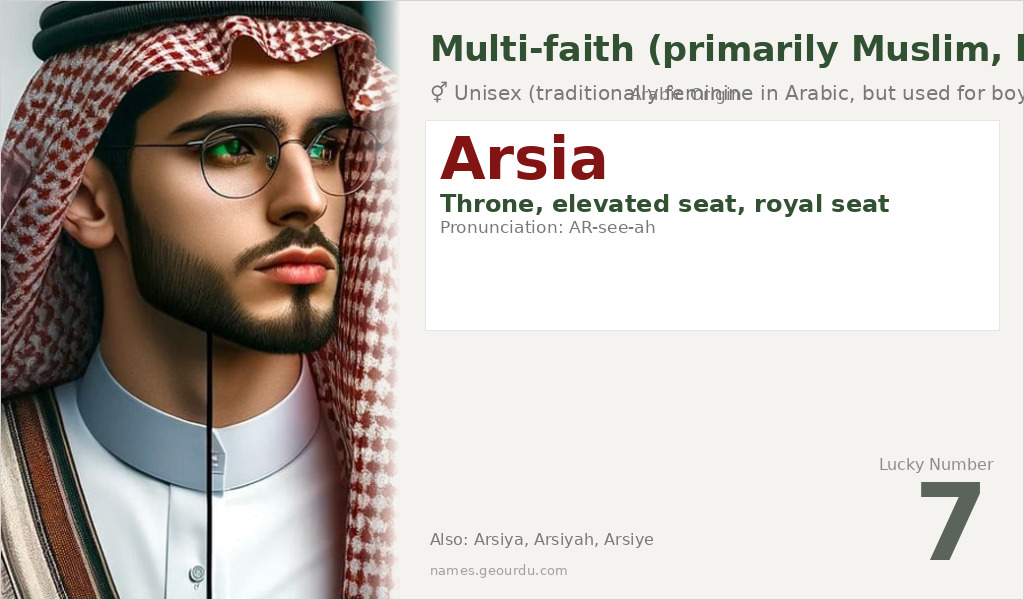
| 📛 Name | Arsia |
| 💎 Meaning | Throne, elevated seat, royal seat |
| 👤 Gender | Unisex (traditionally feminine in Arabic, but used for boys in some Muslim cultures) |
| 🕌 Religion | Multi-faith (primarily Muslim, but also used in other Abrahamic traditions) |
| 🌍 Origin | Arabic |
| 🗣 Pronunciation | AR-see-ah |
| ✍️ Urdu | عرسیہ |
| ✍️ Arabic | عرسية |
| 🔢 Numerology | 7 |
| ✨ Spellings | Arsiya, Arsiyah, Arsiye, Arsiyeh |
Origin & Cultural Significance
Arsia originates from Classical Arabic and entered wider usage through Islamic cultural expansion. While the base word ‘Arsh’ appears in pre-Islamic Arabic poetry, its religious significance solidified with the Quran’s revelation. The name spread through Persian, Turkish, and Urdu adaptations as Islam expanded across Asia. In some regions like Afghanistan and Pakistan, Arsia has been adopted as a masculine name despite its feminine grammatical form in Arabic—a common phenomenon in cross-cultural naming practices. Historical records show usage among both royalty and common people, reflecting its appeal across social strata.
Personality Traits
Those named Arsia often embody the dignified qualities suggested by their name’s meaning. They tend to be natural leaders with a calm, authoritative presence and strong moral compass. Many display spiritual depth, intellectual curiosity, and a protective nature toward loved ones. The throne symbolism may manifest as organizational skills, strategic thinking, and the ability to handle responsibility with grace under pressure.
Similar Names
If you like Arsia, consider: Arsh, Arshad, Arshan, Arshiya, Arshia
Famous People Named Arsia
- Arsia I of Persia — Ancient Persian ruler from the Achaemenid dynasty
- Arsia Barqi — Contemporary Afghan poet and writer
Frequently Asked Questions About Arsia
What does Arsia mean?
Arsia means 'Throne' or 'royal seat,' derived from the Arabic word 'Arsh' (عرش). It specifically references the Throne of God in Islamic tradition, symbolizing divine authority and sovereignty.
Is Arsia a boy or girl name?
Arsia is linguistically feminine in Arabic but is used for both boys and girls in different Muslim cultures. In Arabic-speaking regions, it's primarily feminine, while in South Asia and some Persian-influenced areas, it's sometimes given to boys.
What is the origin of Arsia?
Arsia originates from Classical Arabic, with the root word 'Arsh' appearing in pre-Islamic poetry and gaining profound religious significance in the Quran. The name spread through Islamic cultural expansion to Persian, Turkish, Urdu, and other languages.