
Table of Contents
Arsin is a powerful masculine name with deep roots in Central Asian and Iranian tribal cultures. Primarily used among Pashtun and Baloch communities, this name carries connotations of strength, bravery, and leadership. While not as widely known globally as some Arabic names, it holds significant cultural importance in regions where it originates. Understanding Arsin requires exploring the rich linguistic traditions of Pashto and Balochi languages.
Meaning of Arsin
The name Arsin derives from the Pashto and Balochi word ‘Arsalan’ or ‘Arslan’, which directly translates to ‘lion’. In these languages, the root ‘ars’ signifies lion-like qualities including courage, strength, and nobility. This etymology connects Arsin to a broader family of names across Turkic and Iranian languages that reference lions, such as Aslan in Turkish and Sher in Persian/Urdu. The name specifically emphasizes the protective and brave characteristics associated with lions in Central Asian cultural symbolism. While sometimes simplified as ‘warrior’ or ‘fighter’, the more precise meaning is ‘lion-like’ or ‘possessing lion qualities’.
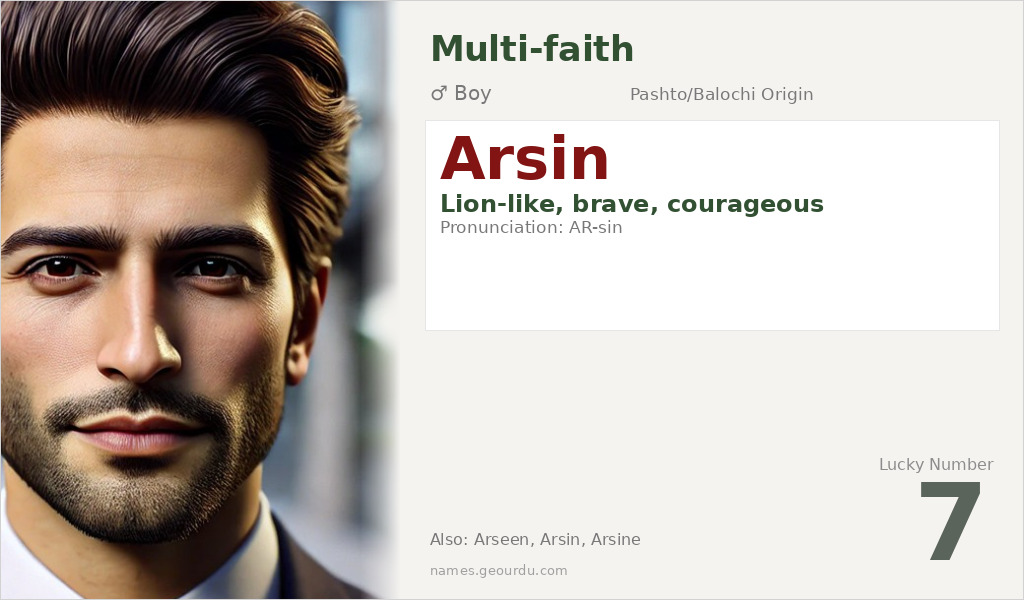
| 📛 Name | Arsin |
| 💎 Meaning | Lion-like, brave, courageous |
| 👤 Gender | Boy |
| 🕌 Religion | Multi-faith |
| 🌍 Origin | Pashto/Balochi |
| 🗣 Pronunciation | AR-sin |
| ✍️ Urdu | ارسن |
| ✍️ Arabic | أرسن |
| 🔢 Numerology | 7 |
| ✨ Spellings | Arseen, Arsin, Arsine, Arsyn |
Origin & Cultural Significance
Arsin originates from the Pashto and Balochi languages spoken primarily in Afghanistan, Pakistan, and Iran. It is particularly common among Pashtun tribes and Baloch communities, where names referencing animals—especially powerful ones like lions—are traditional. The name reflects the nomadic and tribal heritage of these groups, where strength and bravery were highly valued traits. While sometimes used by Muslims in these regions, it is not exclusively Islamic and appears across different religious communities within Pashtun and Baloch populations. The name has maintained its popularity in these cultural contexts while remaining relatively uncommon outside Central Asia.
Personality Traits
Those named Arsin are often associated with leadership qualities and protective instincts. The lion symbolism suggests someone who is courageous in facing challenges and loyal to their family or community. This name tends to be given with the hope that the child will grow up to be strong, respected, and capable of providing protection. The personality traits connected to Arsin reflect the cultural values of the communities where it originates, emphasizing physical and moral strength.
Similar Names
If you like Arsin, consider: Arslan, Arsalan, Aslan, Sher, Haider
Famous People Named Arsin
- Arsin Khan — Pakistani cricketer from Khyber Pakhtunkhwa
- Arsin Naz — Afghan singer and musician
Frequently Asked Questions About Arsin
What does Arsin mean?
Arsin means 'lion-like', 'brave', or 'courageous' in Pashto and Balochi languages, derived from the word 'Arsalan' meaning lion.
Is Arsin a boy or girl name?
Arsin is exclusively a masculine name in all cultural contexts where it is used, particularly among Pashtun and Baloch communities.
What is the origin of Arsin?
Arsin originates from Pashto and Balochi languages spoken in Afghanistan, Pakistan, and Iran, with strong connections to Pashtun and Baloch tribal naming traditions.





