
Table of Contents
Asadi is a powerful Arabic name steeped in animal symbolism and cultural heritage. Meaning ‘lion-like’ or ‘belonging to the lion,’ this name carries connotations of strength, courage, and nobility. Used across various Middle Eastern cultures and religious communities, Asadi represents more than just a personal identifier—it connects bearers to the majestic qualities of the king of beasts. From medieval Persian poets to modern-day bearers, this name has maintained its symbolic potency across centuries.
Meaning of Asadi
The name Asadi derives directly from classical Arabic, combining ‘asad’ (أسد), meaning lion, with the attributive suffix ‘-i’ (ي). This linguistic construction creates what Arabic grammarians call a nisba—a form indicating relationship, origin, or characteristic. Literally translated, Asadi means ‘of the lion,’ ‘belonging to the lion,’ or ‘lion-like.’ The lion has profound symbolic significance in Arabic and Islamic cultures, representing courage, strength, leadership, and nobility. This naming pattern is common in Semitic languages, where animal characteristics are attributed to individuals through such descriptive formations. The name’s etymology is well-documented in classical Arabic dictionaries and linguistic sources.
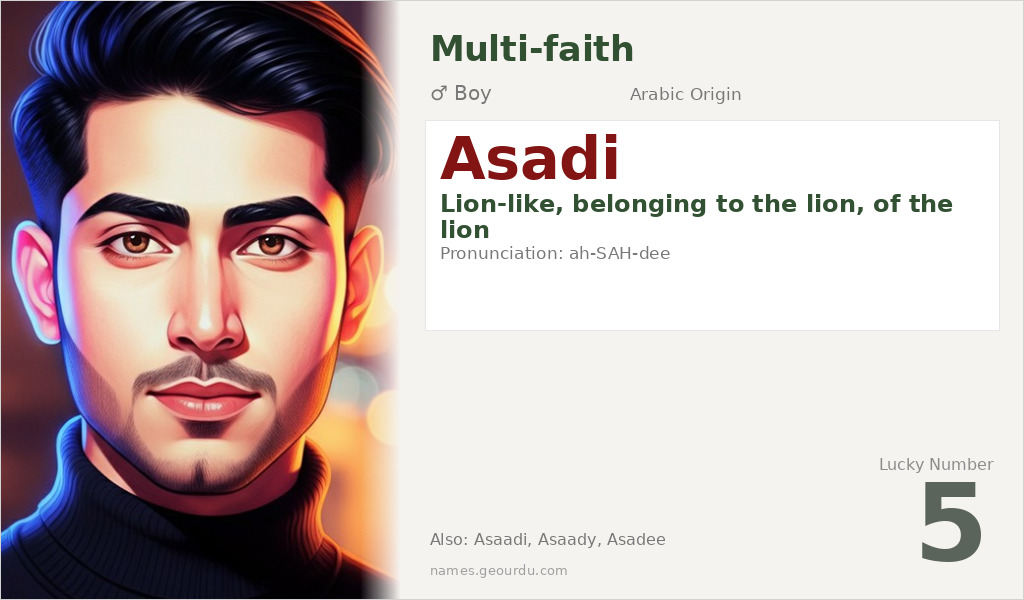
| 📛 Name | Asadi |
| 💎 Meaning | Lion-like, belonging to the lion, of the lion |
| 👤 Gender | Boy |
| 🕌 Religion | Multi-faith |
| 🌍 Origin | Arabic |
| 🗣 Pronunciation | ah-SAH-dee |
| ✍️ Urdu | اسدی |
| ✍️ Arabic | أسدي |
| 🔢 Numerology | 5 |
| ✨ Spellings | Asaadi, Asaady, Asadee, Assadi |
Origin & Cultural Significance
Asadi originates from Arabic linguistic traditions but has been adopted across various cultures in the Middle East and South Asia. While commonly used in Muslim communities, it also appears among Arabic-speaking Christians and other religious groups in the region. The name gained particular prominence through historical figures like Asadi Tusi, the 11th-century Persian poet whose work helped shape classical Persian literature. In tribal contexts, ‘-i’ endings often denoted clan or tribal affiliation, though Asadi functions more as a characteristic name than a tribal identifier. The name’s usage spans from North Africa through the Arabian Peninsula to Persian and Urdu-speaking regions, demonstrating the widespread appeal of lion symbolism across cultures.
Personality Traits
Names carrying animal symbolism often influence perceived personality traits, and Asadi is no exception. Bearers of this name are frequently associated with leonine qualities: courage in facing challenges, strength of character, and natural leadership abilities. The lion symbolism suggests a protective nature, particularly toward family and community. While individual personalities vary, the name’s meaning creates expectations of dignity, confidence, and the ability to command respect in social and professional settings.
Similar Names
If you like Asadi, consider: Asad, Haider, Hamza, Laith, Usama
Famous People Named Asadi
- Asadi Tusi — 11th century Persian poet and author of the Garshaspnama epic
- Asadi of Tus — Medieval Persian poet known for his literary debates and contributions to Persian literature
Frequently Asked Questions About Asadi
What does Asadi mean?
Asadi means 'lion-like,' 'belonging to the lion,' or 'of the lion' in Arabic. It derives from 'asad' (lion) with the attributive suffix '-i' indicating association or characteristic.
Is Asadi a boy or girl name?
Asadi is exclusively a masculine name in all cultural contexts where it's used. The '-i' ending in Arabic names typically indicates masculine attribution, and there are no recorded feminine usages of this specific form.
What is the origin of Asadi?
Asadi originates from classical Arabic language and naming traditions. While most commonly associated with Arabic-speaking cultures, it has been adopted in Persian, Urdu, and other languages influenced by Arabic linguistic and cultural traditions.





