
Table of Contents
Ashwatthama is a powerful Sanskrit name steeped in Hindu mythology and epic history. Derived from ancient Indian roots, this name carries the distinctive meaning of ‘horse-voiced’ or ‘possessing a horse’s voice’. Most famously associated with the legendary warrior from the Mahabharata, Ashwatthama represents strength, immortality, and complex mythological legacy.
Meaning of Ashwatthama
The name Ashwatthama originates from Sanskrit, combining two elements: ‘ashva’ (अश्व) meaning ‘horse’ and ‘sthaman’ (स्थमन्) meaning ‘voice’ or ‘sound’. This creates the literal translation ‘horse-voiced’ or ‘one whose voice resembles a horse’s neigh’. In Sanskrit linguistics, compound names like this were common in ancient India, often describing physical characteristics or qualities. The name appears in the Mahabharata, one of India’s great epics, where it belongs to the son of Dronacharya. Unlike many modern interpretations, the name’s meaning is specifically about vocal quality rather than parentage or abstract concepts.
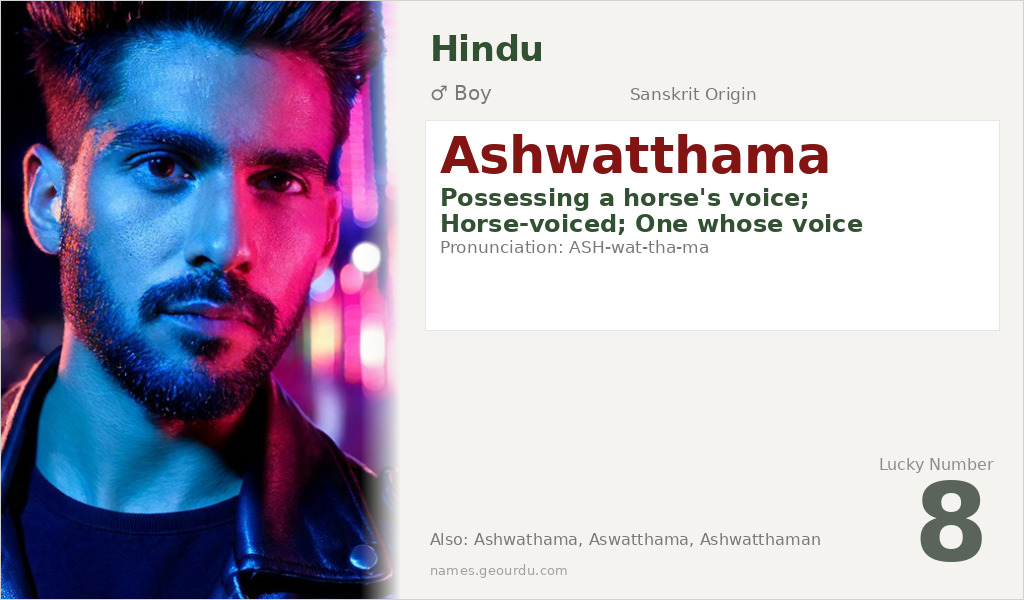
| 📛 Name | Ashwatthama |
| 💎 Meaning | Possessing a horse's voice; Horse-voiced; One whose voice resembles a horse's neigh |
| 👤 Gender | Boy |
| 🕌 Religion | Hindu |
| 🌍 Origin | Sanskrit |
| 🗣 Pronunciation | ASH-wat-tha-ma |
| ✍️ Urdu | اشوتھاما |
| ✍️ Arabic | أشواتاما |
| 🔢 Numerology | 8 |
| ✨ Spellings | Ashwathama, Aswatthama, Ashwatthaman |
Origin & Cultural Significance
Ashwatthama has its origins in ancient Sanskrit literature and Hindu mythology, specifically appearing in the Mahabharata epic composed around 400 BCE-400 CE. The name belongs to a central character who was the son of Dronacharya (the royal guru) and Kripi. In the cultural context, names describing physical attributes were common in ancient India. Ashwatthama’s mythological significance includes his birth with a gem on his forehead, his role as a formidable warrior in the Kurukshetra War, and his curse of immortality. The name remains primarily associated with Hindu tradition and Sanskrit heritage, though it’s rarely used as a contemporary given name due to the character’s morally complex legacy.
Personality Traits
Those named Ashwatthama are often perceived as strong-willed and resilient individuals, reflecting the mythological warrior’s enduring nature. The name suggests someone with a powerful presence and vocal strength, literally meaning ‘horse-voiced’. However, the mythological association also carries connotations of complexity—Ashwatthama was both a brilliant warrior and a figure who committed controversial acts, suggesting a personality with both great strengths and challenging flaws.
Similar Names
If you like Ashwatthama, consider: Arjuna, Bhishma, Duryodhana, Karna, Yudhishthira
Famous People Named Ashwatthama
- Ashwatthama (Mahabharata) — Legendary warrior in Hindu epic Mahabharata, son of Dronacharya and Kripi, known for his immortality and role in the Kurukshetra War
- Ashwatthama (modern usage) — Occasionally used as a given name in Hindu communities, though rare due to the mythological character's complex legacy
Frequently Asked Questions About Ashwatthama
What does Ashwatthama mean?
Ashwatthama means 'horse-voiced' or 'possessing a horse's voice' in Sanskrit, from 'ashva' (horse) and 'sthaman' (voice).
Is Ashwatthama a boy or girl name?
Ashwatthama is exclusively a boy's name, originating from the male mythological warrior in the Hindu epic Mahabharata.
What is the origin of Ashwatthama?
Ashwatthama originates from Sanskrit language and Hindu mythology, specifically from the ancient Indian epic Mahabharata where it belongs to the son of Dronacharya.





