
Table of Contents
Asmit is a profound Sanskrit name for boys that carries deep philosophical significance in Hindu tradition. Meaning ‘selfhood’ or ‘individuality’, this name reflects the essence of personal identity and consciousness. Popular in India and among Hindu communities worldwide, Asmit represents both spiritual awareness and modern individuality. With its roots in ancient Sanskrit texts, this name bridges traditional wisdom with contemporary values.
Meaning of Asmit
The name Asmit originates from the Sanskrit word ‘asmitā’ (अस्मिता), which literally translates to ‘I-am-ness’ or ‘selfhood’. This term is central to Indian philosophy, particularly in Yoga and Vedanta traditions, where it denotes the sense of individual ego or personal identity. The word is composed of ‘asmi’ (अस्मि), meaning ‘I am’—the first person singular present tense of the verb ‘to be’—combined with the abstract noun suffix ‘-tā’. While in philosophical contexts ‘asmitā’ can refer to the ego as an obstacle to enlightenment, as a personal name it carries positive connotations of self-awareness, confidence, and individuality. The name embodies the concept of recognizing one’s true self beyond mere physical existence.
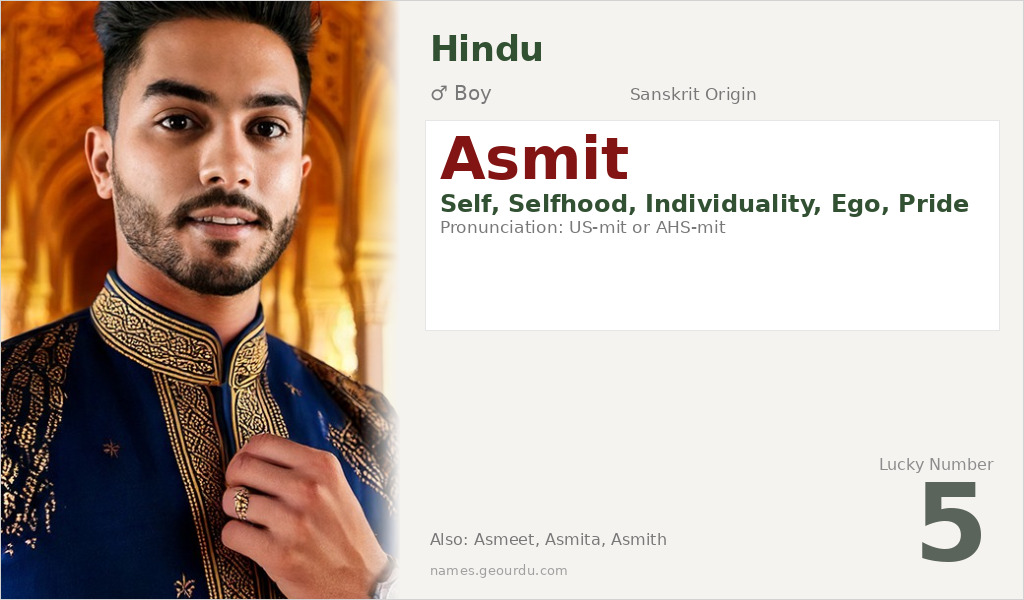
| 📛 Name | Asmit |
| 💎 Meaning | Self, Selfhood, Individuality, Ego, Pride |
| 👤 Gender | Boy |
| 🕌 Religion | Hindu |
| 🌍 Origin | Sanskrit |
| 🗣 Pronunciation | US-mit or AHS-mit |
| ✍️ Urdu | اسمیت |
| ✍️ Arabic | أسميت |
| 🔢 Numerology | 5 |
| ✨ Spellings | Asmeet, Asmita, Asmith |
Origin & Cultural Significance
Asmit has its origins in classical Sanskrit, the ancient liturgical language of Hinduism, Buddhism, and Jainism. The term ‘asmitā’ appears in foundational texts like Patanjali’s Yoga Sutras (circa 2nd century BCE to 4th century CE), where it is classified as one of the five kleshas or afflictions of the mind. Despite this philosophical context, the name Asmit has been adopted in modern Hindu naming traditions with a positive interpretation, emphasizing healthy self-identity rather than excessive ego. It is particularly popular in India, Nepal, and among the Hindu diaspora, reflecting the ongoing relevance of Sanskrit concepts in contemporary culture. The name represents how ancient philosophical terms can be repurposed as meaningful personal identifiers in modern times.
Personality Traits
Those named Asmit typically exhibit strong self-awareness and independent thinking. They are often natural leaders who value their individuality while maintaining respect for tradition. Their philosophical bent makes them introspective and spiritually curious, often seeking deeper meaning in life experiences. While confident in their identity, they also demonstrate adaptability and openness to new perspectives.
Similar Names
If you like Asmit, consider: Aham, Atman, Swaraj, Abhiman, Garima
Famous People Named Asmit
- Asmit Patel — Indian television actor known for roles in Hindi TV series
- Asmita Sood — Indian actress and model in Bollywood and television
Frequently Asked Questions About Asmit
What does Asmit mean?
Asmit means 'Self', 'Selfhood', 'Individuality', or 'Ego' in Sanskrit. It comes from the word 'asmitā' (अस्मिता) meaning 'I-am-ness' or the sense of personal identity.
Is Asmit a boy or girl name?
Asmit is primarily a masculine name in Hindu naming traditions, though the feminine form 'Asmita' is also common. The name is almost exclusively used for boys in contemporary practice.
What is the origin of Asmit?
Asmit originates from Sanskrit, the ancient classical language of India. It derives from the philosophical term 'asmitā' found in Hindu texts like the Yoga Sutras of Patanjali.





