
Table of Contents
Asokan is a distinguished name with deep roots in Indian history and Sanskrit tradition. Derived from the famous Emperor Ashoka, this name carries profound meaning and cultural significance. Whether you’re considering this name for your child or researching its background, understanding its rich heritage provides valuable insight into its enduring appeal across generations.
Meaning of Asokan
The name Asokan originates from the Sanskrit word Ashoka, which combines ‘a-‘ (meaning ‘without’ or ‘not’) with ‘shoka’ (meaning ‘sorrow’ or ‘grief’). This creates the beautiful meaning ‘without sorrow’ or ‘free from grief’. The name gained historical prominence through Emperor Ashoka of the Maurya Dynasty, who ruled from approximately 268 to 232 BCE. After witnessing the devastation of the Kalinga War, Ashoka embraced Buddhism and became known for his peaceful reign and propagation of dharma. The Tamil/South Indian variant Asokan preserves this classical meaning while adapting to regional linguistic conventions, maintaining the name’s philosophical depth across different Indian languages.
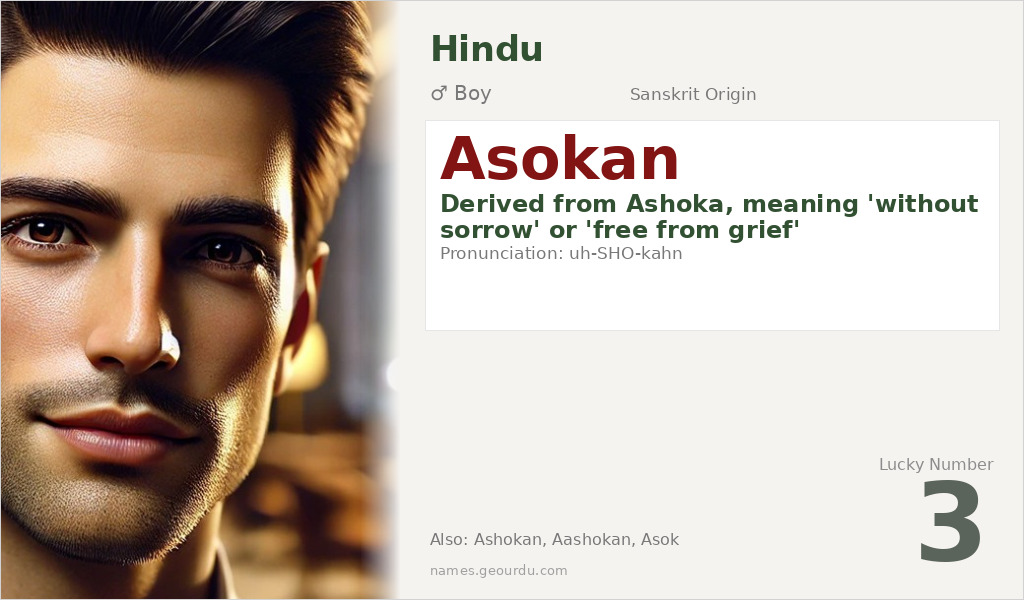
| 📛 Name | Asokan |
| 💎 Meaning | Derived from Ashoka, meaning 'without sorrow' or 'free from grief' |
| 👤 Gender | Boy |
| 🕌 Religion | Hindu |
| 🌍 Origin | Sanskrit |
| 🗣 Pronunciation | uh-SHO-kahn |
| ✍️ Urdu | اشوکن |
| ✍️ Arabic | أشوكان |
| 🔢 Numerology | 3 |
| ✨ Spellings | Ashokan, Aashokan, Asok, Ashok |
Origin & Cultural Significance
Asokan has its origins in classical Sanskrit, one of the oldest Indo-European languages with documented literature dating back over 3,500 years. The name became culturally significant through Emperor Ashoka, whose reign marked a turning point in Indian history as he transformed from a conqueror to a benevolent ruler promoting non-violence and social welfare. While the name is predominantly used in Hindu communities, it also appears among Jains and Buddhists due to Ashoka’s historical association with these traditions. In contemporary usage, Asokan is particularly common in South Indian states like Tamil Nadu, Kerala, and Karnataka, where it represents both cultural heritage and aspirational qualities of peace and resilience.
Personality Traits
Those named Asokan are often perceived as individuals with strong moral character and emotional intelligence. They typically exhibit qualities of wisdom, compassion, and resilience—traits that reflect the name’s meaning of being ‘without sorrow’. Many Asokans demonstrate natural leadership abilities combined with a thoughtful, philosophical approach to life’s challenges, making them respected figures in their communities and professions.
Similar Names
If you like Asokan, consider: Ashoka, Ashok, Ashwin, Arjun, Anand
Famous People Named Asokan
- Asokan (Indian film actor) — Popular Malayalam film actor known for his roles in over 200 films since the 1980s
- Asokan (Tamil actor) — Indian actor who has appeared in Tamil and Malayalam films
Frequently Asked Questions About Asokan
What does Asokan mean?
Asokan means 'without sorrow' or 'free from grief', derived from the Sanskrit elements 'a-' (without) and 'shoka' (sorrow).
Is Asokan a boy or girl name?
Asokan is exclusively a boy's name in all cultural contexts where it is used, particularly in Hindu naming traditions.
What is the origin of Asokan?
Asokan originates from Sanskrit, specifically as a derivative of the name Ashoka, and is most commonly used in South Indian Hindu communities.





