
Table of Contents
Atma is a profound name that transcends mere labeling, embodying the essence of spiritual identity in Hindu tradition. Derived from ancient Sanskrit, it captures the concept of the eternal soul or true self, central to philosophies like Vedanta. This name invites a journey into self-discovery and philosophical depth, making it a timeless choice for those valuing spiritual heritage.
Meaning of Atma
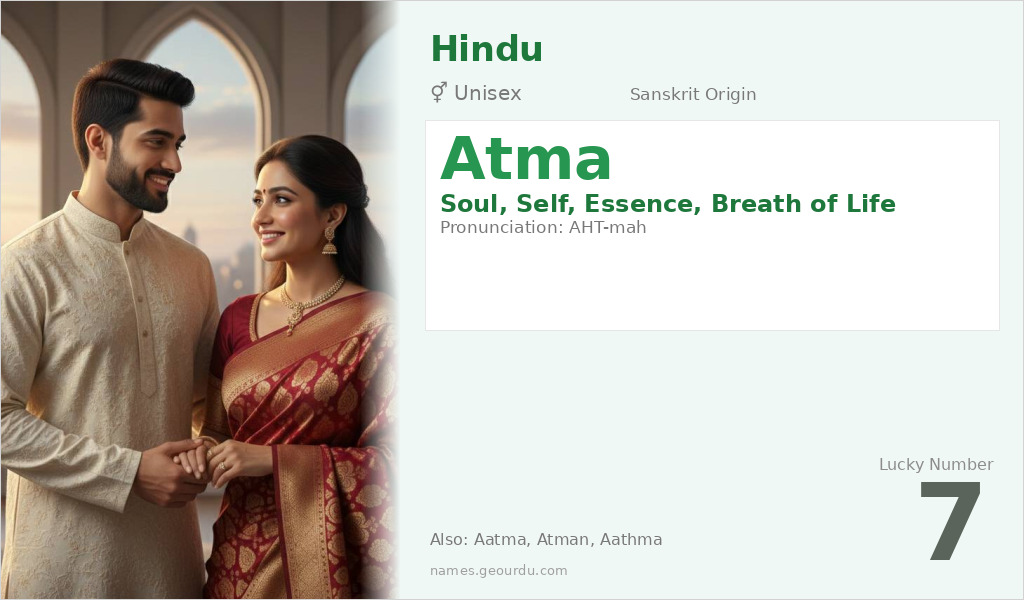
Atma (आत्मा) is a Sanskrit term meaning ‘soul’, ‘self’, ‘essence’, or ‘breath of life’. Its etymology traces back to the Proto-Indo-European root *h₁eh₁tmṓ, which signifies ‘breath’ or ‘spirit’, evolving into the Sanskrit word ‘ātman’ (आत्मन्). In Hindu scriptures, such as the Upanishads, Atman represents the innermost self that is identical with Brahman, the universal consciousness. This concept is foundational to Indian spirituality, emphasizing the eternal and indivisible nature of the soul. Linguistically, it shares roots with other Indo-European words like German ‘Atem’ (breath) and Greek ‘atmós’ (vapor), highlighting its ancient connection to life force.
| 📛 Name | Atma |
| 💎 Meaning | Soul, Self, Essence, Breath of Life |
| 👤 Gender | Unisex |
| 🕌 Religion | Hindu |
| 🌍 Origin | Sanskrit |
| 🗣 Pronunciation | AHT-mah |
| ✍️ Urdu | آتما |
| ✍️ Arabic | أتما |
| 🔢 Numerology | 7 |
| ✨ Spellings | Aatma, Atman, Aathma, Aatmaa |
Origin & Cultural Significance
The name Atma originates from Sanskrit, the classical language of ancient India, with documented usage dating back over 3,000 years in texts like the Rigveda. It is deeply ingrained in Hindu culture and philosophy, particularly within traditions such as Vedanta and Yoga, where understanding the Atman is key to spiritual liberation (moksha). While primarily associated with Hinduism, the concept influences other Indian religions like Jainism and Buddhism, though with varying interpretations. In modern times, Atma is used as a given name across India and among diaspora communities, often chosen for its spiritual resonance rather than regional specificity.
Personality Traits
Those named Atma are often seen as reflective and spiritually inclined, drawn to exploring life’s deeper questions and inner truths. They may exhibit a calm, composed demeanor, with a natural wisdom that inspires others. Their connection to the name’s meaning can foster a strong sense of identity and purpose, guiding them toward compassionate and philosophical pursuits.
Similar Names
If you like Atma, consider: Ananda (Bliss), Chaitanya (Consciousness), Jiva (Living Soul), Purusha (Cosmic Spirit), Brahman (Ultimate Reality)
Famous People Named Atma
- Atma Ram — Indian scientist and former director of the Central Glass and Ceramic Research Institute (1908–1983)
- Atma Singh — Sikh warrior and martyr in Indian history
Frequently Asked Questions About Atma
What does Atma mean?
Atma means 'soul', 'self', or 'essence' in Sanskrit, originating from the root 'ātman' and deeply rooted in Hindu spiritual philosophy.
Is Atma a boy or girl name?
Atma is a unisex name in Hindu tradition, used for both boys and girls, reflecting its spiritual and non-gendered essence.
What is the origin of Atma?
Atma originates from Sanskrit, an ancient Indo-European language of India, with historical usage in Hindu scriptures like the Upanishads and Vedas.