
Table of Contents
Ayaz is a distinctive masculine name with poetic resonance across Turkish, Persian, and South Asian cultures. Meaning ‘cool breeze’ or ‘frost,’ it evokes refreshing clarity and purity. Historically immortalized through Sultan Mahmud of Ghazni’s devoted companion, this name carries centuries of literary and cultural significance. Today, it remains popular in Turkey, Azerbaijan, Iran, Pakistan, and among diaspora communities.
Meaning of Ayaz
The name Ayaz originates from the Old Turkic word ‘ayaz,’ meaning frost, dry cold air, or clear winter sky. In Persian and Turkish languages, it evolved to signify a refreshing cool breeze, often associated with purity and clarity. Historically, the name gained prominence through Ayaz, the beloved slave and companion of Sultan Mahmud of Ghazni (11th century), who became a symbol of unwavering loyalty in Sufi literature. Linguistically, it’s unrelated to Arabic roots but was adopted into Persianate cultures through Turkic influence. The metaphorical meaning extends beyond temperature to represent spiritual refreshment and faithful devotion in poetic traditions.
| 📛 Name | Ayaz |
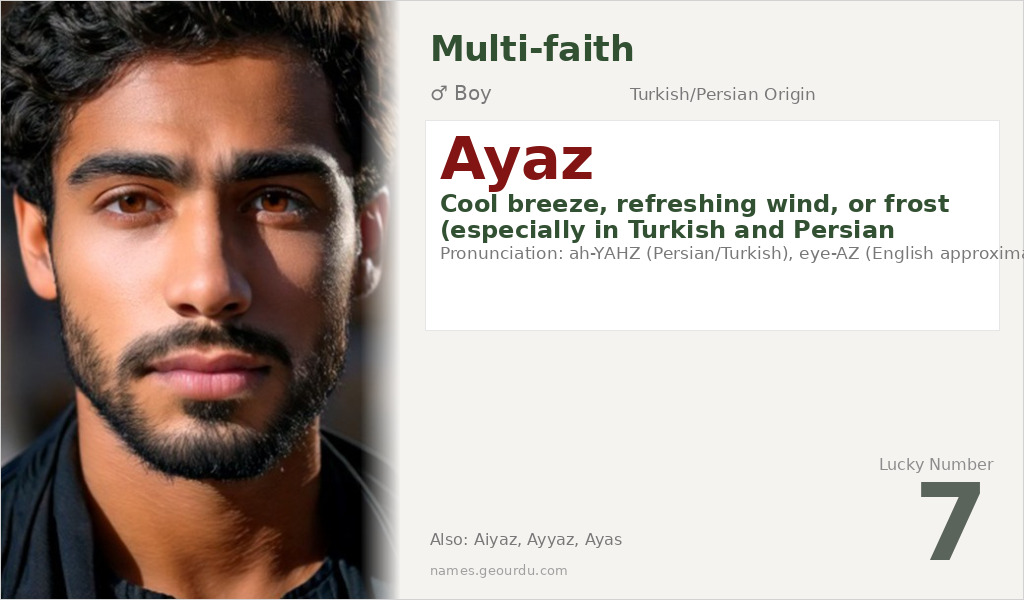
| 💎 Meaning | Cool breeze, refreshing wind, or frost (especially in Turkish and Persian contexts); historically refers to a loyal servant/slave of Sultan Mahmud of Ghazni |
| 👤 Gender | Boy |
| 🕌 Religion | Multi-faith |
| 🌍 Origin | Turkish/Persian |
| 🗣 Pronunciation | ah-YAHZ (Persian/Turkish), eye-AZ (English approximation) |
| ✍️ Urdu | آیاز |
| ✍️ Arabic | آياز |
| 🔢 Numerology | 7 |
| ✨ Spellings | Aiyaz, Ayyaz, Ayas, Aiaz |
Origin & Cultural Significance
Ayaz has dual origins in both Turkic and Persian linguistic traditions. From its Turkic roots meaning ‘frost,’ it entered Persian culture during the Ghaznavid Empire when Turkic rulers governed Persian-speaking regions. The historical figure Ayaz, a slave of Sultan Mahmud, became legendary in Persian poetry—most notably in Ferdowsi’s Shahnameh and Attar’s mystical works—where he represents the ideal devotee. The name spread through the Ottoman Empire and into South Asia via Persian cultural influence, becoming established in Urdu-speaking regions. While commonly used in Muslim communities, it’s not exclusively Islamic and appears in secular contexts in Turkey and Azerbaijan.
Personality Traits
Those named Ayaz are often associated with calm, steady personalities that bring clarity to complex situations. Like a refreshing breeze, they may have a soothing effect on others while maintaining thoughtful reserve. Their historical namesake’s loyalty translates to modern perceptions of reliability and deep commitment in relationships. While sometimes perceived as introspective, they typically demonstrate quiet strength and principled consistency in their actions.
Similar Names
If you like Ayaz, consider: Barış (Turkish: peace), Rüzgar (Turkish: wind), Sabah (Arabic/Turkish: morning), Baran (Persian/Kurdish: rain), Samir (Arabic: companion in night talk)
Famous People Named Ayaz
- Ayaz Mutallibov — First President of Azerbaijan (1991-1992)
- Ayaz Khan — Pakistani television actor known for drama serials
- Ayaz Mahmood — Pakistani cricketer who played for national team in 1990s
Frequently Asked Questions About Ayaz
What does Ayaz mean?
Ayaz means 'frost,' 'cool breeze,' or 'refreshing wind' in Turkish and Persian. Historically, it refers to the loyal servant of Sultan Mahmud of Ghazni, symbolizing devotion.
Is Ayaz a boy or girl name?
Ayaz is exclusively a masculine name in all cultures where it's used, from Turkey to South Asia. There are no recorded feminine variants.
What is the origin of Ayaz?
Ayaz originates from Old Turkic language meaning 'frost,' adopted into Persian during the Ghaznavid Empire. It's now used across Turkish, Persian, and Urdu-speaking cultures.





