
Table of Contents
Baasha is a name with intriguing historical roots and contemporary usage across different cultures. While most famously known as a Biblical king of Israel, the name has found resonance in some Muslim communities, particularly in South Asia. This exploration delves into the etymology, cultural significance, and modern interpretations of this distinctive name that bridges ancient history and present-day naming traditions.
Meaning of Baasha
The meaning of Baasha varies significantly depending on cultural context. In its most documented form, Baasha originates from Hebrew (בַּעְשָׁא), where it appears in the Old Testament as the name of a king who ruled Israel for 24 years. Biblical scholars suggest the name may derive from the Hebrew root ב-ע-ש, potentially meaning ‘shame’ or ‘confusion’. In some South Asian Muslim communities, particularly among Pashto and Balochi speakers, Baasha may represent a variant of the Turkish title ‘paşa’ (meaning ‘high official’ or ‘lord’), though this connection lacks extensive documentation. The name does not appear in classical Arabic name dictionaries, indicating it may be a regional adaptation rather than a traditional Arabic name.
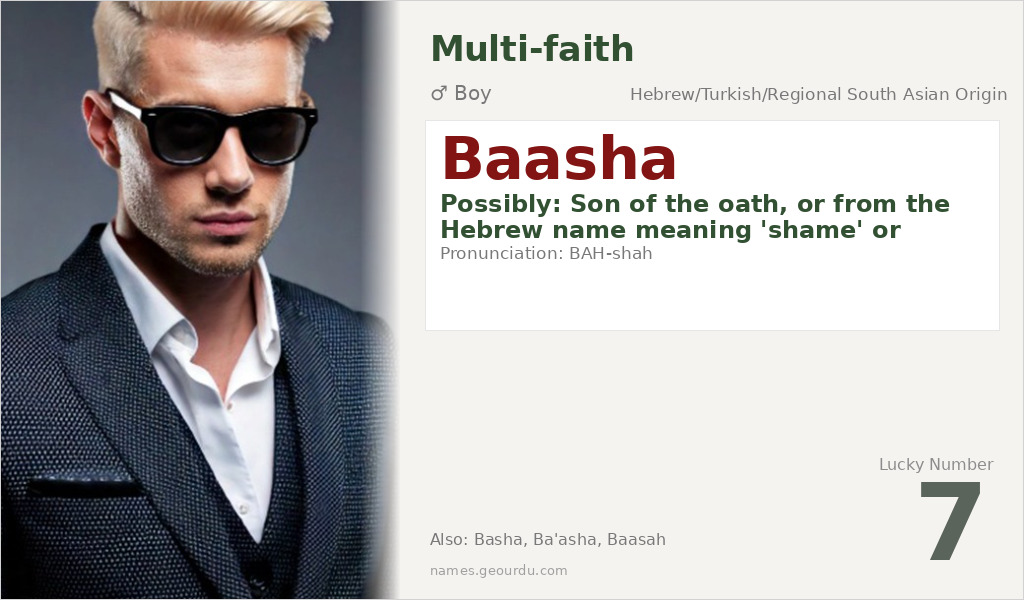
| 📛 Name | Baasha |
| 💎 Meaning | Possibly: Son of the oath, or from the Hebrew name meaning 'shame' or 'confusion' |
| 👤 Gender | Boy |
| 🕌 Religion | Multi-faith |
| 🌍 Origin | Hebrew/Turkish/Regional South Asian |
| 🗣 Pronunciation | BAH-shah |
| ✍️ Urdu | باشا |
| ✍️ Arabic | بعشا |
| 🔢 Numerology | 7 |
| ✨ Spellings | Basha, Ba'asha, Baasah |
Origin & Cultural Significance
Baasha has dual origins that reflect its cross-cultural journey. Primarily, it originates from ancient Hebrew culture, where Baasha son of Ahijah became the third king of the northern Kingdom of Israel around 909-886 BCE, as recorded in the Books of Kings. Centuries later, the name appears to have been adopted in some South Asian Muslim communities, possibly through cultural exchange or as a variant of honorific titles. This regional usage is most documented in Pashtun and Baloch communities, where names often undergo phonetic adaptations. The name’s presence in multiple religious contexts—both Biblical and some Muslim communities—demonstrates how names can transcend their original cultural boundaries.
Personality Traits
While personality associations with names are largely cultural constructs rather than empirical facts, names like Baasha that have historical and leadership connotations often carry expectations of strength and determination. Parents choosing this name might envision qualities of resilience and purpose for their child. The Biblical association with kingship suggests traditional values of leadership and responsibility, while the name’s relative rarity in modern times might indicate parents seeking a distinctive yet meaningful name for their child.
Similar Names
If you like Baasha, consider: Bashir, Basharat, Bashar, Basheer, Basit
Famous People Named Baasha
- Baasha (Biblical Figure) — King of Israel who ruled for 24 years in the 9th century BCE, mentioned in 1 Kings 15-16
- Baasha (Contemporary Figure) — Occasionally found as a given name in South Asian Muslim communities, though no widely recognized public figures bear this name
Frequently Asked Questions About Baasha
What does Baasha mean?
Baasha has multiple possible meanings depending on context. In Hebrew, it may mean 'shame' or 'confusion'. In some South Asian Muslim communities, it may be related to the Turkish 'paşa' meaning 'high official', though this is less documented.
Is Baasha a boy or girl name?
Baasha is exclusively a masculine name in all documented contexts, from the Biblical king to contemporary usage in Muslim communities.
What is the origin of Baasha?
Baasha primarily originates from Hebrew as a Biblical name, but also appears in some South Asian Muslim communities, particularly among Pashto and Balochi speakers, possibly as a variant of Turkish honorific titles.





