
Table of Contents
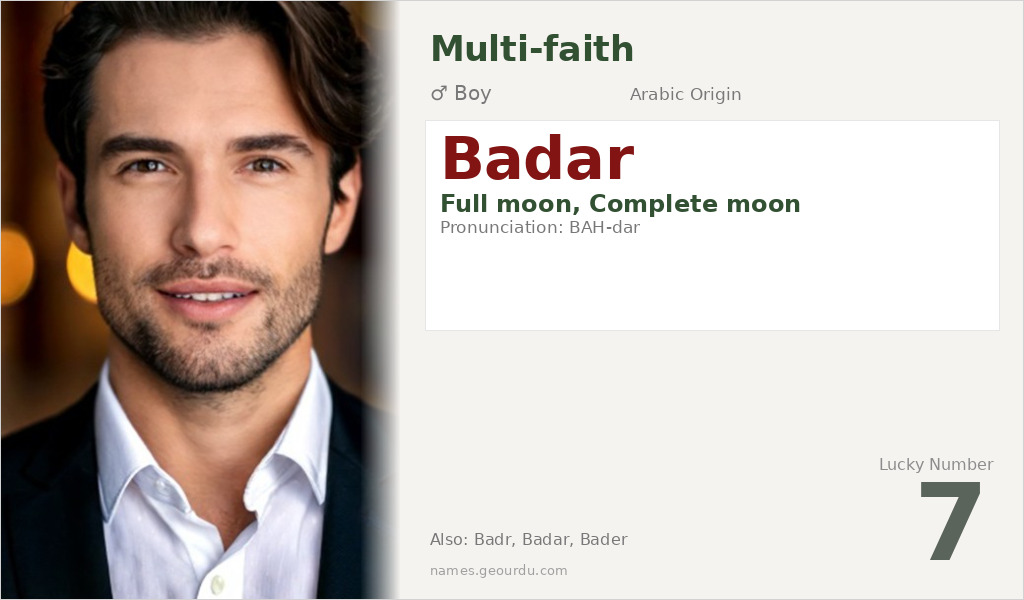
Badar is a beautiful masculine name that carries celestial significance across multiple cultures. Derived from the Arabic word for ‘full moon,’ this name evokes images of illumination, completeness, and natural beauty. While commonly used in Muslim communities due to its Arabic origins, Badar has also found acceptance in Hindu naming traditions in South Asia. The name’s connection to important historical events adds layers of cultural richness to its simple yet powerful meaning.
Meaning of Badar
The name Badar originates from the Arabic word ‘badr’ (بدر), which specifically means ‘full moon’ or ‘complete moon.’ In Arabic linguistic tradition, ‘badr’ refers to the moon when it reaches its maximum illumination on the 14th night of the lunar month. This term appears frequently in classical Arabic poetry where the full moon serves as a metaphor for beauty, perfection, and guidance. The name gained additional significance through Islamic history with the Battle of Badr, a pivotal event in early Islam. While the name has been adopted by Hindu communities in South Asia, its core meaning remains firmly rooted in Arabic etymology rather than Sanskrit or other Indian languages.
| 📛 Name | Badar |
| 💎 Meaning | Full moon, Complete moon |
| 👤 Gender | Boy |
| 🕌 Religion | Multi-faith |
| 🌍 Origin | Arabic |
| 🗣 Pronunciation | BAH-dar |
| ✍️ Urdu | بدر |
| ✍️ Arabic | بدر |
| 🔢 Numerology | 7 |
| ✨ Spellings | Badr, Badar, Bader, Badur |
Origin & Cultural Significance
Badar has its origins in pre-Islamic Arabic language and culture, where celestial bodies held significant symbolic value. The name appears in early Arabic poetry and was in use before the advent of Islam. Its prominence increased dramatically after the Battle of Badr in 624 CE, which became a defining moment in Islamic history. Through cultural exchange and the spread of Islam, the name traveled to South Asia where it was adopted by various communities including Muslims and Hindus. In contemporary usage, Badar remains popular in Arabic-speaking countries, South Asia, and among diaspora communities worldwide, maintaining its original meaning while acquiring local cultural associations.
Personality Traits
Those named Badar often embody the qualities associated with the full moon—illumination, guidance, and cyclical completeness. They tend to be individuals who bring clarity to complex situations and shine brightest in supportive environments. Their personality often reflects a balance between observation and action, with periods of quiet reflection followed by decisive implementation. Like the moon’s phases, they may experience natural cycles in their energy and creativity, ultimately returning to states of full expression and achievement.
Similar Names
If you like Badar, consider: Qamar (moon), Badruddin (full moon of faith), Badri (related to full moon), Mah (moon in Persian), Chand (moon in Urdu/Hindi)
Famous People Named Badar
- Badr al-Din al-Ghazzi — 16th century Syrian Islamic scholar and historian
- Badr Shakir al-Sayyab — influential Iraqi poet of the 20th century
Frequently Asked Questions About Badar
What does Badar mean?
Badar means 'full moon' or 'complete moon' in Arabic. It specifically refers to the moon when it's fully illuminated on the 14th night of the lunar month.
Is Badar a boy or girl name?
Badar is primarily a masculine name used for boys across Arabic, Muslim, and Hindu naming traditions. While names can sometimes cross gender boundaries in modern usage, Badar remains overwhelmingly male in historical and contemporary contexts.
What is the origin of Badar?
Badar originates from the Arabic language, derived from the word 'badr' meaning full moon. The name has historical significance in Islam due to the Battle of Badr and has been adopted by various cultures including Hindu communities in South Asia through cultural exchange.





