
Table of Contents
Badiuzzamaan is a distinguished Arabic name that carries profound historical and cultural weight in the Muslim world. Meaning ‘Wonder of the Age’ or ‘Marvel of the Era’, this name has been borne by some of Islam’s most influential scholars and literary figures. With roots in classical Arabic language and Islamic tradition, Badiuzzamaan represents admiration for extraordinary individuals who leave their mark on their time period. This comprehensive guide explores the name’s true meaning, origin, and significance beyond common misconceptions.
Meaning of Badiuzzamaan
Badiuzzamaan is a compound Arabic name with clear linguistic components that reveal its precise meaning. The first part, ‘Badi’ (بديع), derives from the Arabic root B-D-ʿ (ب-د-ع) meaning ‘to invent, create, or bring forth something new and wonderful’. This root gives us words like ‘bid’ah’ (innovation) and ‘badi’ (wonderful). The second part, ‘al-Zamaan’ (الزمان), comes from the root Z-M-N (ز-م-ن) meaning ‘time’ or ‘era’. When combined, the name literally translates to ‘Wonder of the Age’ or ‘Marvel of the Era’. This construction follows classical Arabic naming patterns where ‘Badi’ functions as an adjective modifying ‘al-Zamaan’. The name is grammatically complete as ‘Badi’ al-Zaman’ with the definite article ‘al-‘ properly attached to ‘Zaman’.
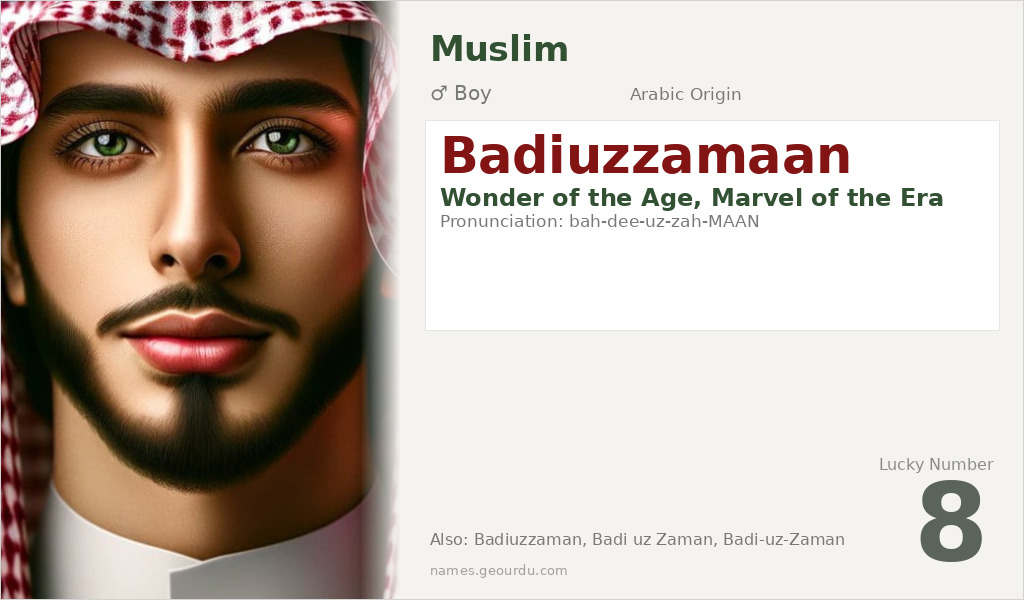
| 📛 Name | Badiuzzamaan |
| 💎 Meaning | Wonder of the Age, Marvel of the Era |
| 👤 Gender | Boy |
| 🕌 Religion | Muslim |
| 🌍 Origin | Arabic |
| 🗣 Pronunciation | bah-dee-uz-zah-MAAN |
| ✍️ Urdu | بدیع الزمان |
| ✍️ Arabic | بديع الزمان |
| 🔢 Numerology | 8 |
| ✨ Spellings | Badiuzzaman, Badi uz Zaman, Badi-uz-Zaman, Badi al-Zaman, Badīʿ al-Zamān |
Origin & Cultural Significance
Badiuzzamaan originates from classical Arabic and has been used for centuries within Islamic cultures, particularly among Arabic, Persian, Turkish, and South Asian Muslim communities. The name gained prominence through historical figures like Badi’ al-Zaman al-Hamadani, the 10th-century Persian poet whose literary masterpiece ‘Maqamat’ established a new genre in Arabic literature. In Ottoman and later Turkish contexts, the name was notably borne by Badiuzzaman Said Nursi, the influential 20th-century Islamic scholar. The name reflects Islamic cultural values that celebrate intellectual and spiritual excellence, often bestowed upon individuals believed to possess extraordinary qualities for their historical period. It remains in use today, particularly among families with appreciation for classical Islamic names with deep historical resonance.
Personality Traits
The meaning ‘Wonder of the Age’ naturally suggests personality traits associated with exceptionalism and leadership. Those named Badiuzzamaan are often expected to demonstrate intellectual curiosity, innovative thinking, and the ability to inspire others. The name carries an implicit expectation of making significant contributions to one’s community or field. Historically, bearers of this name have been scholars, writers, and reformers, suggesting traits of wisdom, perseverance, and visionary thinking that transcends ordinary limitations.
Similar Names
If you like Badiuzzamaan, consider: Badi, Zaman, Badruddin, Jalaluddin, Fakhruddin
Famous People Named Badiuzzamaan
- Badi' al-Zaman al-Hamadani (969-1007) — Renowned Persian poet and writer famous for his Maqamat, considered one of the greatest literary figures of medieval Islam
- Badiuzzaman Said Nursi (1877-1960) — Influential Kurdish-Islamic scholar and theologian from Turkey, author of the Risale-i Nur collection
Frequently Asked Questions About Badiuzzamaan
What does Badiuzzamaan mean?
Badiuzzamaan means 'Wonder of the Age' or 'Marvel of the Era'. It is an Arabic compound name where 'Badi' means 'wonderful/extraordinary' and 'al-Zamaan' means 'the age/the era'.
Is Badiuzzamaan a boy or girl name?
Badiuzzamaan is exclusively a boy's name in all cultural contexts where it is used. There is no feminine equivalent or usage as a girl's name in Arabic or Islamic naming traditions.
What is the origin of Badiuzzamaan?
Badiuzzamaan originates from classical Arabic language and Islamic culture. It follows standard Arabic grammatical construction and has been used for centuries across the Muslim world, particularly in Arabic, Persian, Turkish, and South Asian contexts.





