
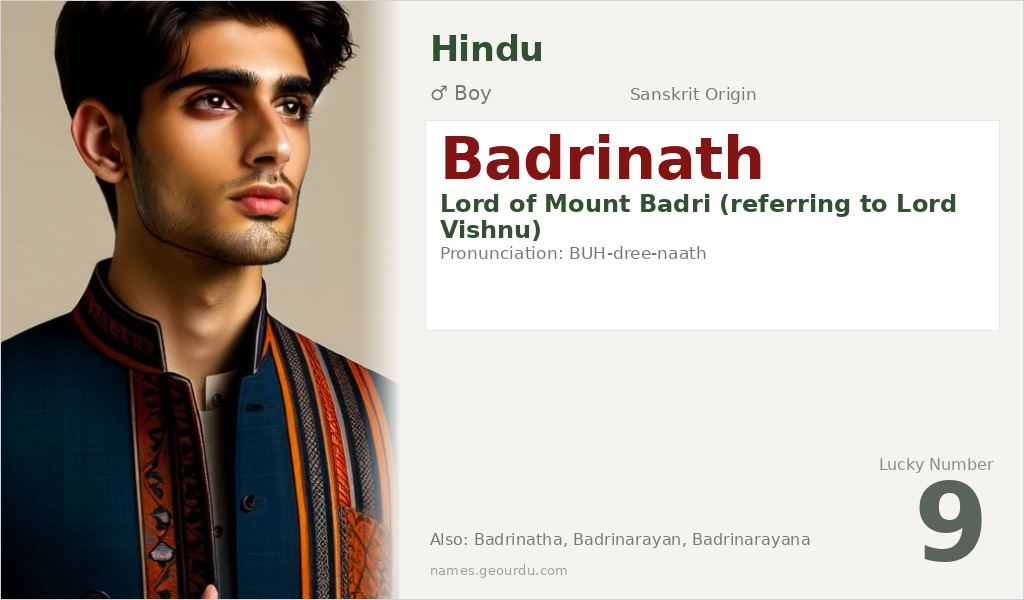
Table of Contents
Badrinath is a profound Hindu boy name steeped in spiritual significance and ancient Sanskrit roots. Directly referencing Lord Vishnu in his Badrinath form, this name carries the weight of pilgrimage, devotion, and divine protection. Popular in India and among Hindu communities worldwide, Badrinath embodies both geographical sanctity and theological depth.
Meaning of Badrinath
Badrinath derives from Sanskrit, combining ‘Badri’ (बद्री), referring to the Badri tree (Indian jujube) or berry, and ‘nath’ (नाथ), meaning ‘lord’ or ‘master’. The full meaning is ‘Lord of Mount Badri’, specifically identifying Lord Vishnu, who is worshipped at the Badrinath Temple in the Himalayas. According to Hindu texts, Vishnu performed intense meditation (tapasya) under a Badri tree at this location, hence the name. Linguistically, it’s a tatpurusha compound where ‘Badri’ modifies ‘nath’, indicating possession or association. The name is exclusively theocentric, never used in secular contexts in its source culture.
| 📛 Name | Badrinath |
| 💎 Meaning | Lord of Mount Badri (referring to Lord Vishnu) |
| 👤 Gender | Boy |
| 🕌 Religion | Hindu |
| 🌍 Origin | Sanskrit |
| 🗣 Pronunciation | BUH-dree-naath |
| ✍️ Urdu | بدریناتھ |
| ✍️ Arabic | بادري ناث |
| 🔢 Numerology | 9 |
| ✨ Spellings | Badrinatha, Badrinarayan, Badrinarayana |
Origin & Cultural Significance
The name Badrinath originates from Sanskrit and Hindu religious tradition, specifically associated with the Char Dham pilgrimage site in Uttarakhand, India. It emerged as a given name to honor Lord Vishnu in his Badrinath manifestation, which is particularly revered in Vaishnavism. Culturally, naming a child Badrinath is considered auspicious, invoking the deity’s protective blessings. The name is predominantly used in India, Nepal, and the Hindu diaspora, with deep roots in Puranic literature where Badrinath is described as a sacred seat of Vishnu. It does not have significant usage or alternative meanings in other language families like Arabic, Persian, or Germanic languages, remaining firmly within the Sanskrit Hindu onomastic tradition.
Personality Traits
Those named Badrinath are often perceived as calm, resilient, and spiritually inclined, mirroring the meditative qualities of Lord Vishnu in Badrinath. They may naturally assume protective roles in their families or communities, guided by a sense of duty and preservation. The name’s association with steadfastness and divine connection can influence expectations of wisdom and tranquility in personality.
Similar Names
If you like Badrinath, consider: Vishnu, Narayan, Krishna, Balaji, Venkatesh
Famous People Named Badrinath
- Badrinath Ki Dulhania — 2017 Bollywood film title referencing the Badrinath temple pilgrimage
- Badrinath Temple — One of the Char Dham pilgrimage sites in Hinduism, dedicated to Lord Badrinath (Vishnu)
Frequently Asked Questions About Badrinath
What does Badrinath mean?
Badrinath means 'Lord of Mount Badri' in Sanskrit, specifically referring to Lord Vishnu worshipped at the Badrinath Temple in the Himalayas.
Is Badrinath a boy or girl name?
Badrinath is exclusively a boy name in Hindu tradition, as it refers to the male deity Lord Vishnu and follows masculine Sanskrit grammar.
What is the origin of Badrinath?
Badrinath originates from Sanskrit and Hindu religion, directly linked to the Badrinath Temple and the worship of Vishnu in Vaishnavism.





