Table of Contents
Bahawal is a distinguished Arabic name meaning ‘sovereign’ or ‘ruler,’ carrying centuries of royal heritage and cultural significance. Particularly prominent in South Asian Muslim communities, this name evokes images of authority, leadership, and noble lineage. From historical princely states to modern families seeking meaningful names, Bahawal continues to resonate with those who value tradition and strength of character.
Meaning of Bahawal
Bahawal derives from the Arabic root ب-ه-ل (b-h-l), which fundamentally relates to concepts of sovereignty, dominion, and rulership. The name specifically means ‘possessor of sovereignty’ or ‘one who has authority,’ making it a title-like designation for leaders and rulers. This etymology connects it to classical Arabic linguistic traditions where compound names often denote power and status. In historical context, the name gained particular prominence through the Abbasi rulers of Bahawalpur, who established a dynasty that lasted from the 18th to mid-20th century, further cementing its association with governance and nobility.
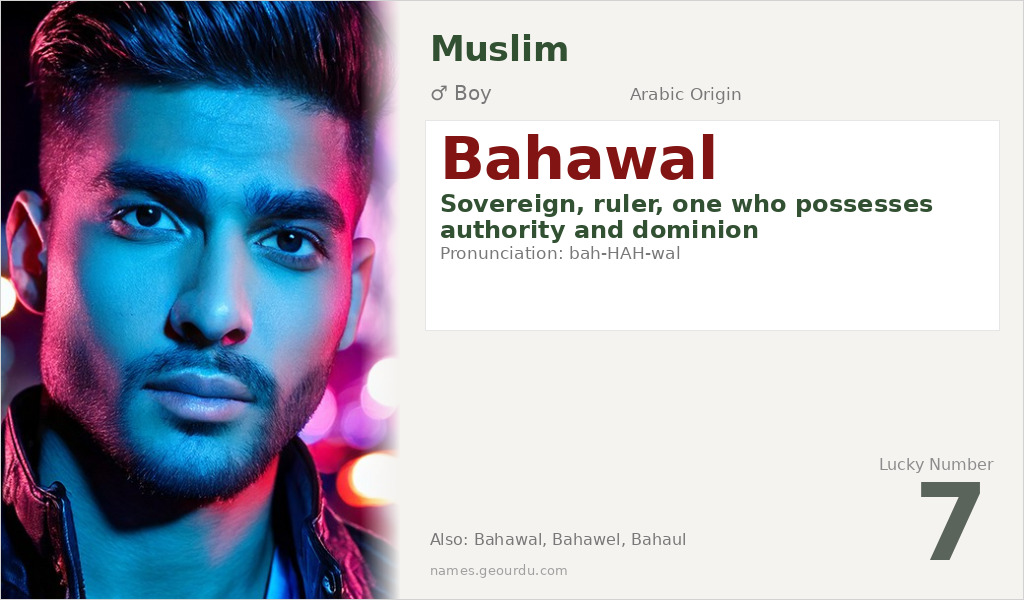
| 📛 Name | Bahawal |
| 💎 Meaning | Sovereign, ruler, one who possesses authority and dominion |
| 👤 Gender | Boy |
| 🕌 Religion | Muslim |
| 🌍 Origin | Arabic |
| 🗣 Pronunciation | bah-HAH-wal |
| ✍️ Urdu | بہاول |
| ✍️ Arabic | بَهَوَل |
| 🔢 Numerology | 7 |
| ✨ Spellings | Bahawal, Bahawel, Bahaul, Bahawwal |
Origin & Cultural Significance
While fundamentally Arabic in linguistic origin, Bahawal achieved its greatest cultural significance in the South Asian subcontinent, particularly in the Punjab and Sindh regions. The name became historically important through Bahawal Khan Abbasi I, who founded the princely state of Bahawalpur in 1748. This connection transformed Bahawal from a general Arabic name into one specifically associated with a ruling dynasty and geographical region. Today, it remains popular among Muslim families in Pakistan and India who appreciate its royal connotations and historical depth, though it’s less common in Arab-majority countries where simpler forms like ‘Baha’ might be preferred.
Personality Traits
Those named Bahawal often embody the leadership qualities suggested by their name’s meaning. They tend to be natural authorities who approach life with seriousness and purpose, valuing structure and tradition. While sometimes reserved, they possess strong protective instincts toward family and community. Their analytical nature helps them make considered decisions, though they may need to balance their authoritative tendencies with flexibility in personal relationships.
Similar Names
If you like Bahawal, consider: Bahadur, Bahram, Bahjat, Baha, Wali
Famous People Named Bahawal
- Bahawal Khan Abbasi I — 18th-century founder of the princely state of Bahawalpur in present-day Pakistan
- Nawab Sadiq Muhammad Khan Abbasi V — last ruling Nawab of Bahawalpur, known for his modernization efforts in education and infrastructure
Frequently Asked Questions About Bahawal
What does Bahawal mean?
Bahawal means 'sovereign,' 'ruler,' or 'one who possesses authority' in Arabic, derived from the root ب-ه-ل (b-h-l) relating to dominion and rulership.
Is Bahawal a boy or girl name?
Bahawal is exclusively a masculine name in all cultural contexts where it's used, particularly in Muslim naming traditions of South Asia.
What is the origin of Bahawal?
Bahawal originates from Arabic but gained significant cultural prominence through the Abbasi rulers of Bahawalpur in present-day Pakistan, making it particularly associated with South Asian Muslim heritage.