
Table of Contents
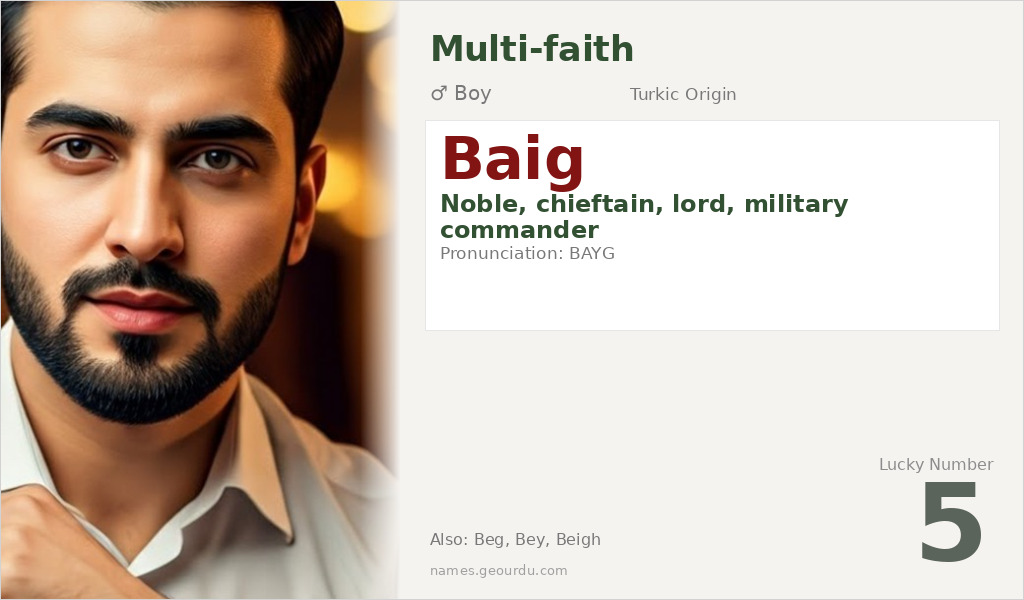
Baig is a distinguished name with deep historical roots that transcends religious boundaries. Originally a Turkic title for nobility and military commanders, it has evolved into both a given name and surname across South Asia and the Middle East. This name carries centuries of cultural heritage, symbolizing leadership, authority, and social status. Understanding Baig requires exploring its journey from Central Asian steppes to modern naming traditions.
Meaning of Baig
The name Baig derives from the Turkic word ‘beg’, which originally meant ‘chieftain’, ‘lord’, or ‘military commander’. This term was used extensively in Turkic and Mongol societies to denote nobility and leadership positions. Through the expansion of the Mongol Empire and subsequent Turkic migrations, the title spread to Persia, where it became ‘beg’ in Persian, and eventually to South Asia via various Islamic empires. In languages like Urdu, Punjabi, and Sindhi, Baig/Beg retained its core meaning of nobility and authority while becoming incorporated into local naming conventions. The name never meant ‘wealthy son’ as sometimes incorrectly stated, but specifically denotes leadership and noble status.
| 📛 Name | Baig |
| 💎 Meaning | Noble, chieftain, lord, military commander |
| 👤 Gender | Boy |
| 🕌 Religion | Multi-faith |
| 🌍 Origin | Turkic |
| 🗣 Pronunciation | BAYG |
| ✍️ Urdu | بیگ |
| ✍️ Arabic | بيك |
| 🔢 Numerology | 5 |
| ✨ Spellings | Beg, Bey, Beigh, Baeg, Baiq |
Origin & Cultural Significance
Baig has its origins in the Turkic languages of Central Asia, where ‘beg’ was a title for tribal leaders and military commanders. The term gained prominence during the Mongol Empire and subsequent Turkic dynasties like the Timurids and Ottomans. In South Asia, it was introduced through various Islamic conquests and settlements, particularly during the Delhi Sultanate and Mughal Empire periods. Today, Baig is used by diverse religious communities including Muslims, Sikhs, and Hindus across Pakistan, India, Afghanistan, and Bangladesh, often as both a given name and surname. Its cross-cultural adoption demonstrates how titles can evolve into personal names while retaining their prestigious connotations.
Personality Traits
Those named Baig often inherit the leadership qualities embedded in their name’s history. They typically display confidence, authority, and a natural ability to take charge in various situations. With roots in military and noble traditions, individuals with this name often value honor, responsibility, and protecting their community. Their strong presence and traditional values frequently earn them respect and admiration from peers.
Similar Names
If you like Baig, consider: Khan, Mirza, Malik, Sardar, Amir
Famous People Named Baig
- Mirza Asadullah Baig Khan (Ghalib) — Renowned Urdu and Persian poet of the Mughal era
- Baig Rajab Ali — Prominent Sindhi poet and writer from Pakistan
Frequently Asked Questions About Baig
What does Baig mean?
Baig means 'noble', 'chieftain', 'lord', or 'military commander'. It originates from the Turkic word 'beg' and has been used as a title and name across Central Asia, the Middle East, and South Asia.
Is Baig a boy or girl name?
Baig is primarily a masculine name, though it can occasionally be used as a surname for both genders. Its origins as a title for male military leaders and nobility make it overwhelmingly male as a given name.
What is the origin of Baig?
Baig has Turkic origins from the word 'beg'. It spread through Mongol and Turkic empires to Persia and South Asia, where it became incorporated into various languages including Urdu, Punjabi, and Sindhi as both a title and personal name.





