
Table of Contents
Balban is a distinctive name with deep historical roots in Persian and Turkic cultures. Most famously associated with Ghiyas ud din Balban, the powerful Sultan of Delhi in the 13th century, this name carries connotations of strength and authority. While often used in Muslim communities, its origins predate specific religious associations. The name’s etymology reveals its meaning as ‘strong’ or ‘powerful’, making it a compelling choice for parents seeking a name with historical weight and masculine energy.
Meaning of Balban
The name Balban derives from Persian linguistic elements, where ‘bal’ (بل) signifies strength, power, or might. The suffix ‘-ban’ (بان) functions as a possessive or agentive marker, creating a meaning akin to ‘possessor of strength’ or ‘the powerful one’. This construction appears in various Persian and Turkic names and titles, particularly in military and aristocratic contexts. Historical records from the Delhi Sultanate period show ‘Balban’ used both as a personal name and an honorific title for commanders. The name’s semantic field includes concepts of protection, authority, and martial capability, reflecting its usage among ruling and warrior classes in medieval Persianate societies.
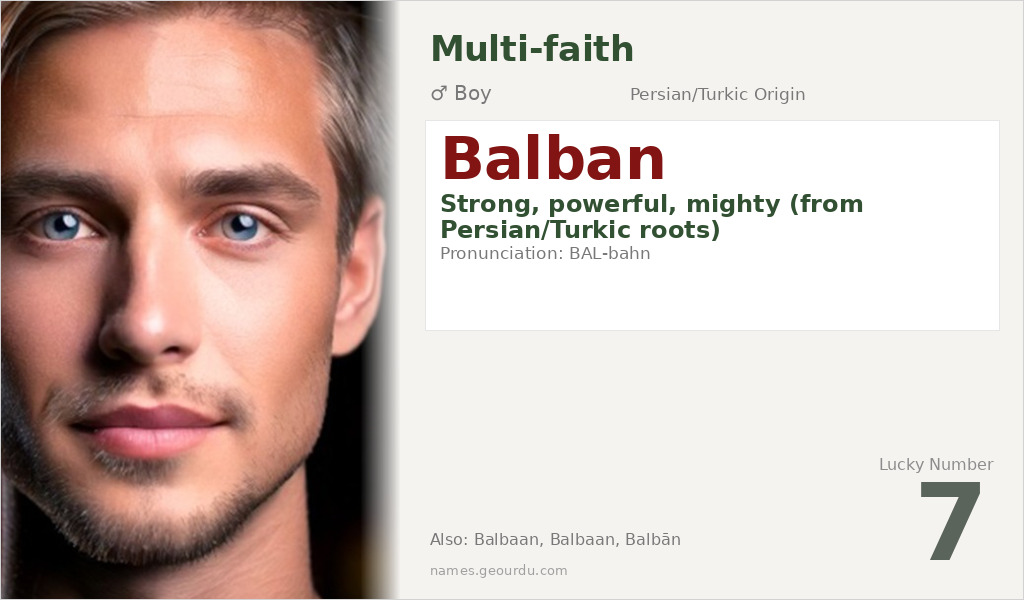
| 📛 Name | Balban |
| 💎 Meaning | Strong, powerful, mighty (from Persian/Turkic roots) |
| 👤 Gender | Boy |
| 🕌 Religion | Multi-faith |
| 🌍 Origin | Persian/Turkic |
| 🗣 Pronunciation | BAL-bahn |
| ✍️ Urdu | بلبن |
| ✍️ Arabic | بلبان |
| 🔢 Numerology | 7 |
| ✨ Spellings | Balbaan, Balbaan, Balbān |
Origin & Cultural Significance
Balban originates from Persian and Turkic naming traditions that flourished across Central Asia, Persia, and the Indian subcontinent. The name gained particular prominence during the Delhi Sultanate era (1206-1526), when Turkic and Persian cultural influences dominated South Asian aristocracy. Ghiyas ud din Balban, originally a slave who rose to become Sultan, exemplifies the name’s association with social mobility and power consolidation. While the name appears in Islamic historical contexts, its linguistic roots are cultural rather than religious, belonging to the broader Persianate world that included Muslims, Zoroastrians, and others. The name continues to be used in regions with Persian cultural influence, including parts of Iran, Afghanistan, Pakistan, and India.
Personality Traits
Those bearing the name Balban often embody characteristics of strength, determination, and natural leadership. The name’s etymological meaning tends to influence perceptions, with Balbans frequently seen as authoritative figures who take charge in challenging situations. They typically exhibit protective instincts toward loved ones and a strong sense of responsibility. While potentially appearing reserved or serious, they usually possess deep loyalty and commitment to their principles and communities.
Similar Names
If you like Balban, consider: Bahram, Bahadur, Balveer, Baldwin, Balthazar
Famous People Named Balban
- Ghiyas ud din Balban — Ninth Sultan of the Mamluk dynasty of Delhi (reigned 1266–1287), known for consolidating power and establishing strong administration
- Balban (historical figure) — Various military commanders and nobles in Persian and Turkic histories bearing this title/name
Frequently Asked Questions About Balban
What does Balban mean?
Balban means 'strong', 'powerful', or 'mighty' originating from Persian and Turkic linguistic roots where 'bal' means strength and '-ban' is a possessive suffix.
Is Balban a boy or girl name?
Balban is exclusively a masculine name with historical usage as both a personal name and title for male rulers and military commanders in Persian and Turkic cultures.
What is the origin of Balban?
Balban originates from Persian and Turkic languages, with significant historical usage during the Delhi Sultanate period in South Asia. It was particularly associated with the Mamluk dynasty ruler Ghiyas ud din Balban.





