
Table of Contents
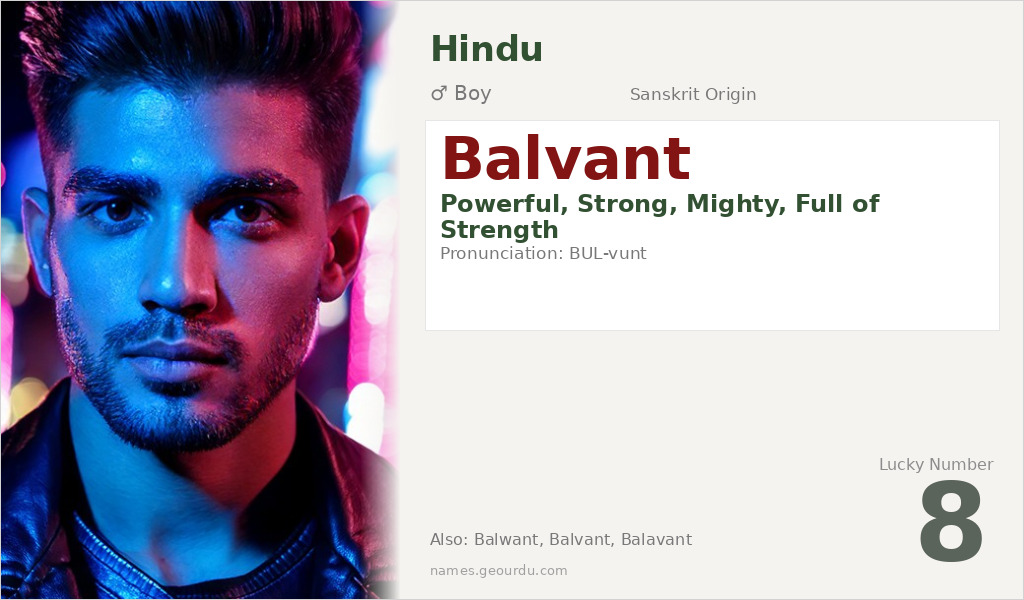
Balvant is a classic Indian name that carries the weight of strength and power in its very essence. Derived from ancient Sanskrit roots, this name has been cherished for generations in Hindu families seeking a name that embodies resilience and might. With its straightforward meaning and cultural significance, Balvant remains a meaningful choice for parents valuing traditional virtues. The name’s enduring appeal lies in its connection to fundamental human qualities celebrated across cultures.
Meaning of Balvant
Balvant originates from the Sanskrit word ‘balavant’ (बलवन्त्), which directly translates to ‘possessing strength’ or ‘powerful.’ The name is composed of two elements: ‘bala’ meaning strength, power, or might, and the suffix ‘-vant’ which indicates possession or having a quality. This linguistic construction is common in Sanskrit names, creating adjectives that describe inherent characteristics. The concept of ‘bala’ in Hindu philosophy extends beyond physical strength to include mental, spiritual, and moral fortitude. Historical texts like the Mahabharata and Puranas use similar terms to describe heroic figures and deities, embedding the name in India’s cultural consciousness. The name has maintained its original meaning through centuries of linguistic evolution in various Indian languages.
| 📛 Name | Balvant |
| 💎 Meaning | Powerful, Strong, Mighty, Full of Strength |
| 👤 Gender | Boy |
| 🕌 Religion | Hindu |
| 🌍 Origin | Sanskrit |
| 🗣 Pronunciation | BUL-vunt |
| ✍️ Urdu | بلونت |
| ✍️ Arabic | بالفانت |
| 🔢 Numerology | 8 |
| ✨ Spellings | Balwant, Balvant, Balavant, Balvanta |
Origin & Cultural Significance
Balvant has its roots firmly planted in ancient Sanskrit, the classical language of India that has influenced numerous modern South Asian languages. As a Hindu name, it reflects values emphasized in Hindu scriptures where strength (bala) is celebrated as both a physical and spiritual virtue. The name appears in regional variations across India, particularly in Punjabi, Gujarati, and Hindi-speaking communities. While primarily associated with Hindu tradition, the name’s appeal transcends religious boundaries in some regions due to its universal meaning. Historical records show the name being used for centuries, often given to boys expected to embody protective and leadership qualities within their families and communities.
Personality Traits
Those named Balvant are often associated with leadership qualities and inner strength. They tend to approach life with determination and resilience, capable of overcoming obstacles through sheer willpower. Their protective nature makes them reliable family members and friends, while their inherent strength often inspires confidence in others. While individual personalities vary, the name’s meaning creates expectations of someone who can shoulder responsibility and face challenges head-on.
Similar Names
If you like Balvant, consider: Balveer, Balraj, Baldev, Balkrishna, Balaram
Famous People Named Balvant
- Balwant Singh — Indian field hockey player who won gold at the 1964 Tokyo Olympics
- Balwant Gargi — Punjabi playwright, novelist, and theatre director known for his contributions to Punjabi literature
Frequently Asked Questions About Balvant
What does Balvant mean?
Balvant means 'powerful,' 'strong,' or 'full of might.' It comes from the Sanskrit word 'balavant' (बलवन्त्), combining 'bala' (strength) with the possessive suffix '-vant.'
Is Balvant a boy or girl name?
Balvant is exclusively a boy's name in Hindu naming tradition. The masculine form 'balavant' has feminine equivalents like 'balavati,' but Balvant itself is used only for males.
What is the origin of Balvant?
Balvant originates from Sanskrit, the ancient classical language of India. It has been used for centuries in Hindu communities and appears in various Indian languages including Hindi, Punjabi, and Gujarati.





