Table of Contents
Banashankari is a beautiful and powerful Sanskrit name deeply rooted in Hindu mythology and South Indian culture. This name doesn’t just mean ‘forest’—it specifically refers to the goddess Parvati in her form as the divine protector of forests and wilderness. As a compound name combining ‘Vana’ (forest) and ‘Shankari’ (consort of Shiva), Banashankari carries profound spiritual significance. Parents choosing this name often seek to honor both nature’s majesty and feminine divine energy.
Meaning of Banashankari
The name Banashankari has a precise and well-documented meaning in Sanskrit: ‘Goddess of the forest’ or ‘Consort of Lord Shiva in the forest’. It is formed from two Sanskrit words: ‘Vana’ (वन), meaning forest, woods, or wilderness, and ‘Shankari’ (शङ्करी), which is a feminine form derived from Shankara, another name for Lord Shiva, meaning ‘the auspicious one’. Shankari thus means ‘consort of Shankara’ or ‘goddess’. When combined, these elements create a name that specifically denotes the forest-dwelling form of the goddess Parvati. This is not a generic term for forests but a proper name for a specific deity in Hindu tradition. The name appears in ancient texts and is associated with the famous Banashankari Temple in Badami, Karnataka, where the goddess is worshipped as a principal deity.
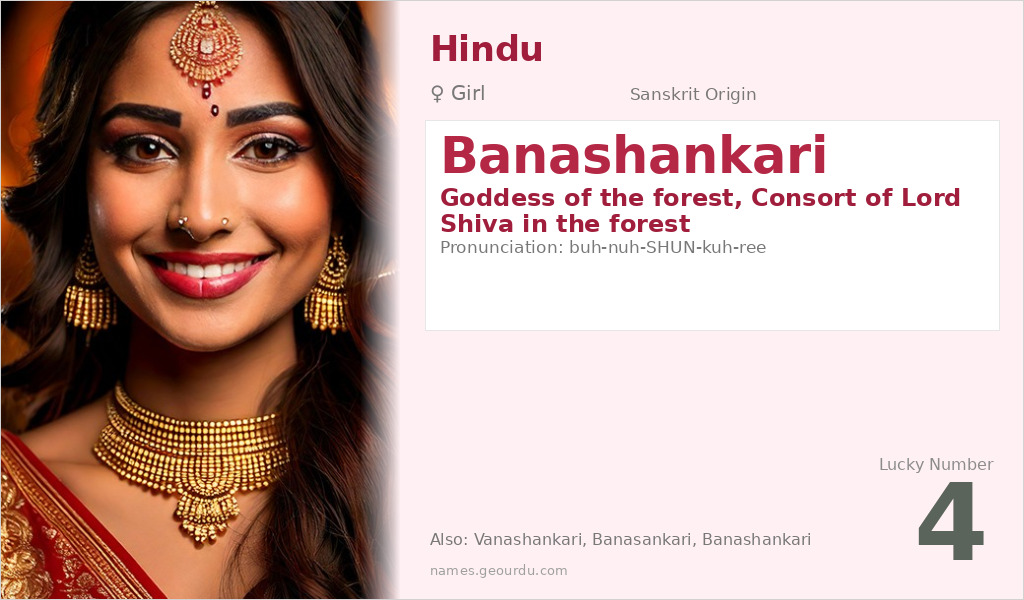
| 📛 Name | Banashankari |
| 💎 Meaning | Goddess of the forest, Consort of Lord Shiva in the forest |
| 👤 Gender | Girl |
| 🕌 Religion | Hindu |
| 🌍 Origin | Sanskrit |
| 🗣 Pronunciation | buh-nuh-SHUN-kuh-ree |
| ✍️ Urdu | بناشنکری |
| ✍️ Arabic | باناشانكاري |
| 🔢 Numerology | 4 |
| ✨ Spellings | Vanashankari, Banasankari, Banashankari |
Origin & Cultural Significance
Banashankari originates from classical Sanskrit, the ancient liturgical language of Hinduism. The name is particularly significant in South Indian Hindu tradition, where it refers to a specific form of the goddess Parvati worshipped as the protector of forests. This form of the goddess is especially venerated in Karnataka, India, where the Banashankari Temple in Badami dates back to the 7th century during the Chalukya dynasty. The name represents the synthesis of nature worship (vanadevata) with mainstream Hindu goddess tradition. While the name is used for human girls, it always carries the cultural memory of this divine association, making it both a personal name and a theophoric name honoring the forest goddess.
Personality Traits
Those named Banashankari are often associated with qualities of the forest goddess they’re named after: nurturing, protective, and deeply connected to the natural world. They may exhibit a calm, grounded presence combined with inner strength and resilience. Like the forest that provides shelter and sustenance, individuals with this name are often perceived as caring providers who protect those in their circle. Their personality reflects the balance between gentle nurturing and fierce protection that characterizes the goddess Banashankari.
Similar Names
If you like Banashankari, consider: Parvati, Shankari, Vanadevi, Aranyani, Banasundari
Famous People Named Banashankari
- Banashankari Devi — Renowned Indian classical vocalist of the Patiala gharana
- Various women named Banashankari in South India, particularly Karnataka, where the name is culturally significant due to the Banashankari Temple
Frequently Asked Questions About Banashankari
What does Banashankari mean?
Banashankari means 'Goddess of the forest' or 'Consort of Lord Shiva in the forest'. It is a Sanskrit compound name combining 'Vana' (forest) and 'Shankari' (consort of Shiva/goddess).
Is Banashankari a boy or girl name?
Banashankari is exclusively a girl's name in Hindu tradition, as it refers to a feminine deity (the goddess Parvati in her forest form) and uses feminine Sanskrit grammatical forms.
What is the origin of Banashankari?
Banashankari originates from Sanskrit, the ancient language of Hindu scriptures. It is particularly significant in South Indian Hindu culture, where it names a specific form of the goddess Parvati worshipped as protector of forests.