
Table of Contents
Bansi is a melodic Hindu boy name with deep roots in Indian culture and spirituality. Derived from Sanskrit, this name carries the beautiful meaning of ‘flute’ or ‘bamboo pipe’, evoking images of traditional music and divine connection. Most famously associated with Lord Krishna and his enchanting flute playing, Bansi represents artistic expression and spiritual harmony. This name has maintained its popularity across generations while retaining its cultural significance.
Meaning of Bansi
Bansi originates from the Sanskrit word ‘वंशी’ (vaṃśī), which directly translates to ‘flute’ or ‘bamboo pipe’. The term is composed of ‘वंश’ (vaṃśa), meaning ‘bamboo’ or ‘reed’, combined with the suffix ‘-ī’ indicating possession or relation. In classical Sanskrit literature, vaṃśī specifically refers to the bamboo flute, distinguishing it from other wind instruments. This linguistic construction highlights the instrument’s material origin while emphasizing its musical function. The name’s etymology is well-documented in Sanskrit dictionaries and religious texts, particularly those describing Lord Krishna’s attributes.
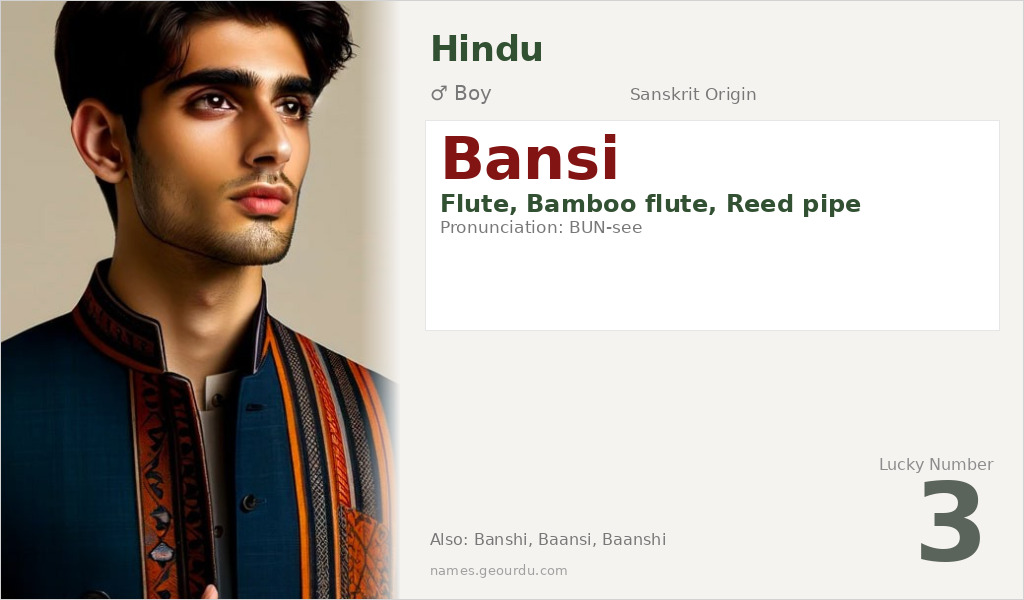
| 📛 Name | Bansi |
| 💎 Meaning | Flute, Bamboo flute, Reed pipe |
| 👤 Gender | Boy |
| 🕌 Religion | Hindu |
| 🌍 Origin | Sanskrit |
| 🗣 Pronunciation | BUN-see |
| ✍️ Urdu | بانسی |
| ✍️ Arabic | بانسي |
| 🔢 Numerology | 3 |
| ✨ Spellings | Banshi, Baansi, Baanshi, Vansi |
Origin & Cultural Significance
Bansi has its origins in ancient Sanskrit, the classical language of Hinduism, Buddhism, and Jainism. The name gained prominence through Hindu mythology, particularly in stories of Lord Krishna, who is often called ‘Muralidhar’ (flute-bearer) and depicted playing the bansuri. This connection elevated the name from simply meaning a musical instrument to representing divine music and spiritual calling. While primarily used in Hindu communities, the name appears across various Indian languages including Hindi, Gujarati, and Marathi. Its usage reflects India’s rich musical heritage and the cultural importance of the flute in religious and artistic traditions.
Personality Traits
Those named Bansi often exhibit creative and harmonious personalities, reflecting their name’s musical origins. They tend to be expressive communicators who value artistic pursuits and emotional connections. The flute symbolism suggests individuals who can bring people together through their charm and diplomacy. These traits make Bansi-named individuals well-suited for careers in arts, communication, or community leadership.
Similar Names
If you like Bansi, consider: Bansuri, Murali, Venugopal, Shri Krishna, Krishna
Famous People Named Bansi
- Bansi Chandragupta — Renowned Indian art director and production designer who worked with Satyajit Ray
- Bansi Kaul — Indian theatre director and playwright known for his innovative productions
Frequently Asked Questions About Bansi
What does Bansi mean?
Bansi means 'flute' or 'bamboo pipe' in Sanskrit, referring to the traditional musical instrument famously played by Lord Krishna.
Is Bansi a boy or girl name?
Bansi is traditionally a masculine name in Hindu culture, though some modern variations might use it for girls in certain regions.
What is the origin of Bansi?
Bansi originates from Sanskrit, the classical language of ancient India, and is deeply connected to Hindu mythology and musical traditions.





