Table of Contents
Banu is a name that carries centuries of aristocratic heritage across multiple cultures. With its roots in ancient Persia, this elegant name meaning ‘lady’ or ‘princess’ has traveled through history and geography, finding homes in diverse communities from South Asia to the Middle East. Whether as an honorific title or a personal name, Banu represents dignity, nobility, and feminine grace that transcends religious and national boundaries.
Meaning of Banu
Banu derives from the Persian word meaning ‘lady’, ‘princess’, or ‘noblewoman’, with its linguistic origins tracing back to Middle Persian ‘bānūg’. This term evolved from Old Persian roots and became established as both a title and personal name in Persian-speaking regions. The name is grammatically feminine and carries connotations of high social status and respect. In modern usage across Persian, Urdu, Turkish, and other languages, Banu maintains its core meaning of feminine nobility, though it has also been adopted by non-Persian communities who appreciate its elegant sound and meaning.
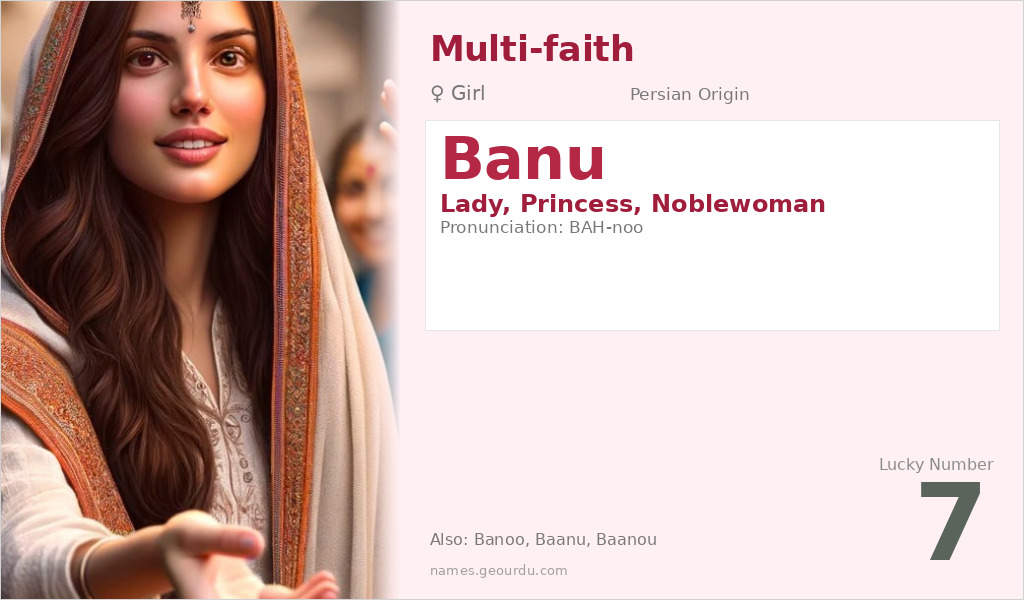
| 📛 Name | Banu |
| 💎 Meaning | Lady, Princess, Noblewoman |
| 👤 Gender | Girl |
| 🕌 Religion | Multi-faith |
| 🌍 Origin | Persian |
| 🗣 Pronunciation | BAH-noo |
| ✍️ Urdu | بانو |
| ✍️ Arabic | بانو |
| 🔢 Numerology | 7 |
| ✨ Spellings | Banoo, Baanu, Baanou |
Origin & Cultural Significance
Banu originated in Persia (modern-day Iran) as an aristocratic title and name, with historical records showing its use for royal women in Persian courts. Through cultural exchange and migration, the name spread to neighboring regions including Afghanistan, Turkey, Central Asia, and the Indian subcontinent via Persian influence during various empires. In South Asia, it entered naming traditions through Persian literary and courtly culture, becoming established in Muslim, Hindu, and Sikh communities. While most commonly associated with Persian heritage, Banu has become a multicultural name with particular popularity in Iran, Afghanistan, Pakistan, India, and Turkey.
Personality Traits
Those named Banu often embody the dignified qualities suggested by their name’s meaning. They may display natural leadership abilities combined with graciousness and emotional intelligence. The name’s noble associations can inspire confidence and poise, while its historical depth might foster an appreciation for tradition and cultural heritage. Many Banus develop strong interpersonal skills and a sense of responsibility that reflects their name’s regal connotations.
Similar Names
If you like Banu, consider: Banafsheh, Parisa, Shirin, Gulbanu, Mahinbanu
Famous People Named Banu
- Banu Qasi — 9th-century Muslim dynasty in Iberian Peninsula
- Banu Chashm — Afghan poet and writer from Kandahar
- Banu Alkan — Turkish actress known for film roles
Frequently Asked Questions About Banu
What does Banu mean?
Banu means 'lady', 'princess', or 'noblewoman' in Persian. It originates from Middle Persian 'bānūg' and has been used as both a title and personal name for centuries.
Is Banu a boy or girl name?
Banu is exclusively a feminine name. In all cultures where it's used, it refers to women and carries feminine grammatical forms in its source languages.
What is the origin of Banu?
Banu originates from Persian (Iranian) language and culture. While now used across multiple religions and regions, its linguistic and historical roots are firmly Persian, not Hindu or Sanskrit as sometimes mistakenly claimed.