Table of Contents
Banuk is a beautiful and culturally rich name that carries the essence of nobility and grace. Originating from the Pashto language, it is a popular choice among Pashtun and Baloch communities, symbolizing a woman of high status or a princess. This name is not just a label but a reflection of deep-rooted traditions and heritage. In this article, we explore the meaning, origin, and significance of Banuk in detail.
Meaning of Banuk
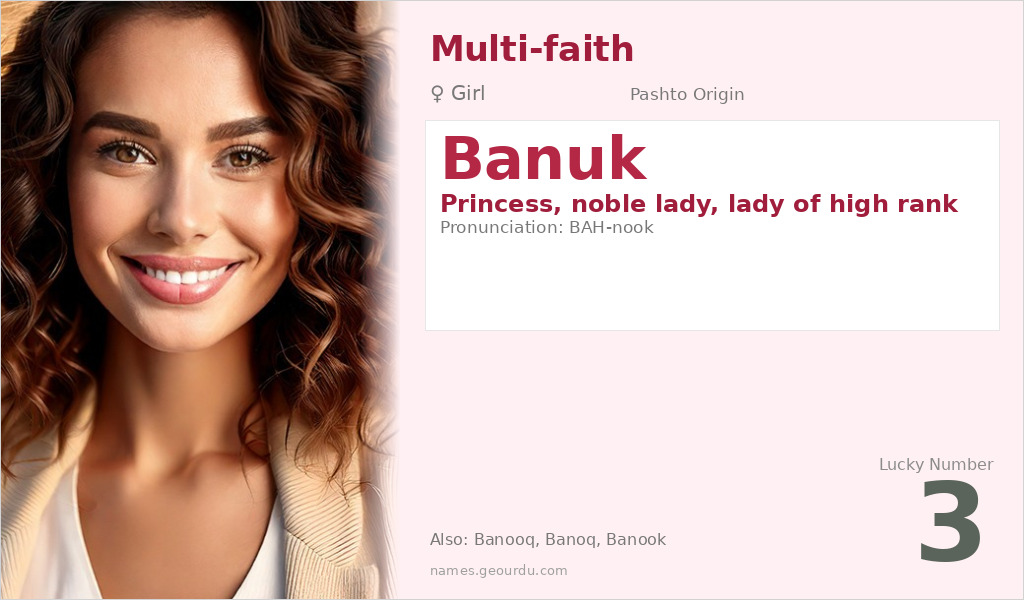
Banuk means ‘princess’ or ‘noble lady’ and is derived from the Pashto word ‘banū’, which itself comes from the Persian ‘bānū’ meaning ‘lady’ or ‘mistress’. The suffix ‘-k’ in Pashto adds a diminutive or affectionate nuance, making Banuk translate to ‘little lady’ or ‘dear princess’. This etymology is well-documented in Pashto linguistic resources and is distinct from similar names in other languages like Arabic or Urdu. The name emphasizes qualities of dignity, leadership, and respect, often used in Pashtun and Baloch cultures to honor women of noble lineage. It is a compound in the sense of combining ‘banū’ with a suffix, but not a religious compound like Abdul-based names.
| 📛 Name | Banuk |
| 💎 Meaning | Princess, noble lady, lady of high rank |
| 👤 Gender | Girl |
| 🕌 Religion | Multi-faith |
| 🌍 Origin | Pashto |
| 🗣 Pronunciation | BAH-nook |
| ✍️ Urdu | بانوک |
| ✍️ Arabic | بانوك |
| 🔢 Numerology | 3 |
| ✨ Spellings | Banooq, Banoq, Banook |
Origin & Cultural Significance
Banuk originates from the Pashto language, spoken primarily in Afghanistan and Pakistan, and is also used in Balochi-speaking regions of Iran, Pakistan, and Afghanistan. It is a cultural name deeply embedded in Pashtun and Baloch tribal traditions, where names often reflect social status and heritage. Historically, Banuk has been used for princesses and women of high rank in these communities, appearing in folklore, poetry, and oral histories. While commonly adopted by Muslims in these regions, it is not exclusively Islamic and can be found across multi-faith contexts in South and Central Asia. The name’s usage highlights the linguistic and cultural diversity beyond mainstream Arabic influences.
Personality Traits
People named Banuk are often associated with traits of elegance, strength, and cultural pride, mirroring the name’s meaning of nobility. They may exhibit leadership qualities and a protective, nurturing demeanor, akin to the role of a princess in traditional societies. In Pashtun and Baloch cultures, such names inspire a sense of responsibility and grace, influencing personality development. These individuals are likely to value family, tradition, and community, embodying the dignified spirit of their heritage.
Similar Names
If you like Banuk, consider: Bano, Banafsha, Benazir, Gul Banu, Shireen
Famous People Named Banuk
- Banuk (historical figure) — a common name among Pashtun and Baloch women, often used in folklore and tribal histories to denote princesses or noblewomen
- Banuk Karima Baloch — a prominent Baloch human rights activist from Pakistan (though not widely documented in global media, the name appears in regional contexts)
Frequently Asked Questions About Banuk
What does Banuk mean?
Banuk means 'princess' or 'noble lady' in Pashto, derived from the word 'banū' with an affectionate suffix '-k'.
Is Banuk a boy or girl name?
Banuk is exclusively a girl's name, used in Pashtun and Baloch cultures to denote females of high status.
What is the origin of Banuk?
Banuk originates from the Pashto language, with roots in Persian, and is culturally significant in Pashtun and Baloch communities of Afghanistan, Pakistan, and Iran.