Table of Contents
Bashrah is a beautiful Arabic feminine name that carries the joyful meaning of ‘good news’ or ‘glad tidings.’ With roots in classical Arabic literature and Islamic tradition, this name has been cherished for centuries across Muslim communities. Its linguistic connection to announcements of happiness and divine blessings makes it a meaningful choice for parents seeking a name with positive connotations. Today, Bashrah remains a culturally significant name with deep etymological foundations.
Meaning of Bashrah
The name Bashrah originates from the Arabic triliteral root ‘bashr’ (ب-ش-ر), which fundamentally means ‘to bring good news’ or ‘to announce something joyful.’ In Arabic linguistics, ‘bashrah’ specifically denotes the first indication or early sign of something positive, similar to how one might describe the first fruits of a harvest or initial signs of prosperity. This term appears in pre-Islamic poetry and was later incorporated into Islamic vocabulary, where it gained religious significance as announcements of divine mercy or blessings. The feminine form Bashrah is directly derived from this noun, while the masculine equivalent is Bashir. The name’s meaning remains consistent across Arabic-speaking regions and has been preserved in Islamic naming traditions for over fourteen centuries.
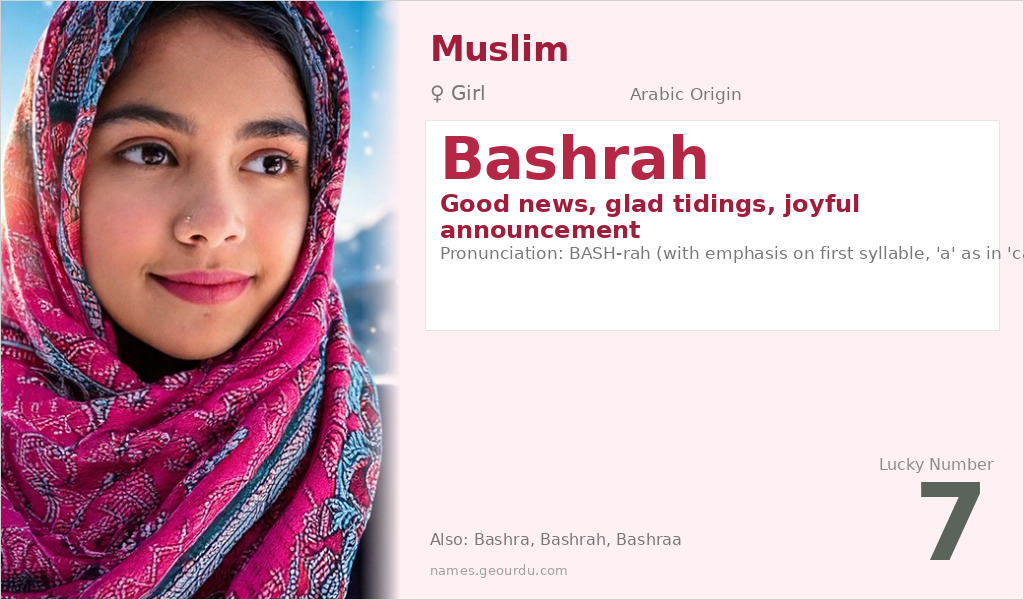
| 📛 Name | Bashrah |
| 💎 Meaning | Good news, glad tidings, joyful announcement |
| 👤 Gender | Girl |
| 🕌 Religion | Muslim |
| 🌍 Origin | Arabic |
| 🗣 Pronunciation | BASH-rah (with emphasis on first syllable, 'a' as in 'cat') |
| ✍️ Urdu | بشرہ |
| ✍️ Arabic | بشرة |
| 🔢 Numerology | 7 |
| ✨ Spellings | Bashra, Bashrah, Bashraa, Bashrat |
Origin & Cultural Significance
Bashrah has its origins in classical Arabic language and pre-Islamic Arabian culture, where the concept of ‘bashrah’ was important in poetry and oral traditions. With the advent of Islam, the name gained religious significance as the Quran and Hadith literature frequently use derivatives of the root ‘bashr’ in contexts of divine announcements and prophecies. The name appears in early Islamic history, with notable bearers including Bashrah al-Adawiyya, a female scholar from Basra during the 7th century. While primarily used in Arabic-speaking communities, the name has spread to other Muslim cultures through Islamic scholarship and migration. It remains particularly popular in regions with strong Arabic linguistic influence, including the Middle East, North Africa, and South Asian Muslim communities.
Personality Traits
Those named Bashrah often embody the optimistic qualities suggested by their name’s meaning. They tend to be natural communicators who excel at sharing positive developments and maintaining hopeful perspectives. Many display intuitive understanding of others’ emotional states and possess a calming presence that comforts those around them. The name’s association with ‘good news’ frequently manifests in their tendency to focus on solutions rather than problems, making them valuable in collaborative environments.
Similar Names
If you like Bashrah, consider: Bushra, Bashir, Bashira, Bishr, Mubashshira
Famous People Named Bashrah
- Bashrah bint Tha'labah — Pre-Islamic Arab poetess known for her elegiac poetry
- Bashrah al-Adawiyya — Early Islamic female scholar from Basra (7th century)
Frequently Asked Questions About Bashrah
What does Bashrah mean?
Bashrah means 'good news,' 'glad tidings,' or 'joyful announcement' in Arabic. It comes from the root word 'bashr' meaning to bring positive news.
Is Bashrah a boy or girl name?
Bashrah is exclusively a feminine name in Arabic and Islamic naming traditions. The masculine equivalent is Bashir.
What is the origin of Bashrah?
Bashrah originates from classical Arabic language and has been used since pre-Islamic times. It gained particular significance in Islamic culture through Quranic and Hadith references to 'bashr' (bringing good news).