
Table of Contents
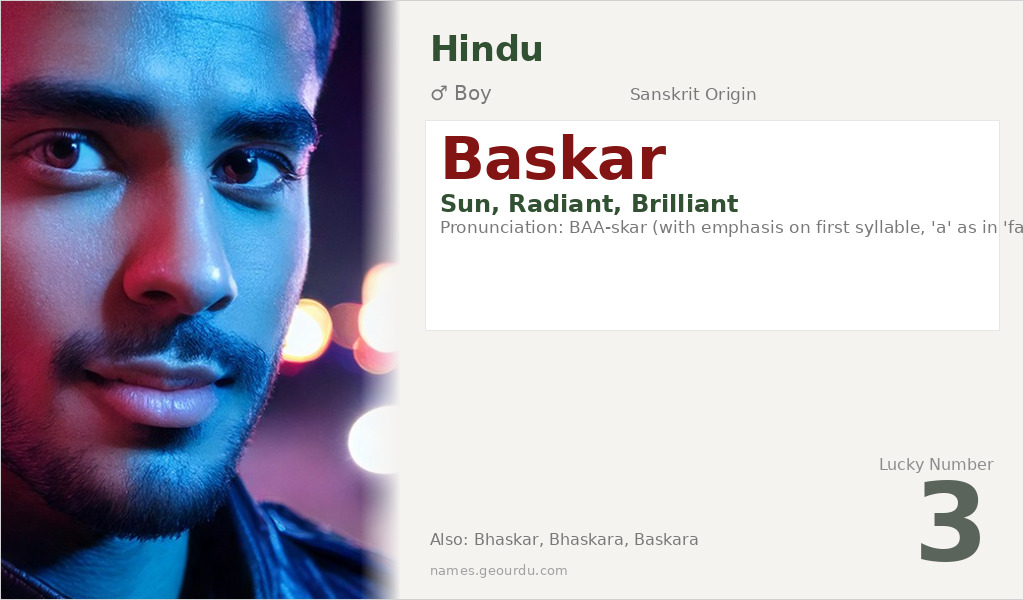
Baskar is a classic Hindu boy name with deep roots in Sanskrit tradition and Hindu mythology. Meaning ‘sun’ or ‘radiant’, this name carries the symbolism of light, knowledge, and divine brilliance. Popular across India and among Hindu communities worldwide, Baskar connects its bearer to ancient cultural heritage while remaining relevant in modern times. The name’s solar associations make it particularly meaningful for parents seeking a name that embodies warmth, energy, and leadership qualities.
Meaning of Baskar
Baskar originates from the Sanskrit word ‘Bhaskara’ (भास्कर), which is composed of two elements: ‘bhas’ meaning ‘to shine’ or ‘to be brilliant’, and ‘kara’ meaning ‘maker’ or ‘doer’. Thus, the name literally translates to ‘maker of light’ or ‘one who causes brilliance’, referring directly to the sun. In Hindu tradition, Bhaskara is an epithet for Surya, the sun god who represents light, knowledge, and life-giving energy. The name appears in ancient Sanskrit texts and has been used for centuries, maintaining its original meaning without significant alteration. Its linguistic purity and clear etymology make it one of the most straightforward and meaningful names in the Sanskrit naming tradition.
| 📛 Name | Baskar |
| 💎 Meaning | Sun, Radiant, Brilliant |
| 👤 Gender | Boy |
| 🕌 Religion | Hindu |
| 🌍 Origin | Sanskrit |
| 🗣 Pronunciation | BAA-skar (with emphasis on first syllable, 'a' as in 'father') |
| ✍️ Urdu | بھاسکر |
| ✍️ Arabic | بهاسكار |
| 🔢 Numerology | 3 |
| ✨ Spellings | Bhaskar, Bhaskara, Baskara, Bhasker |
Origin & Cultural Significance
Baskar has its origins in ancient Sanskrit, the classical language of India that forms the basis of many Hindu names. The name is particularly significant in Hindu culture due to its association with Surya, the solar deity who is worshipped as the source of light, life, and energy. Historically, the name has been borne by notable figures in Indian mathematics and astronomy, most famously Bhaskara I and Bhaskara II, who made groundbreaking contributions to these fields during the 7th and 12th centuries respectively. The name remains popular in India, especially in South Indian states where Sanskrit-derived names are common, and has spread to Hindu communities worldwide through diaspora. Its enduring popularity stems from both its beautiful meaning and its connection to India’s rich intellectual and spiritual heritage.
Personality Traits
The solar symbolism of Baskar suggests personality traits associated with warmth, energy, and leadership. Those named Baskar are often perceived as natural leaders who can illuminate situations with their insight and positivity. They tend to be creative, expressive individuals with a radiant personality that draws others to them. The name’s connection to knowledge and brilliance also implies intellectual curiosity and a desire to enlighten both themselves and those around them.
Similar Names
If you like Baskar, consider: Surya, Ravi, Aditya, Arun, Divakar
Famous People Named Baskar
- Bhaskara I — 7th century Indian mathematician and astronomer who made significant contributions to mathematics and wrote commentaries on Aryabhata's work
- Bhaskara II — 12th century Indian mathematician and astronomer, author of Siddhanta Shiromani, considered one of the greatest mathematicians of medieval India
Frequently Asked Questions About Baskar
What does Baskar mean?
Baskar means 'sun', 'radiant', or 'brilliant' in Sanskrit. It comes from the word 'Bhaskara' which literally means 'maker of light'.
Is Baskar a boy or girl name?
Baskar is exclusively a boy name in Hindu naming tradition. The masculine form is Baskar/Bhaskar, while feminine versions would be Bhaskari or similar derivatives.
What is the origin of Baskar?
Baskar originates from Sanskrit, the ancient classical language of India. It is a Hindu name with specific connections to Surya (the sun god) in Hindu mythology and has been used for centuries in Indian culture.





