
Table of Contents
Bazil is a powerful masculine name with rich cross-cultural heritage, carrying meanings of bravery and nobility across different linguistic traditions. While often associated with Muslim communities in South Asia, this name actually spans multiple faiths and ethnic groups from Afghanistan to the Levant. Its dual etymology reflects both Greek royal connotations and Central Asian warrior symbolism, making it a name with fascinating historical depth.
Meaning of Bazil
The name Bazil carries two primary etymological streams that have converged over centuries. From Greek Basileios (Βασίλειος), meaning ‘royal’ or ‘kingly’, it entered Semitic languages as Basīl through early Christian communities. More significantly in South Asian contexts, Bazil derives from Pashto and Balochi roots where ‘baz’ refers to falcons or hawks—birds symbolizing courage, speed, and nobility in warrior cultures. In these languages, the suffix ‘-il’ often denotes possession or quality, creating the meaning ‘one who possesses falcon-like qualities’ or simply ‘brave warrior’. This meaning appears in historical texts describing Pashtun and Baloch fighters, and continues in modern usage across Afghanistan, Pakistan, and Iranian Balochistan.
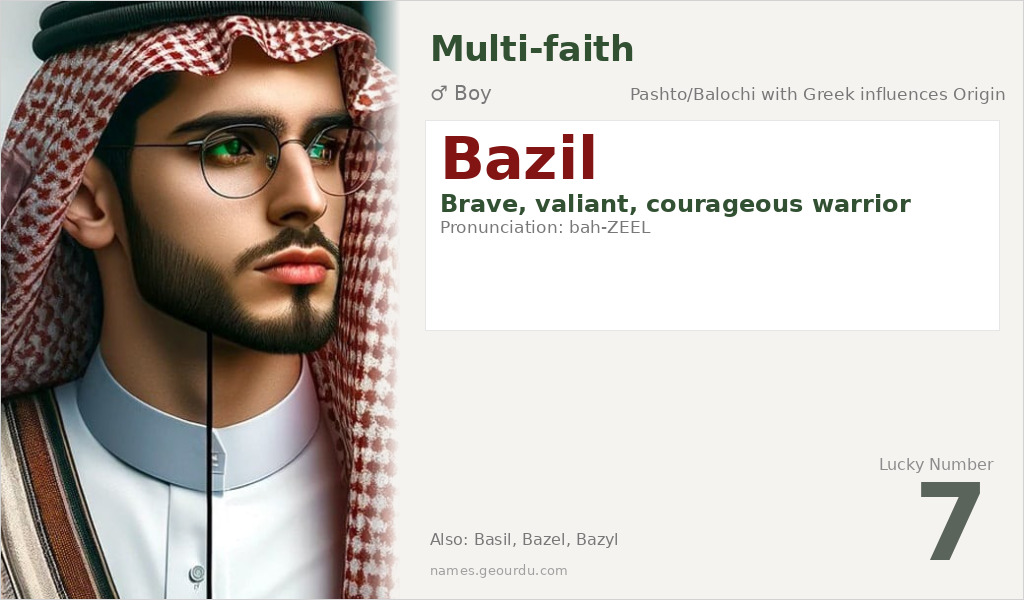
| 📛 Name | Bazil |
| 💎 Meaning | Brave, valiant, courageous warrior |
| 👤 Gender | Boy |
| 🕌 Religion | Multi-faith |
| 🌍 Origin | Pashto/Balochi with Greek influences |
| 🗣 Pronunciation | bah-ZEEL |
| ✍️ Urdu | بازل |
| ✍️ Arabic | بازل |
| 🔢 Numerology | 7 |
| ✨ Spellings | Basil, Bazel, Bazyl, Basīl |
Origin & Cultural Significance
Bazil’s origins are geographically diverse, emerging independently in different cultural spheres. In the Eastern Mediterranean, the Greek Basileios was adopted by Arabic-speaking Christians as Basīl, particularly among Maronite and Orthodox communities. Simultaneously, in the mountainous regions spanning modern Afghanistan and Pakistan, the Pashto/Balochi Bazil developed as a traditional name among tribal societies valuing martial prowess. During the Islamic Golden Age, these traditions interacted through trade and conquest routes, with the name appearing in Persianate courts where Turkish influences reinforced its warrior connotations. Today, it remains popular among Pashtun, Baloch, and Kurdish communities while also appearing in Arab Christian families, representing a fascinating case of convergent naming evolution.
Personality Traits
Those named Bazil are often associated with characteristics of courage, leadership, and protective instincts. Drawing from the name’s warrior heritage, they may exhibit determination and resilience in facing challenges. The falcon symbolism suggests sharp perception and strategic thinking, while the royal Greek connection implies natural authority and dignity. These individuals typically value honor, tradition, and independence, making them respected figures in their communities.
Similar Names
If you like Bazil, consider: Basil, Baz, Bahram, Bahadur, Shuja
Famous People Named Bazil
- Bazil Khan — 19th century Pashtun tribal leader from the Khyber region known for his resistance against British colonial forces
- Bazil Ahmed — Contemporary Balochi poet and cultural preservationist from Pakistani Balochistan
Frequently Asked Questions About Bazil
What does Bazil mean?
Bazil primarily means 'brave warrior' or 'valiant' in Pashto and Balochi languages, derived from 'baz' meaning falcon. It also carries the Greek meaning 'royal' or 'kingly' through the name Basileios.
Is Bazil a boy or girl name?
Bazil is exclusively a masculine name across all cultural contexts where it appears, from Pashtun tribal societies to Arab Christian communities.
What is the origin of Bazil?
Bazil has dual origins: from Greek Basileios meaning 'royal', and independently from Pashto/Balochi roots meaning 'brave warrior'. It's particularly associated with Pashtun, Baloch, and Kurdish cultures in South Asia and the Middle East.





