Table of Contents
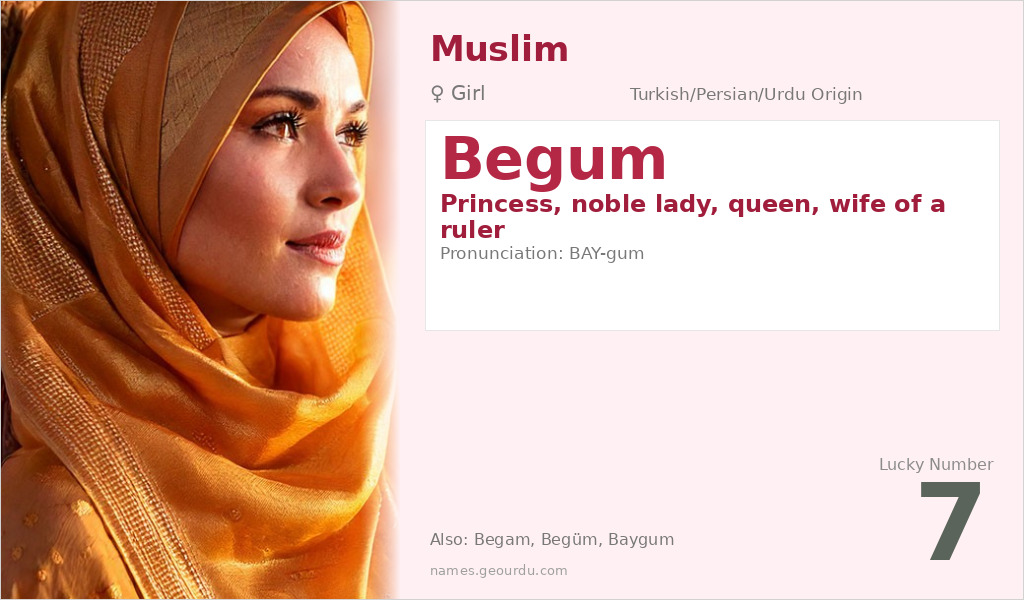
Begum is a name that carries centuries of royal heritage and feminine dignity. Originating from Turkish and Persian nobility titles, this name has graced queens, freedom fighters, and modern women across South Asia. With its meaning firmly rooted in ‘princess’ and ‘noble lady,’ Begum represents both historical prestige and contemporary elegance. Discover the rich linguistic journey and cultural significance of this regal name.
Meaning of Begum
Begum derives from the Turkish word ‘beg’ (also spelled ‘bey’), meaning ‘lord,’ ‘chief,’ or ‘ruler,’ combined with the Persian feminine suffix ‘-um.’ This creates the meaning ‘female ruler’ or ‘wife of a ruler.’ The term entered South Asian languages through Persian during the Mughal Empire (1526-1857), where it became an official title for Muslim noblewomen. In Urdu, Hindi, Bengali, and other regional languages, Begum evolved from an aristocratic title to a common given name, always retaining its connotations of nobility, respect, and high social status. The name is particularly prevalent in Pakistan, India, Bangladesh, and Afghanistan among Muslim communities.
| 📛 Name | Begum |
| 💎 Meaning | Princess, noble lady, queen, wife of a ruler |
| 👤 Gender | Girl |
| 🕌 Religion | Muslim |
| 🌍 Origin | Turkish/Persian/Urdu |
| 🗣 Pronunciation | BAY-gum |
| ✍️ Urdu | بیگم |
| ✍️ Arabic | بيجوم |
| 🔢 Numerology | 7 |
| ✨ Spellings | Begam, Begüm, Baygum |
Origin & Cultural Significance
Begum’s origins trace back to Central Asian Turkish tribes, where ‘beg’ was a title for chieftains and military commanders. As Turkish culture interacted with Persian civilization, the feminine form ‘Begum’ emerged and spread through the Persianate world. During the Mughal Empire’s rule over the Indian subcontinent, Begum became institutionalized as a formal title for royal women, often preceding personal names. This historical usage in royal courts across Delhi, Lucknow, and Hyderabad cemented its association with Muslim aristocracy. Today, while still used as an honorific in some contexts, Begum primarily functions as a first name celebrating feminine nobility across South Asian diaspora communities worldwide.
Personality Traits
Those named Begum often embody the regal qualities their name suggests. They typically carry themselves with natural grace and command respect in social and professional settings. Many develop strong leadership abilities and organizational skills, possibly influenced by the name’s historical associations with governance and nobility. Family-oriented and protective, Begums often prioritize dignity and tradition while adapting to modern contexts.
Similar Names
If you like Begum, consider: Sultana, Malika, Shahzadi, Amira, Nawab
Famous People Named Begum
- Begum Hazrat Mahal — Freedom fighter and queen of Awadh who led the Indian Rebellion of 1857 against the British East India Company
- Begum Rokeya — Bengali feminist thinker, writer, and social reformer from British India, pioneer of women's education
Frequently Asked Questions About Begum
What does Begum mean?
Begum means 'princess,' 'noble lady,' 'queen,' or 'wife of a ruler.' It originates from Turkish 'beg' (lord) with Persian feminine suffix '-um,' entering South Asian languages through Persian and Urdu.
Is Begum a boy or girl name?
Begum is exclusively a feminine name. The '-um' suffix is specifically feminine in Persian linguistic tradition, and historically it was only used for women of noble status.
What is the origin of Begum?
Begum has Turkic roots from the word 'beg' combined with Persian grammatical elements. It became prominent in South Asia through Persian during the Mughal Empire and is now most associated with Urdu and Muslim naming traditions.